 Official government website of the Government of the Kingdom of Saudi Arabia




8
8- Decent Work and Economic Growth

- About the Eighth Goal
- Job Practices: Living Wages
- Employment Practices: Labor Unions
- Anti-discrimination employment policy
- Employment policy to combat forced labor and modern slavery
- Employment Practices: Equal Rights for Contract Workers (Outsourced)
- Employment Policy on Fair Wage Structure
- Track wage structure for gender equality
- Grievance Procedures in Employment Practices
- Workers' rights in employment practices
Related Content
Goal 8: Decent Work and Economic Growth
Qassim University's Commitment to SDG 8: Promoting Decent Work and Economic Growth for its Staff
Goal 8 of the Sustainable Development Goals (SDGs) focuses on promoting sustained, inclusive and sustainable economic growth, full and productive employment, and decent work for all. In Saudi Arabia, ensuring appropriate working conditions and providing fair economic opportunities for employees is a key element in achieving balanced development. Recognizing the importance of this goal, Qassim University has adopted a number of measures that support the well-being of its affiliates, the development of their career paths, and the enhancement of their economic empowerment.
Fair and inclusive hiring practices:
The University of Qassim's commitment to SDG 8 is evident in its fair and inclusive employment practices. The university adheres to non-discrimination policies and is keen on providing equal employment opportunities for all individuals, regardless of gender, nationality, or social background.
Competitive compensation and benefits:
The university offers competitive compensation and benefits packages to its employees, recognizing the importance of fair reward for their efforts and contributions. Qassim University's commitment to providing competitive salaries and benefits aligns with the principles of decent work and economic growth.
Professional Development Opportunities:
Qassim University actively supports the professional development of its employees by offering training programs, workshops, and skill development opportunities. This empowers staff to advance their careers and contribute effectively to the university's goals.
A safe and supportive work environment:
Qassim University places the utmost importance on providing a safe and supportive work environment as part of its commitment to Sustainable Development Goal 8. The university maintains the application of occupational safety standards in the workplace, provides resources that promote the health and well-being of its employees, and works to establish a culture of respect and cooperation among all its affiliates.
Enhancing work-life balance:
Qassim University recognizes the importance of work-life balance in promoting the well-being of its employees. Therefore, it implements policies that enable employees to balance their professional commitments with their personal and family responsibilities, contributing to the creation of a healthy and productive work environment.
Ethical and transparent governance
Qassim University's governance practices align with ethical and transparent management principles, ensuring that decision-making processes are clear, accountable, and in line with the interests of its affiliates, thus contributing to fostering a positive work environment.
Employee Engagement and Effective Feedback
Qassim University values the opinions of its members and is keen on continuous interaction with them to address feedback, receive suggestions, and improve the work environment. This mutual communication contributes to strengthening the sense of belonging among employees and increasing their participation in the university's growth and development.
Appreciation and motivation
Qassim University values the contributions of its staff through recognition programs and incentive initiatives, seeking to celebrate their achievements and dedication to work, thereby fostering a positive and supportive work culture within the university.
Cooperation for economic growth:
Qassim University collaborates with various sectors, including industrial partners and government entities, to support economic growth. Its research and educational programs align with the needs of the local economy, contributing to the development of a qualified workforce and fostering economic growth in the region. Qassim University's commitment to Sustainable Development Goal 8 is evident in its comprehensive approach to promoting decent work and economic growth for its affiliates. This includes implementing fair employment practices, offering competitive compensation and benefits, supporting professional development, ensuring a safe work environment, promoting work-life balance, establishing transparent governance, fostering positive employee engagement, and collaborating for economic development. Through this commitment, Qassim University effectively contributes to achieving Goal 8 in the Kingdom of Saudi Arabia and plays a pivotal role in building a sustainable and inclusive workforce that drives economic growth and enhances the well-being of its affiliates.
Human Resources
The Dean's Office supervises the implementation of all administrative procedures for all administrative staff at the university.
Tasks
- Implementing procedures for preparing and calculating payrolls and disbursing financial allowances and benefits for all university staff.
- Applying recruitment and contracting procedures, and following up on career paths, including promotions, assignments, and internal and external transfers.
- Implement all matters related to training and scholarship procedures for all university staff.
- Work on monitoring attendance regularity and promoting the concept of self-supervision among university staff.
- Supervision, follow-up, and auditing of the job performance evaluation for all university administrative staff during the job performance cycle.
- Communicating with regulatory bodies and responding to remarks or inquiries from relevant parties.
- Carry out any tasks assigned to the agency within its scope of responsibilities.
Deanship of Human Resources

Click this link [1]
The Deanship of Human Resources is a distinguished supporting deanship at the university, contributing effectively to raising the level of services provided to university staff and achieving their satisfaction, in accordance with the required quality standards to support the university's vision and strategy, which in turn aligns with the goals of the Kingdom's vision 2030.
Vision
National excellence in providing integrated and advanced services to faculty and staff within a stimulating work environment.
The message
Providing high-quality and distinguished services to university staff, contributing to the university's pursuit of excellence by fostering a supportive and motivating work environment for positive change.
Goals
- Contributing to the university's efforts to attract, motivate, and retain top human talent.
- Leveraging electronic systems to facilitate, develop, and shorten work procedures, thereby achieving and enhancing the satisfaction of university staff.
- Striving to achieve the highest levels of integrity in the execution of all transactions of university affiliates with fairness and transparency in accordance with regulations and bylaws to ensure the achievement of equality.
- Applying the highest standards of quality management systems in all administrative dealings of the Deanship.
- Contributing to the creation of a creative work environment that enhances job satisfaction for university staff and promotes their pursuit of excellence.
2022 Functional Correlation Index
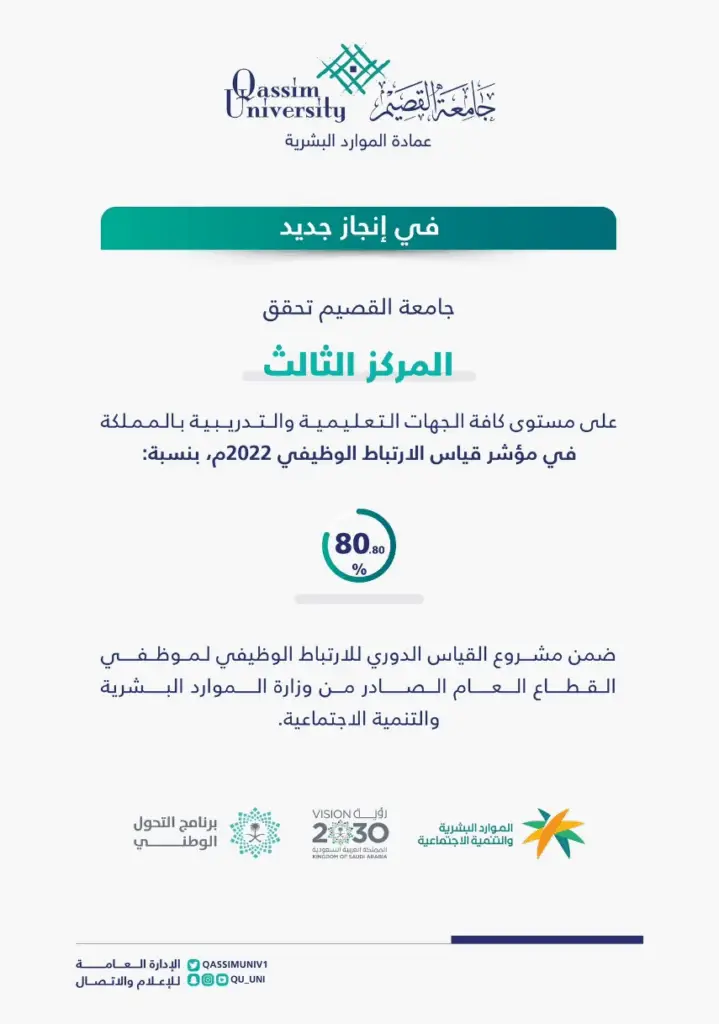
As part of its efforts to develop the work environment system and its personnel and raise productivity levels, in line with the objectives of the Kingdom's Vision 2030,
Qassim University achieved third place among all educational and training entities in the Kingdom in the employment engagement index for 2022 AD, with a rate of 80.8%. This was achieved within the periodic measurement of the level of employment engagement for public sector employees issued by the Ministry of Human Resources and Social Development.
Quality Management System Application Project
Click this link [4]
Introduction:
The Quality Management System application project aims to establish institutional quality concepts in all university departments and units. This will be achieved by building an integrated administrative system that ensures performance improvement and procedure development in accordance with best international practices and standards. The project seeks to achieve efficiency and effectiveness in providing academic and administrative services, and to raise the satisfaction level of beneficiaries, in alignment with the university's strategic directions and the Kingdom's Vision 2030 for institutional excellence and sustainable quality.
Benefits and Goals of Implementing a Quality Management System and Obtaining ISO 9001:2015 Certification for the Deanship:
- Analysis and modification of all Deanship administrative operations in accordance with an international standard.
- Documenting all dean's office procedures, organizing work, and recording all job-related events.
- Prepare a quality manual for the deanship and implement a unified reference for all its administrative processes.
- Improving efficiency through the implementation of processes and procedures based on a focus on quality.
- The deanship's ability to consistently meet the needs of beneficiaries, in addition to legal and regulatory requirements.
- Focus on enhancing beneficiary satisfaction at the university by understanding their needs and reducing errors.
- Managing risks and opportunities related to the Dean's context and objectives.
- Highlighting the extent of the Deanship's compliance with the requirements of the specified Quality Management System.
- Achieve international recognition and improve the image of the deanship and the university.
- Improving decision-making by discovering and identifying problems in a timely manner.
- Applying a culture of continuous improvement by adopting a systematic approach to identify and capitalize on development opportunities.
Stages of Qualification for ISO 9001:2015 Certification:
Obtaining an ISO 9001 certification requires planning, commitment, and support through the following:
Phase of signing with the partner (certifying authority):
Selecting and appointing quality representatives for the Deanship, so that this team has full authority to establish and monitor the system and communicate with external parties related to it. The Deanship/University shall also select and contract with the partner (certification body) to conduct independent audits and reviews, and then grant the certificate.
Gap Analysis
This is followed by a gap analysis (to study the extent of the organization's commitment to ISO requirements) in accordance with ISO standards, with the issuance of a report that includes the findings and the development of an action plan to address the identified gaps.
Application Phase:
- Implementing the executive plan, developing documents, and preparing all deanship systems and procedures to comply with ISO standards.
- Forming a specialized team to implement quality management standards to ensure the achievement of desired results.
- Develop a detailed plan outlining each individual's role and responsibilities, along with a timeline for each task.
Internal Review and Audit Phase
- Conduct an internal audit to identify non-conformities and address them by implementing well-thought-out corrective actions.
- The Quality Assurance and Planning Unit in the Deanship undertakes planned periodic follow-ups and reviews of the Deanship and its adherence to the approved system and plan, and works to resolve implementation issues until the Quality Assurance Unit is assured of the Deanship's compliance with the management system and its requirements as stated in the ISO standards.
Final evaluation and external audit stage
The contracted certification body, in coordination with the Dean's representative, organizes the assessment and external audit appointments.
ISO certification stage
After the external audit, the certification body grants the Deanship an ISO 9001 certificate, which is subject to periodic audits by the granting body to ensure the Deanship's continued compliance with ISO requirements.
Minister of Higher Education and Saudi Ambassador Praise Qassim University's Effectiveness at Washington Career Day
Click this link [5]
She visited the university's pavilion and emphasized the excellence of its participation. His Excellency the Minister of Higher Education, Prof. Dr. Khalid bin Mohammed Alangari, and His Excellency the Saudi Ambassador to the United States of America, Mr. Adel Al-Jubeir, praised the effectiveness of Qassim University's participation in the Career Day for Saudi graduates in America, which was recently held in Maryland, United States of America. During their visit to the university's pavilion at the Career Day exhibition, the Minister and the Saudi Ambassador stressed the importance of the active participation of the participating entities in such events through the serious desire to attract the sons and daughters of the country to work for them, praising the statistics and results presented by the University Vice President and head of the participating delegation, Prof. Abdulmunim bin Ibrahim Al-Abdulmunim, which culminated in the university's participation in Career Day last year, where more than 40 graduates were employed, in addition to the university seeking to expand the recruitment circle this year to improve the process and output of the university by raising the efficiency of faculty members and attracting more graduates to the university. Dr. Nasser Al-Fouzan, Undersecretary of the Ministry of Higher Education for Scholarship Affairs, praised the active presence of the university and the excellence of its integrated and distinguished pavilion that attracted attention, wishing the university continued success in its scientific career, stressing that the holding of such career days requires the active presence of higher education institutions and the public and private sectors, which was witnessed at this event from a clear seriousness in attracting qualified Saudi competencies from the finest universities in America and other scholarship countries. For his part, Dr. Mohammed Al-Hazan, Director of the Relations and Media Department at the Ministry of Higher Education, explained that active participation is what the ministry aspires and seeks through these events, which contribute to opening channels of communication between higher education institutions and job seekers, praising the presence of Qassim University newspaper in this forum, noting that its distinguished pages reflected the university's activities, programs and achievements in a professional media style. For his part, Prof. Abdul-Moneim Al-Abdul-Moneim expressed his appreciation for the interest of the Ministry of Higher Education, the Cultural Attaché and the Kingdom's Embassy in the United States of America, stressing that the Custodian of the Two Holy Mosques Scholarship Program embodies a visionary vision in developing national competencies, and that the tangible successes achieved would not have been possible without this interest and follow-up from these authorities, thanking UQU President Prof. Khaled bin Abdul-Rahman Al-Hamoudi for his continuous support for everything that would develop the university. Dr. Al-Abdulmonem pointed out that the university pavilion received more than 1500 male and female graduates who wished to work at the university, where about 500 of them were interviewed to complete the requirements, the most important of which is to continue in the same specialization (bachelor, master, doctorate). The percentage of graduates complying with the conditions amounted to more than 60% of the total applicants, including about 10% in rare specialties such as medicine, pharmacy and science. He emphasized that the university will work during the coming period to study the files of male and female applicants through the concerned colleges and departments, in preparation for communicating with them to appoint them at the university - God willing.
The university offers training programs for its employees.
Click this link [6]
More than 75 beneficiaries
The university offers training programs for its staff.
Information and Communication Center
Qassim University has intensified its training programs offered by the Deanship of University Development at the beginning of each academic year for faculty and staff, aiming to enhance their performance and elevate administrative performance in university units according to modern scientific and training methods. This is in addition to supporting faculty and improving their efficiency in teaching, scientific research, and community service. This comes as part of the Deanship's endeavor to achieve leadership in developing university performance and local and global distinction in human resource development and building a knowledge society. Stemming from this goal, the Deanship has presented a number of preparatory programs delivered by a selection of distinguished university faculty members. Among the most prominent was the training program for preparing new faculty members, which lasted for five days and was attended by 50 new faculty members, as well as a number of lecturers, teaching assistants, and older faculty members who wished to join.
77 beneficiaries of the university's new faculty onboarding program
Click this link [7]
On Thursday, 8/1/1442 A.H., Qassim University, represented by the Leadership and Capacity Development Center, concluded the introductory program for new faculty members, which was held remotely for two days and benefited 77 faculty members from the university, including 46 men and 31 women. The program was implemented via the Blackboard platform to introduce new faculty members to their role and tasks and ways to benefit from the university's resources and capabilities that help them provide best practices in the educational and research process, community service, and professional development. The program also included a visual presentation on the university, highlighting its most important achievements and the various programs of the center to introduce them. The Deanship of Human Resources also presented a number of important topics that benefit new faculty members, in addition to a paragraph on scientific research, its mechanisms and methods presented by the Deanship of Scientific Research, and a paragraph on quality and academic accreditation standards presented by the Deanship of Development and Quality. On the second day of the program, the Scientific Council of the University provided an explanation of the procedures and regulations, the Deanship of Library Affairs presented a paragraph on ways to benefit from the library and search engines, a visual presentation on the Blackboard system presented by the Deanship of E-Learning, and the College of Shari`ah, represented by the Department of Regulations, presented a paragraph on the culture of human rights. By implementing such programs that stem from the actual needs of the university's employees, the Leadership and Capacity Development Center contributes to achieving the university's vision and implementing its mission and objectives within the framework of its established values. It also supports the efforts of its employees in developing their capabilities and improving their performance, based on a knowledge base that draws its strength from scientific and technical innovations and the increasing accumulation of knowledge in various fields.
The Minister of Human Resources commends the efforts of Qassim University in the periodic measurement project of job engagement.
Click this link [8]
His Excellency the Minister of Human Resources and Social Development, Engineer Ahmed bin Sulaiman Al-Rajhi, praised the efforts of Qassim University in the periodic measurement project for the year 2019, through which the university achieved advanced results in two of the evaluation criteria adopted in the project's questionnaire, namely: The response rate of the organization's employees and the percentage of sustainable job attachment for the year 2019. Engineer Al-Rajhi expressed his thanks and appreciation to Prof. Dr. Abdulrahman bin Hamad Al-Dawood, President of the University, and all its employees for their efforts and active participation in the periodic measurement questionnaire for job engagement, which resulted in the University achieving high results in the criterion of sustainable job engagement for 2019 with a ratio of 81% in the category of educational and training entities, in addition to the efforts made by the University in obtaining high results in the criterion of the response rate of the entity's employees for 2019, which reached 51%. This project aims to identify aspects that contribute to correcting future strategic paths to raise the level of effective professional engagement and achieve the highest levels of satisfaction between employees and their entities, as one of the main pillars of improving performance in various sectors and governmental and other institutions. The project represents a mutual relationship and partnership based on establishing employee loyalty and motivating them to do their best to achieve the goals of the entity to which they belong, by investing in the human element through encouragement, training, qualification, scholarship, development, talent management, providing a distinctive work environment, and other factors that contribute to improving the work environment, achieving employee satisfaction, and raising the level of their job engagement.
References
[1] [Online]. Available: .Click this link
[2] [Online]. Available: .Click this link
[3] [Online]. Available: .Click this link
[4] [Online]. Available: .Click this link
[5] [Online]. Available: .Click this link
[6] [Online]. Available: .Click this link
[7] [Online]. Available: .Click this link
[7] [Online]. Available: .Click this link
- About Goal Seven
- Energy provider renovation and construction
- Upgrading buildings for higher energy efficiency
- Carbon reduction and emission mitigation
- Energy Consumption Reduction Plan
- Identify energy waste
- Divestment policy
- Engaging the Local Community for Energy Efficiency
- Commitment to 100% Renewable Energy
- Energy efficiency services for the industrial sector
- Developing Policies for Clean Energy Technologies
- Low-carbon innovation support