 Official government website of the Government of the Kingdom of Saudi Arabia




7
7- Clean and affordable energy

- About Goal Seven
- Energy provider renovation and construction
- Upgrading buildings for higher energy efficiency
- Carbon reduction and emission mitigation
- Energy Consumption Reduction Plan
- Identify energy waste
- Divestment policy
- Engaging the Local Community for Energy Efficiency
- Commitment to 100% Renewable Energy
- Energy efficiency services for the industrial sector
- Developing Policies for Clean Energy Technologies
- Low-carbon innovation support
Related Content
Goal 7: Clean and affordable energy
Qassim University's Contribution to Goal 7: Promoting Affordable and Clean Energy in the Kingdom of Saudi Arabia
Sustainable Development Goal 7 (SDG7) focuses on ensuring access to affordable, reliable, sustainable, and modern energy for all. In Saudi Arabia, a country rich in energy resources, addressing energy affordability and transitioning to clean energy sources is crucial for achieving sustainable development. Qassim University recognizes the importance of SDG7 and has taken proactive steps to contribute to the promotion of affordable and clean energy within its community and beyond.
Energy Efficiency Initiatives:
Qassim University's commitment to Goal 7 is demonstrated through its energy efficiency initiatives. The university implements measures to reduce energy consumption on campus, such as upgrading lighting systems, optimizing HVAC systems, and promoting energy-saving behaviors among students and staff.
Integrating Renewable Energy
Qassim University is actively exploring the integration of renewable energy sources, such as solar and wind power, into its operations. Qassim University's efforts to harness clean energy contribute to reducing reliance on fossil fuels, lowering carbon emissions, and promoting sustainable energy practices.
Education on Sustainable Energy:
Qassim University plays a vital role in educating future professionals who will shape the future energy landscape. The university offers courses and programs that cover topics related to sustainable energy sources, energy conservation, and renewable technologies. By equipping students with knowledge about clean energy, the university contributes to building a skilled workforce capable of leading the transition to sustainable energy systems.
Researching clean energy technologies:
The university's commitment to SDG 7 extends to its research efforts focused on clean energy technologies. Qassim University's research projects explore innovative solutions for harnessing renewable energy sources and utilizing them efficiently. This research contributes to the development of clean energy technologies that can benefit the wider community.
Promoting energy conservation practices:
Qassim University promotes energy conservation practices and behavior change among students, employees, and the community. The university organizes awareness campaigns, workshops, and seminars to educate individuals on the importance of energy conservation and offers practical tips for reducing consumption.
Cooperation with energy authorities:
The university collaborates with energy authorities, research institutions, and industrial partners to collectively address energy challenges and promote the adoption of clean energy. These partnerships contribute to knowledge exchange, technology transfer, and the implementation of joint projects aimed at developing affordable and clean energy solutions.
Pilot projects for clean energy:
Qassim University is establishing pilot projects that demonstrate the feasibility and benefits of clean energy technologies. These projects serve as practical examples for students and the community, inspiring them to consider clean energy options and contribute to a more sustainable energy future.
Developing sustainable infrastructure
Qassim University integrates sustainable energy principles into its infrastructure development plans. The university considers energy-efficient building design, renewable energy integration, and smart building technologies when constructing new facilities, contributing to long-term energy savings.
Qassim University's commitment to Sustainable Development Goal 7 is evident in its proactive efforts to promote affordable and clean energy. Through implementing energy efficiency measures, integrating renewable energy sources, educating students, conducting research, promoting energy conservation practices, collaborating with energy agencies, and incorporating sustainable design principles, the university actively contributes to a more sustainable energy future for the Kingdom of Saudi Arabia. Through this commitment, Qassim University plays a pivotal role in advancing the goals of SDG 7 and ensuring access to clean and affordable energy for current and future generations.
The Engineering Club at Qassim University discusses the role of solar energy in strengthening the national economy in line with Vision 2030.
Click this link [1]
The Engineering Student Club at Qassim University's College of Engineering, in partnership with the Saudi Council of Engineers and the “ASME” organization, held a lecture titled “The Role of Solar Energy in Strengthening the National Economy According to Vision 2030.“.
Dr. Radwan Abdel Ghani spoke during his lecture about the pillars on which the vision relies: a vibrant society, a prosperous economy, and an ambitious nation, and the importance of energy in achieving these pillars. This lecture was part of the multiple programs organized by the Engineering Student Club to raise the competency of engineering college students and those interested in this field. The lecture received great attention from the students due to its importance and the information it contained, which explained the role of solar energy in Vision 2030.
For their part, a number of members of the Engineering Student Club affirmed that the club will continue to hold lectures that will develop students and raise their efficiency in line with the Saudi Vision 2030.
The lecture was held at the Engineering College theater with more than 120 attendees, including the Dean of the Engineering College, Dr. Fahd Al-Mofadi, his deputies, and a number of faculty members, engineers, and students.
King Fahd University of Petroleum and Minerals President: Benefiting from the experiences of universities in developed countries Institute of Public Administration Director: A new mechanism to ensure qualified individuals reach leadership positions Al-Zamil: We have formed several community partnerships in the energy, industry, and telecommunications sectors
Click this link [2]
During the third seminar
King Fahd University of Petroleum and Minerals President: Leveraging the experiences of universities in developed countries
Institute of Management Director: New Mechanism to Ensure Qualified Individuals Reach Leadership Positions
Al-Zamil: We have entered into several community partnerships in the energy, industry, and communications sectors.
Media and Communication Center:
The proceedings of the conference “The Role of Saudi Universities in Activating Vision 2030” continued at Qassim University, where the third session was held following the official opening ceremony of the conference. The session was chaired by His Highness Prince Dr. Turki bin Saud bin Mohammed Al Saud, President of King Abdulaziz City for Science and Technology, and was titled "Universities and Vision 2030". It was attended by His Excellency Dr. Mohammed bin Sulaiman Al-Jasser, former Minister of Economy and Planning, His Excellency Dr. Khalid bin Saleh Al-Sultan, President of King Fahd University of Petroleum and Minerals, His Excellency Dr. Mushabab bin Ayed Al-Qahtani, Director General of the Institute of Public Administration, and Dr. Abdulrahman Al-Zamil, Chairman of the Board of Directors of Zamil Holding Group.
Dr. Khalid bin Saleh Al-Sultan presented a working paper titled ”The Role of Saudi Universities in Activating Vision 2030: Reality and Aspirations.” In it, he presented the experiences of universities that have led transformation in societies and achieved development goals in several developed countries. He highlighted the contribution of the university sector to the British national income, amounting to approximately 40 billion pounds sterling in one year, in addition to creating 340,000 job opportunities through its various activities. For every one pound sterling spent on knowledge exchange activities in British universities, a return of 6.4 pounds is achieved. The same applies to several developed countries such as the United States of America, Switzerland, Denmark, and Canada.
“The Sultan” spoke about King Fahd University of Petroleum and Minerals launching new initiatives that align with the Vision's aspirations, in addition to its existing and ongoing qualitative initiatives. These initiatives focus on enhancing excellence in preparing national competencies and leaders, pioneering research and technologies in water and environmental protection, expanding the impact of the innovation and entrepreneurship ecosystem, contributing pioneering initiatives to develop the national economy, building distinguished models of public education schools, developing the management of non-profit institutions, and diversifying the university's funding system.
His research paper concluded that applying the vision is important, but the availability of the depth and spirit of the vision is more important, especially for universities, given that global practices indicate their multiplier role in achieving what the vision aspires to, by focusing on measuring core achievements and tangible impacts rather than relying on indicators and numbers.
Dr. Mashbab bin Ayed Al-Qahtani, Director General of the Institute of Public Administration, presented a working paper on “The Role of the Institute of Administration in Achieving Vision 2030," focusing on strengthening the institute's role as a distinguished expertise center to support institutional and administrative change and development, and to provide distinguished services that meet customer needs and achieve high satisfaction levels. It also aims to develop financial resources and increase spending efficiency, in addition to developing an interconnected, interactive, and responsive work environment to build motivated, capable, and empowered human resources within the institute, which contributes to increasing the institute's societal interaction and impact.
“Al Mashab” also presented the Institute of Public Administration's initiatives within the National Transformation Program, which include identifying and attracting future administrative leaders in both the government and private sectors and qualifying them according to international best practices. It also focuses on developing the knowledge and skills of current leaders to keep pace with the demands of change and transformation in administrative, economic, and technical fields. Additionally, it aims to develop relevant systems and regulations to support the appointment of qualified individuals to leadership positions. The institute also seeks to establish a framework that includes organizational mechanisms contributing to meeting the training needs of civil servants, enhancing their efficiency by providing intensive remote training courses.
Dr. Abdulrahman Al-Zamil, Chairman of the Board of Directors of Al-Zamil Holding Group, reviewed his organization's efforts in scientific research development and the support it provides in this field. Al-Zamil Oasis includes a digital manufacturing lab for prototyping scientific projects and innovations, a mobile science exhibition hall that features periodic exhibitions in various scientific fields coordinated with international scientific centers, and an early learning hall. This hall is a comprehensive facility for children to practice scientific thinking skills in various ways, following educational kits for four scientific tracks based on a methodology. STEMand specialized for early childhood education.
Al-Zamil also affirmed that his holding group has established many community partnerships with various governmental and private entities in the field of scientific research development, in several areas such as energy, oil, industry, space, aviation, and technology and communications.
Your Excellency, the University President: The National Industries Development Program contributes to transforming the Kingdom into a major industrial power.
Click this link [3]
His Excellency Professor Dr. Abdulrahman bin Hamad Al-Dawood, the University President, confirmed that the launch by His Highness the Crown Prince Mohammed bin Salman of the National Industrial Development and Logistics Program, which is one of the most important and largest programs of the Kingdom's Vision 2030, will contribute to transforming the Kingdom into a major industrial power with many industrial strongholds, and will make it an important hub on global trade routes for providing logistics services, in a way that maximally benefits from untapped natural resources and the distinguished geographical location that God has bestowed upon our dear nation.
The university president pointed out that the Custodian of the Two Holy Mosques, King Salman bin Abdulaziz, and His Royal Highness the Crown Prince – may God protect them – are leading this economic transformation to achieve the goals of Vision 2030, thereby reducing reliance on oil as the main source of income in the Kingdom. The focus is on a number of vital sectors that are important contributors to economic and social development, namely the industry, mining, energy, and logistics sectors. Their contributions to the Gross Domestic Product are to increase by more than one trillion riyals, creating more than one and a half million jobs, attracting more investments, and increasing the volume of non-oil exports to exceed one trillion riyals.
He added: Education and scientific research will play a major role in the development, strengthening, and advancement of the industries planned for the next phase. Industry fundamentally relies on trained personnel, academically and practically qualified to operate these factories. Universities will have a significant role through the qualified cadres they provide in fields such as science, engineering, mining, and others, in addition to the scientific research and studies that can contribute to the development of many industries and benefit from innovations and inventions produced by the research laboratories in the Kingdom's universities.
Al-Dawood explained that this blessed step confirms that the Kingdom is moving forward on its path toward the future with firm steps and unwavering determination, and that the schemes and intrigues woven by the enemies of this great nation will not deter it from achieving its goals for a future that is more prosperous, secure, stable, and united under the banner of monotheism, to ensure a better life for future generations in all fields. He prayed to God Almighty to guide the leadership of this dear nation and its people to what is good and developmental, to guide their steps, and to make them a support for this nation and its people.
Call for scientific abstracts to participate in its international conference on «Solar Energy Prospects in the Kingdom»

Click this link [4]
The university, represented by the College of Engineering, announced the commencement of receiving scientific abstracts for the international conference «Solar Energy Horizons in the Kingdom of Saudi Arabia: Applications and Challenges,» which will be held from April 1-2, 2020. The university invites researchers wishing to participate in this international conference to submit their scientific research abstracts via the conference link. Abstracts will be received until October 31, 2019, and accepted abstracts will be announced on November 15, 2019.
The conference aims to invite leading academics and researchers in solar energy applications and industry experts from Saudi Arabia and around the world to share experiences, challenges, and results. It also aims to enhance and develop promising solar energy technologies to support and achieve the goals of Saudi Vision 2030, as well as to contribute to achieving the goals of Saudi Vision 2030 in diversifying the economy currently based on oil, transforming the Kingdom from a leading oil exporting country to a sustainable energy exporting country.
For his part, the head of the conference's scientific committee, Dr. Meshal Al-Mushaiqeh, Dean of the College of Engineering, explained that this conference is being held in line with the Kingdom of Saudi Arabia's Vision 2030, which aims to support the national economy, reduce reliance on oil, and raise awareness of the importance of solar energy as an abundant source of renewable energy in the Kingdom. The conference also covers the current status and developments in solar energy technologies and applications, including, for example, solar thermal energy, photovoltaics, and solar architecture, noting that the conference will focus on the use of solar energy engineering in various academic, governmental, and industrial applications in the Kingdom of Saudi Arabia, and on benefiting from past experiences in this vital field.
Al-Mushaiqih added that the conference will discuss a number of axes, including the generation of electrical energy using solar energy, its storage, and water desalination using it, as well as solar heating and cooling applications, passive and active solar applications on buildings, in addition to the axis of solar energy applications in the field of transportation, and its management in the Kingdom of Saudi Arabia.
The conference sessions «Solar Energy Horizons» at the university discuss methods of utilizing solar energy in water desalination and electricity generation.
Click this link [6]
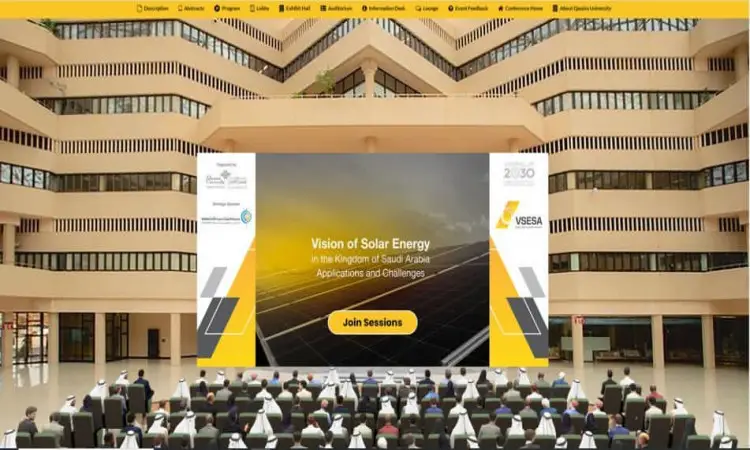
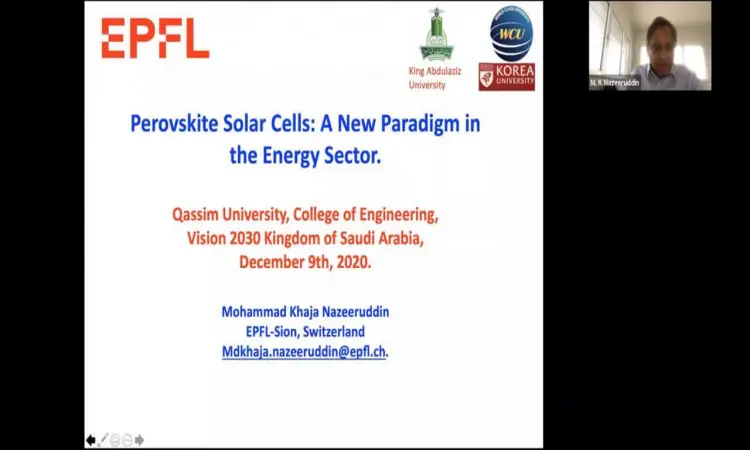
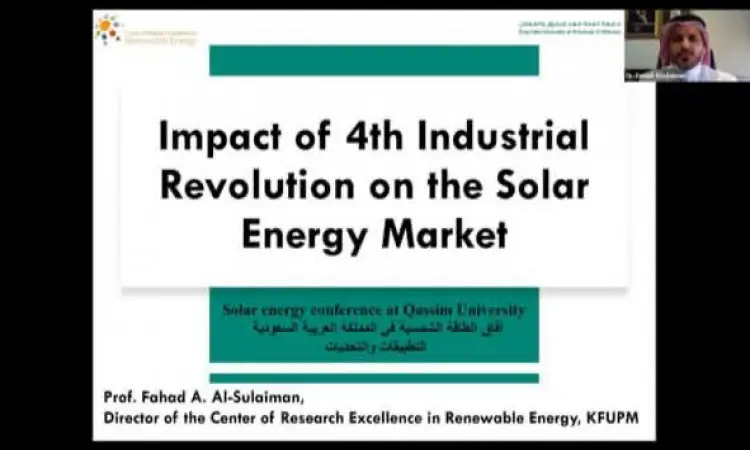
The scientific sessions of the international conference «Solar Energy Horizons in the Kingdom of Saudi Arabia: Applications and Challenges,» organized by the university, represented by the College of Engineering, discussed a number of themes, research, and scientific studies on its first day, Wednesday, 24/4/1442 AH, with the participation of many academics and researchers in solar energy applications and industry experts in the Kingdom of Saudi Arabia and worldwide remotely.
The first scientific sessions of the conference were held under the title “Generating Electric Power from Solar Energy.” Dr. Emad Shams presented a research paper titled “Solving the Maximum Power Point Tracking Problem Using Swarm Intelligence Inspired Algorithms,” in which he discussed methods for tracking the maximum power point of solar energy to ensure the photovoltaic system operates optimally, considering costs. Afterward, Dr. Ahmed Eid spoke about his paper titled “The Impact of Distributed Solar Power Generation on Power Loss and Voltage Stability of Distribution Grids,” where he discussed integrating distributed solar power generators with distribution grids to reduce active power loss and enhance voltage stability.
Next, Dr. Hamid Mohammed presented a paper titled “Evaluation of the Operating Conditions of Crystalline Silicon Photovoltaic Cells for Frequency Distribution in Riyadh City.” He emphasized that the performance of photovoltaic cells varies under outdoor field conditions and can be better analyzed using frequency distribution under different operating conditions. The purpose of this study was to find the most common operating conditions for photovoltaic cells that can be used for planning, designing, and sizing photovoltaic power plants. Dr. Rubmati Mena also spoke about his paper, “Degradation of Crystalline Silicon Photovoltaic Cells Under Hot Climate Conditions.” He revealed that crystalline silicon photovoltaic cells are prone to defects and degradation under hot climate conditions, such as in desert areas that suffer from multiple environmental stresses, high temperatures, and UV radiation, in addition to changes in temperature and humidity with gas ingress. These stress factors can lead to structural, thermomechanical, and chemical changes within the photovoltaic cell that affect its electrical performance.
Then, Dr. Manahil Mohammed spoke with a paper titled “Solar Energy as an Alternative to Electrical Energy in the Vision of the Kingdom of Saudi Arabia 2030." She discussed the opinions of the Saudi people on using solar energy as an alternative to electrical energy in homes. Researchers applied a questionnaire containing 216 samples from different segments of society. The questionnaire consists of four parts. When the sample was asked about the necessity of using renewable energy sources to generate electricity instead of generating it from oil derivatives, 88.8% of the sample agreed. When asked about the most suitable source among renewable energy sources for investment in the Kingdom of Saudi Arabia, 93% recommended solar energy. Of the sample, 19% currently use solar energy at home, and 88.9% strongly agree that government contributions in supporting the costs of solar energy technologies will encourage citizens to adopt solar energy.
At the end of the session, Dr. Hisham Othman spoke about his paper titled “Thermal Characteristics of Parabolic Trough Collectors (A Comparative Study).” He emphasized that parabolic troughs have been commercially proven to be the most advanced among concentrated solar power technologies, as operating temperatures can reach between 350-550 degrees Celsius in parabolic troughs. Solar power plants using parabolic troughs can also produce between 5 and 280 megawatts.
The scientific sessions of the conference continued through a session entitled “Desalination using solar energy”, where Dr. Qazi Bari spoke about his research entitled “Porous column type solar desalination unit”, in which he addressed the sources of high-quality potable water that are rapidly diminishing in many urban and rural areas of the world, especially in the Middle East, Africa and Asia for many reasons, and the removal of salinity and impurities in raw water by any traditional method is still expensive, so the researcher and decision makers tried all possible cost-effective alternatives, and one low-cost method to produce.
Dr. Zakaria Amara then discussed his study titled “Solar Distillation with a Rotating Wheel for Water Desalination: A Comparative Study.” He explained that the back wall of the distiller is unutilized and that significant heat loss occurs through it. Therefore, a metal disc was installed on a horizontal shaft driven by an electric motor. The rotating disc is located in the middle of the back wall, increasing the evaporation area and the area exposed to solar radiation. As the disc rotates, it becomes covered with a thin film of water, which helps speed up evaporation. Dr. Abdullah Naguib then presented his research titled “Solar Water Desalination Using Multi-Effect Membrane Distillation: Laboratory Results.” This work addressed the performance of a solar-powered water desalination system using the membrane distillation process. The system consists of photovoltaic solar panels, solar thermal collectors, and a membrane distillation unit. The latter relies on multi-effect membrane distillation, where thermal energy is recycled and reused in the system during condensation cooling.
Dr. Abdul Qadir Abdullah, in turn, presented a research titled “The Effect of Adding Trays on the Performance of Solar Distillation, An Experimental Approach.” The productivity of solar desalination units is proportional to the water depth and the wetted surface area within the unit. The unit's productivity can be increased by increasing the surface area of the basin. To maintain the minimum possible water depth within the unit, we used trays. Two desalination units were designed and manufactured: the first unit is of a traditional type, and the second is a modified unit with trays. Research experiments were designed, manufactured, and conducted for the modified desalination unit with the aim of improving productivity. Additionally, it was designed according to safety standards. The goal of this work is to increase freshwater productivity through some changes in the unit's design, where we obtained an increase in the productivity of the tray desalination unit by approximately 45% compared to the traditional unit. The daily efficiency was 47% and 34% for the tray desalination unit and the traditional unit, respectively.
The first day of the conference concluded with a scientific session titled “Materials Used in Solar Energy Applications.” The session featured Dr. Nazek Al-Ataab presenting a paper titled “Highly Flexible, Stretchable, Lightweight, and High-Efficiency Silicon Solar Cells for Unmanned Aerial Vehicles.” The study emphasized the significant and growing demand for unmanned aerial vehicles due to their wide range of applications, including, but not limited to, agricultural inspection, firefighting, and border security. While current electric-powered drones are common, equipping them with solar energy technology could enable them to undertake longer flights and carry heavier payloads. However, most currently available solar cells are either too heavy, too rigid, too expensive, or not efficient enough for drone platforms. This necessitates the development of lightweight, highly flexible, and stretchable solar cells with high efficiency, which can perfectly conform to the curved and foldable surfaces of drones without affecting flight aerodynamics.
Dr. Rupmati Meena, presenting his paper titled “Investigation of different types of defects in newly manufactured crystalline silicon photovoltaic modules”, said that solar photovoltaic cells have recently become a promising renewable energy technology, and solar energy is being utilized all over the world. However, photovoltaic cells face many manufacturing stage defects even before actual use, and these defects not only affect the performance of the cells, but are likely to cause severe performance degradation within a few years of field operation After that, Dr. Sadek spoke about a research paper entitled “Design, fabrication and testing of low-cost flat panel collectors under the climate of central Qassim”, during which he emphasized that energy is the main basis for economic, technical and social development, and with the increasing global awareness of energy challenges, solar energy has been given great attention as a promising solution to energy issues, and in this research a small-sized, naturally circulating, low-cost solar collector with a solar receiving aperture of 0. 75 square meters was designed and fabricated in this research.The solar collector was tested to heat 20 liters of water during the day in the city of Unaiza from October 18 to November 4. 75 square meters at the College of Engineering in Unaiza, Qassim University, and the collector was tested to heat 20 liters of water during the day.
At the conclusion of the session, Dr. Mohamed Moussa presented his paper titled “Inorganic Metal Halide Perovskites AMX3 as Promising Candidate Materials for Future Photovoltaic Solar Cell Technologies,” in which he emphasized that since the first appearance of photovoltaic solar cells in 1976, many scientists have made enormous efforts to improve the performance and increase the efficiency of traditional photovoltaic solar cells. A range of inorganic semiconductors have been used to manufacture photovoltaic solar cells, such as amorphous silicon, monocrystalline and polycrystalline silicon, and crystalline thin films. For his part, Dr. Mohammed bin Rabaha spoke about his paper titled “Silicon Nanowires for Photovoltaic Applications,” pointing out that chemical etching based on silver nanoparticles is a very modern and advanced method used to form nanowires (nanoscale) on the surface of monocrystalline silicon wafers.
Your Excellency, the President of the University, opens the first International Conference on Natural Resource Sustainability.
Click this link [7]
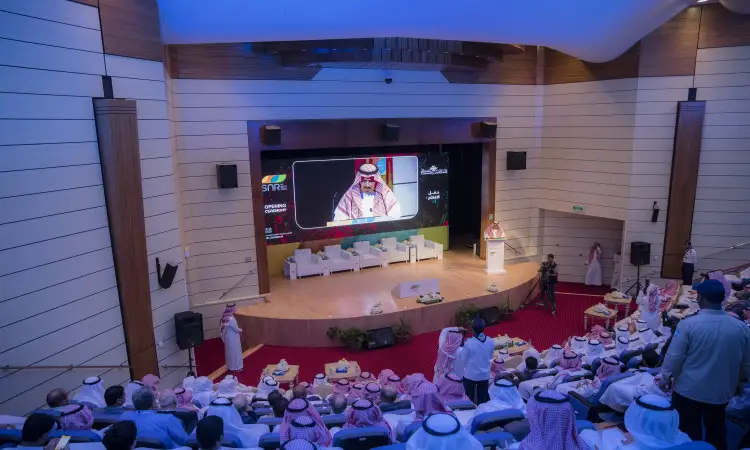
His Excellency Professor Dr. Abdulrahman bin Hamad Al-Dawood, the University President, affirmed that achieving environmental sustainability is one of the most important pillars of the Kingdom's Vision 2030, in order to raise the efficiency of waste management and reduce pollution. As an active member of the international community, especially the G20, which strives to achieve the UN Sustainable Development Goals, he pointed out that the issue of waste management is linked to a number of UN goals, including industry, innovation, infrastructure, sustainable cities, responsible consumption and production, and climate action.
This came during the sponsorship of His Excellency the University President for the First International Conference on Natural Resource Sustainability: Sustainable Management of Solid Waste, which kicked off this Tuesday morning, corresponding to 8/3/1441 AH. The conference is organized by the College of Engineering at the University and the Sustainable Development Center. It is being held at the main hall of the male campus and the theater of the College of Economics and Administration for women, and will last for two days. Thirty-six speakers will participate to cover all the themes and objectives of this scientific gathering, which aims to discuss the necessary measures to transition to sustainable food systems.
Al-Dawood added that the university seeks to achieve sustainability through its centers, research, and scientists, by means of a system of integration and cooperation between its units, and its educational and research programs. He thanked the conference sponsors, the Qassim Region Secretariat, and all contributing sectors inside and outside the university.
His Excellency the University President also inaugurated the exhibition accompanying the conference, in which 6 government and private entities are participating, including a booth for the Qassim Region Municipality, a booth for the College of Engineering, a booth for the Sustainable Development Center, a booth for the Madinah Cement Company, the Cleaning Equipment Manufacturing Company Limited, and Al-Fahd Company. The ceremony also witnessed the signing of a memorandum of cooperation between the College of Engineering at the university and Madinah Cement Company.
For his part, the head of the conference organizing committee, Professor Dr. Khalid Bani Al-Harbi, Vice President for Planning, Development, and Quality, spoke about the importance of this conference, which aligns with the university's strategic role in the Kingdom in general and the region in particular. He highlighted that it embodies the Kingdom's aspirations stemming from its Vision 2030, which places great importance on economic fields and quality of life. He noted that the university has adopted a number of academic activities to embody this role, most importantly these types of scientific gatherings, in addition to supporting research in this field, incorporating sustainability concepts into academic program curricula, and most recently launching the university's sustainable project, which is supervised by His Excellency the University President and under the kind patronage of His Royal Highness Prince Dr. Faisal bin Mishal bin Saud bin Abdulaziz, the Governor of the region – may God protect him.
Al-Harbi added: “The organizing committee has held more than 12 lengthy meetings to prepare for the conference, while other executive committees” meetings exceeded 30 working meetings, 19 of which were for the scientific committee. The preparatory team's working hours reached over 150 working hours, and the team included more than 36 members. This work resulted in the participation of more than 15 countries with 168 participants, and more than 120 scientific papers were reviewed.".
Al-Harbi explained that the organizing committee and those in charge of this conference, which is dedicated to sustainability as a concept and a subject of research through participants and interested parties, decided that the conference should go beyond that to be sustainable even in its organizational aspect. He offered thanks and appreciation to the partners of success, represented by the strategic partner, Madinah Cement Company, the silver sponsor, Al-Fahd Company, and the supporting sponsor, the Qassim Region Municipality, as well as the cooperating entities with the conference, foremost among them the Ministry of Environment, Water and Agriculture, represented by the Environmental Agency and the Ministry's branch in the region, represented by His Excellency Engineer Salman Al-Suwina, as well as the General Directorate of Education in the region, represented by His Excellency Professor Saleh Al-Jasser, for their constructive cooperation in making this conference a success.
After that, the Dean of the College of Engineering, Dr. Meshaal bin Ibrahim Al-Meshaiqah, spoke, stating that the College of Engineering at the university attaches great importance to natural resource sustainability issues due to their specialized nature. The college aims to be one of the university's most important arms in achieving this noble purpose, alongside other specialized entities from other colleges and units, most notably the University's Sustainable Development Center. The center is a partner in organizing and a host for the conference with the college in holding this distinguished international forum.
Al-Mushaiqih pointed out that the conference aims to demonstrate the volume of wasted natural and economic resources and to estimate the environmental cost of waste. It will also discuss the necessary measures to transform into sustainable food systems with reduced losses and decreased food waste. Additionally, it aims to stimulate integration among partners from different disciplines for sustainable waste management, explore opportunities to incentivize investment in waste recycling technology development in the Kingdom, and study the obstacles to investment in waste processing industries. This will be achieved through several pivotal themes discussed at the conference: effective management, valued food and responsible citizens, attractive and ambitious investment, and a cohesive team for environmental protection and sustainability.
The conference organizers aim to contribute to the development of a vision for sustainable solid waste management at the national and global levels. This will be achieved through the participation of experts, academics, and specialists from 15 countries in this field. They will discuss the results of the latest studies, research, and scientific papers related to sustainable solid waste management over six sessions during the two-day conference. The goal is to reduce per capita consumption rates of certain goods and services in Saudi Arabia, which are among the highest globally, leading to an increase in the volume of solid waste generated. Additionally, the conference seeks to curb the depletion and degradation of natural resources due to high consumption rates, and to transfer and localize modern global technologies in waste management in a way that is compatible with the Kingdom's circumstances.
The Dean of the College of Engineering added that the conference also seeks to address the challenges arising from waste, which is the responsibility of every member of society, and to raise community awareness of the risks resulting from waste generation, encourage initiatives aimed at improving sustainable waste management, and provide an opportunity for the exchange of experiences and knowledge among specialists in waste management and sustainable development.
And then, the CEO of Madina Cement, Mr. Majed bin Abdulrahman Al-Osailan, delivered the sponsors' speech, in which he emphasized the existence of millions of tons of municipal waste, estimated at billions of riyals, containing organic and inorganic materials from food and blessings that God bestowed upon this blessed country, as well as other materials that could have been recycled and converted into energy to achieve added value for the nation. Unfortunately, they end up in landfills, which is a type of waste and is contrary to our Islamic values and teachings, in addition to the negative environmental impacts resulting from burying waste underground, some of which takes more than 100 years to decompose naturally.
Al-Asailan highlighted the dangers of some harmful substances leaking from these wastes into the soil and groundwater, or the risk of fires. He pointed out that most advanced European countries, such as Germany, the Netherlands, and Belgium, send almost zero waste to landfills. In cases where landfilling is necessary, very high fees are charged to limit these practices and protect the environment by replacing the use of petroleum fuel with renewable energy and alternative fuels. He offered his sincere thanks and appreciation to all colleagues at the university and those in charge of this conference for their blessed efforts and for how it will contribute to achieving our wise government's directives to raise awareness regarding the environment and sustainability, support coordination between the public and private sectors, and contribute to achieving the Kingdom's Vision 2030 to place the Kingdom among developed countries.
For his part, the Director of the Center for Sustainable Development, Professor Ibrahim bin Saleh Al-Rabdi, spoke about the Center's vision for sustainability by adopting a balanced and integrated approach to achieve equitable development between regions and generations, where everyone receives their rights and fulfills their duty towards their environment, society, and economy to complete the three clusters of sustainability. Sustainability addresses the issue of waste from its material, technical, social, technical, informational, financial, and economic dimensions.
Al-Rabdi explained that waste management is linked to a number of UN goals, especially Goal 9, which is industry, innovation, and infrastructure; Goal 11, concerning sustainable cities; Goal 12, on responsible consumption and production; and Goal 13, which addresses climate change mitigation. It is hoped that this conference will accurately diagnose problems and develop appropriate solutions through the gathered scientists and experts. We are all hopeful that the goals of this conference will be achieved and its recommendations translated into beneficial practical projects.
The conference was attended by the Vice President of the University, Dr. Muhammad Al-Saoudi, the Vice President for Academic Affairs, Dr. Muhammad Al-Othaib, the Vice President for Graduate Studies and Scientific Research, Prof. Dr. Ahmed Al-Turki, Eng. Salman Al-Suwainie, Director of the Ministry of Environment, Water and Agriculture branch in Qassim, Prof. Saleh Al-Jasser, Director of Education in the Qassim region, Eng. Abdul Mohsen Al-Fareehi, Director of Water Directorate in Qassim, Eng. Abdulaziz Al-Suleim, Undersecretary of the Qassim Region Municipality, college deans, faculty members, and university students.
References
[1] [Online]. Available: .Click this link
[2] [Online]. Available: .Click this link
[3] [Online]. Available: .Click this link
[4] [Online]. Available: .Click this link
[5] [Online]. Available: .Click this link
[6] [Online]. Available: .Click this link
[7] [Online]. Available: .Click this link
- About Goal Seven
- Energy provider renovation and construction
- Upgrading buildings for higher energy efficiency
- Carbon reduction and emission mitigation
- Energy Consumption Reduction Plan
- Identify energy waste
- Divestment policy
- Engaging the Local Community for Energy Efficiency
- Commitment to 100% Renewable Energy
- Energy efficiency services for the industrial sector
- Developing Policies for Clean Energy Technologies
- Low-carbon innovation support