 Official government website of the Government of the Kingdom of Saudi Arabia




5
Women’s graduation rate

- About SDG 5
- Women’s application rate
- Policy for women applications and entry
- Women’s access schemes
- Women’s application in underrepresented subjects
- Policy of non-discrimination against women
- Non-discrimination policy
- Maternity policy
- Childcare facilities for students
- Childcare facilities for staff and faculty
- Women’s mentoring schemes
- Women’s graduation rate
- Policies protecting those reporting discrimination
- Paternity policy
Related Content
Women’s graduation rate
Qassim University measures and tracks women’s likelihood of graduating compared with men’s. Graduate data by sex, college and nationality are published on its Open Data portal, each graduating cohort is announced by gender and degree, and colleges and programmes report retention, on-time completion and dropout separately for female and male students, with follow-up actions such as academic advising and support for students at risk to close any gap.Women were 7,048 of 10,646 graduates in 1446 AH (66.2%, computed from open data) and 8,957 of the 13,191 graduates of the 23rd cohort ; college and programme reports give on-time completion and dropout by gender.
Open data: graduates by college, sex and nationality
The University’s Open Data portal publishes graduate data classified by college, sex, nationality, type of study, scholarship and semester of graduation. Files for both semesters of the 1446 AH academic year (2024/2025) were published in December 2025, allowing women’s graduation outcomes to be compared with men’s across the University.
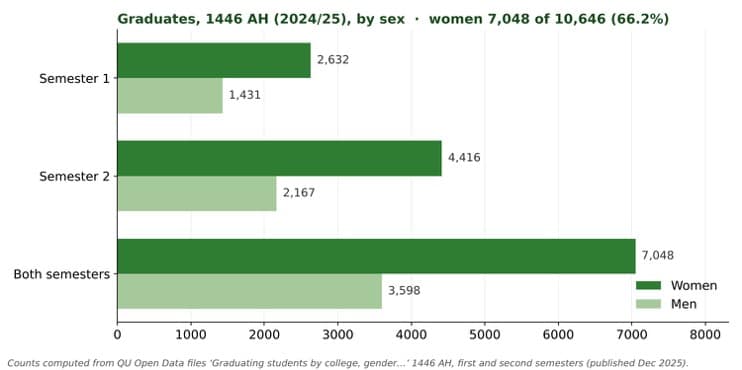
Women made up 66.2% of graduates in 1446 AH (7,048 of 10,646)
Counting the records in the two official 1446 AH graduate files gives 7,048 women and 3,598 men (10,646 in total; women 66.2%). First semester: 2,632 women and 1,431 men; second semester: 4,416 women and 2,167 men. Women outnumber men among graduates of the Colleges of Sciences (1,432 vs 344) and Computer (329 vs 119).
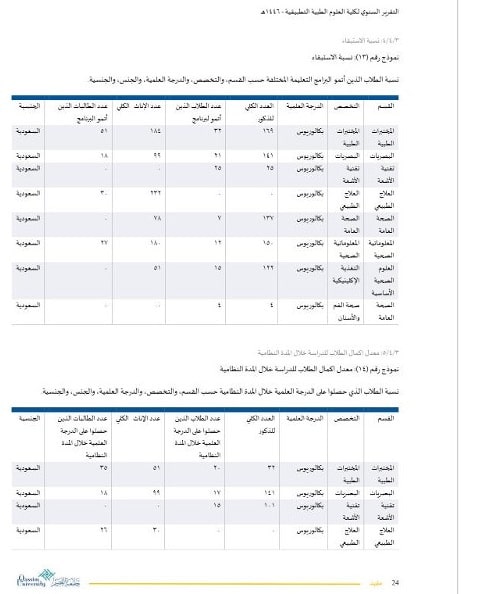
College of Applied Medical Sciences reports retention and on-time completion by gender
The annual report of the College of Applied Medical Sciences for the 1446 AH academic year presents, for each programme and separately for female and male students, retention and completion within the regular period of study, together with withdrawals and students at academic risk. In Medical Laboratory Sciences, for example, 35 of 51 female students and 20 of 32 male students completed their studies within the regular period. The college’s strategic objectives include strengthening academic advising and empowering struggling students.
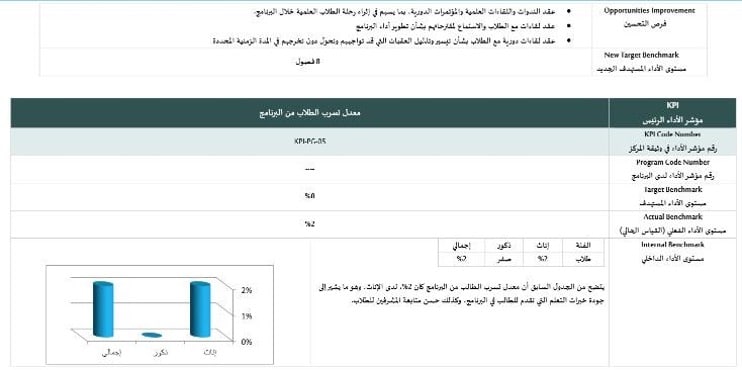
PhD in Linguistic Studies reports its performance indicators by sex
The key performance indicator report of the PhD programme in Linguistic Studies for the 1446 AH academic year, approved by the department council, reports results separately for female and male students. Average time to graduation was nine semesters for both (target: eight), and the dropout rate was 2% for women and 0% for men. The programme’s planned actions include periodic follow-up meetings with students to identify and remove obstacles to on-time graduation.
Measuring and tracking gender graduation rates
The data show that female students represent 65.3% of total graduates and male students 34.6%, with a continuous increase in the graduation rates of female students across academic levels.
Goal-related news
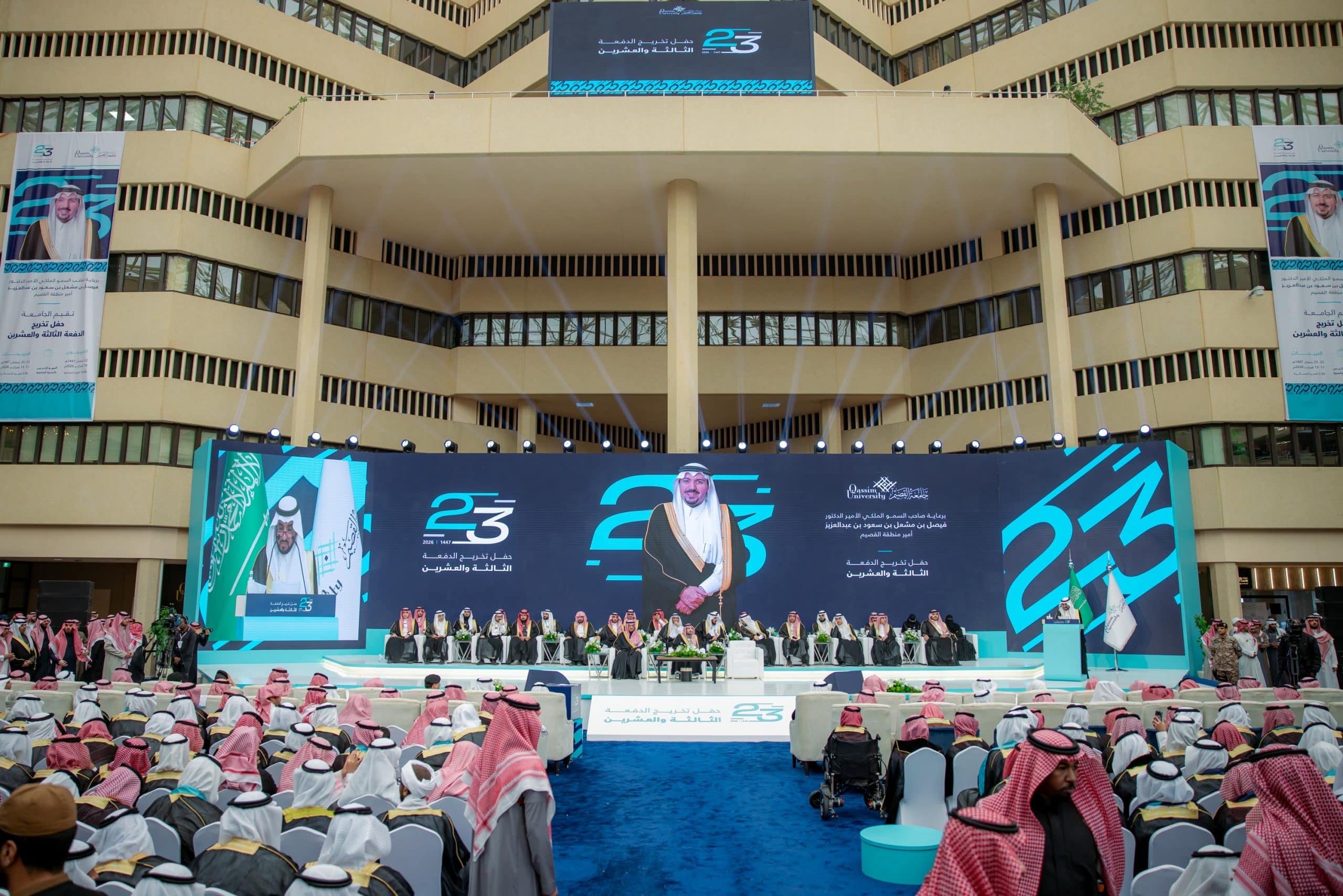
Last Friday evening, February 13, 2026, Al-Qassim University concluded the graduation ceremony of the twenty-third class, which was held under the patronage of His Royal Highness Prince Dr. Faisal bin Mashal bin Saud bin Abdulaziz, Governor of Al-Qassim Region. The ceremony saw the graduation of 13,191 graduates from various university colleges, in degrees of diploma, bachelor’s degree, master’s degree, and doctorate, held in the main hall of the university. The university witnessed the holding of […]
2026-02-14
Goal-related tweets
Goal-related files
2026-10-28
2026-10-28
2026-10-28
- About SDG 5
- Women’s application rate
- Policy for women applications and entry
- Women’s access schemes
- Women’s application in underrepresented subjects
- Policy of non-discrimination against women
- Non-discrimination policy
- Maternity policy
- Childcare facilities for students
- Childcare facilities for staff and faculty
- Women’s mentoring schemes
- Women’s graduation rate
- Policies protecting those reporting discrimination
- Paternity policy