 Official government website of the Government of the Kingdom of Saudi Arabia




5
5- Gender Equality

- About Goal Five
- Rate of women's enrollment
- Admissions and Enrollment Policy for Women
- Women's Empowerment Programs
- Promoting women in underrepresented fields
- Policy of Non-Discrimination against Women
- Non-discrimination policy
- Maternity policy
- Childcare facilities for students
- Childcare facilities for employees and faculty
- Mentoring and guidance programs for women
- Female graduation rate
- Whistleblower protection policies
- Paternity policy
Related Content
Goal Five: Gender Equality
Student Access Metrics
Does your university, as an institution, systematically measure/track the application rate and acceptance/admission rate of women?
Does your university, as an organization, have policies that address the admission of women, their acceptance/entry, and their participation in the university?
Measures of women's progress
Does your university, as an institution, have a non-discrimination policy that includes transgender individuals?
Does your university, as an institution, have a maternity policy that supports women's participation?
Does your university, as an institution, have childcare facilities available for students that enable new mothers to attend university classes?
Does your university, as an institution, have mentoring programs for women in which at least 10% of female students participate?
Does your university have a measurement/tracking body for the probability of graduation of women compared to men, and programs to address any gap?
Does your university, as an institution, have a policy protecting whistleblowers from any academic or professional harm?
Does your university as an organization have a paternity policy that supports women's participation by ensuring non-birthing parents are involved in childcare duties?
Qassim University's pursuit of Goal 5: Promoting gender equality and addressing gender discrimination
Sustainable Development Goal 5 (SDG 5) focuses on achieving gender equality and empowering all women and girls. In Saudi Arabia, addressing gender discrimination and promoting equality is a crucial step towards a more inclusive and just society. Qassim University recognizes the importance of SDG 5 and has made significant efforts to promote gender equality within its campus community and beyond.
Empowering women through education
The University of Qassim demonstrates its commitment to Goal 5 by empowering women through education. The university offers a range of educational opportunities across multiple disciplines, enabling women to access quality education and pursue their academic and professional aspirations.
Equal access to resources
The university ensures that male and female students have equal educational opportunities, resources, facilities, and prospects. Qassim University actively works to remove gender-based barriers that may prevent female students from fully participating in academic and extracurricular activities.
Create a supportive environment
Qassim University is committed to providing a supportive and inclusive environment that encourages women to excel academically and professionally. The university promotes a climate of respect, understanding, and cooperation, where gender-based discrimination and stereotypes are challenged.
Empowering Female Faculty and Staff
The university's commitment extends to its female faculty and staff, as the university provides opportunities for professional development, leadership programs, and career counseling, supporting women's professional advancement and contributions within the university.
Gender-responsive curriculum and research
Qassim University integrates a gender perspective into its curriculum and research initiatives. The university encourages the exploration of gender-related issues and their impact across various fields of study.
Raising awareness through workshops and seminars
The university organizes workshops, seminars, and awareness campaigns addressing gender equality, discrimination, and related issues, fostering dialogue, reflection, and analysis among students and the university community.
Support for Gender Research
Qassim University supports research projects focusing on gender issues, including social roles, norms, and discrimination.
Cooperation with gender organizations
The university collaborates with specialized organizations and institutions to promote gender equality through the exchange of knowledge, best practices, and joint initiatives.
Summary
Qassim University demonstrates a strong commitment to Goal 5 through multiple efforts that promote gender equality and address discrimination, empower women in education, provide an inclusive environment, support faculty, integrate a gender perspective, and raise awareness and support research.
Al-Qassim University is a public university located in the city of Buraydah, Saudi Arabia. It was established in 2004 by merging several colleges that were previously under the Ministry of Education. The university aims to provide high-quality education and conduct research that contributes to the development of society. Al-Qassim University offers a wide range of academic programs across various disciplines, including: * **Health Sciences:** Medicine, Dentistry, Pharmacy, Applied Medical Sciences, Nursing. * **Engineering and Information Technology:** Computer Science and Engineering, Information Systems, Electrical Engineering, Mechanical Engineering, Civil Engineering. * **Humanities and Social Sciences:** Arabic Language and Literature, English Language and Literature, History, Sociology, Psychology, Law, Education. * **Administrative and Financial Sciences:** Business Administration, Accounting, Finance, Economics, Marketing. * **Scientific Colleges:** Science (Physics, Chemistry, Biology, Mathematics), Agriculture and Veterinary Medicine. The university is committed to fostering a vibrant academic environment, attracting qualified faculty, and providing students with modern facilities and resources. It plays a significant role in serving the local community through various initiatives and research projects.
Student Guide [1]
It is also clear that the number of Saudi students registered is 65,912, representing 98.1% of the total enrollment, while the number of non-Saudis is 1,257, representing 1.9%. It is also evident that the number of bachelor's students is the largest (94.1%), while master's students constitute 2.4% and doctoral students 0.6%.
The number of new students was 19,051 in the 37/38 AH year and 15,722 in the 38/39 AH year.
The total number of graduates reached 10,050 graduates: 3,480 males (34.6%) and 6,570 females (65.3%).
Graduate students 226 graduates: 60.6% female and 39.4% male.
Intermediate diploma graduates 121.
The largest number of graduates were from the bachelor's degree level, at 96.5%.
Student Rights (Male/Female)
Student Guide [1]
First: In the academic field
Obtain the student handbook which provides information about the university, its regulations, and its facilities.
Welcome reception for new students.
The education students receive will be evaluated, and their feedback will be used to improve the quality of teaching at the university. Students will evaluate the courses they have taken and the faculty members who taught them, provided that the student approaches this evaluation with credibility and free from personal, partisan, or tribal influences.
Providing a suitable learning environment so that the student can study and learn easily by providing all available educational resources to achieve this goal.
Obtain academic material and knowledge associated with university courses taught in accordance with the university's regulations and bylaws governing academic work.
Obtain study plans from the college, department, and specializations, as well as review course schedules before the start of studies, and register for the offered courses through the system, taking into account registration priority according to fair controls when it is not possible to meet all students' requests.
Delete or add any course, or delete the entire semester according to the academic system, within the specified and announced period for students.
Faculty members' commitment to lecture dates and times, as well as academic and practical hours, and not canceling or changing lecture times except when necessary, with compensation for canceled lectures by alternative lectures after coordination with students and the department.
Scientific inquiry and appropriate discussion with faculty members without censorship or penalty, whether during lectures or during announced office hours.
Test questions must be within the course content and issues raised or referred to during lectures, and the grading distribution must be balanced and logical to achieve a fair assessment of student abilities.
Conduct all course examinations unless there is a regulatory impediment that prevents their execution in accordance with relevant regulations and instructions.
Provide the student with an answer key for the mid-term exam questions and the distribution of grades for the parts of the answer before the final exam for the course.
The student has the right to review their exam answer sheets in accordance with the organizing regulations and decisions.
Facilitating student access to all their rights within the university by administrative or academic authorities in accordance with university regulations and bylaws.
Provide the student with the results they obtained in the monthly, semester, and final exams after they have been corrected and approved.
Commitment of university faculty, staff, and employees to respecting the student and granting them all their academic and moral rights.
The reliability of the electronic system for monitoring grades and absences regularly, and not exceeding a week of delay.
Notify the student of their total continuous assessment marks before the final exam.
Second: In the non-academic field
Enjoy the benefits and social welfare provided by the university and participate in activities in accordance with the regulations.
Obtain appropriate healthcare through treatment at university hospitals and health centers.
Use university services and facilities such as electronic libraries, the gymnasium, the cafeteria, and others in accordance with regulations.
Obtain the financial incentives and rewards stipulated by the system, especially for outstanding students.
Nomination for training courses, internal and external programs, and trips, and increasing participation in cultural activities, community service, and volunteer work.
The right to appeal or complain about any matter concerning a faculty member, department, college, or any university unit. Submitting complaints according to the rules regulating the Student Rights Protection Unit, and enabling the student to know the status of their complaint.
Enable the student to defend themselves before any university body in any disciplinary case, and not to be judged except after hearing their statement, unless it is proven that their absence was with an unacceptable excuse after being summoned for the second time.
Appealing the disciplinary decision issued against him in accordance with the established rules for that.
Maintain the contents of the student file within the university and handle it with care. Do not release it except to the student, their guardian, or someone authorized by investigative bodies, judicial authorities, or other governmental entities. Do not publish any part of it except as a result of disciplinary action.
The right of a student with special needs to receive appropriate services in accordance with applicable laws and regulations.
University ratings
Student Guide [1]
Based on Islamic values, Qassim University believes in:
- Justice
- Integrity
- Transparency
- Quality
- Creativity
- Teamwork
- Academic freedom
New student reception
Student Guide [1]
The Orientation and Guidance Department at the Deanship of Student Affairs recognizes the importance of introducing newly admitted students to the university. A freshman reception program is being prepared, which includes an official invitation to attend the reception with the location specified and provision of important instructions that must be known before the start of studies. The program aims to prepare the student for a new university life, and to inform them about the support systems, services, and essential facilities at the university, such as the library, restaurants, sports halls, printing centers, and laboratories, among others.
The reception was organized for two days under the patronage of His Excellency the University President.
A. Religious and Social Program
The administration is keen on carefully selecting the materials presented in awareness programs, so that they serve the students' best interests and help educate, guide, and protect them intellectually, culturally, religiously, and socially.
B. Exhibitions
The administration aims to establish awareness exhibitions to inform students about the negative effects that may hinder their academic path, and to open the door to positive aspects that contribute to building a better future for them.
Student Services
Services provided include: offering discounts on air, bus, and train fares, issuing university ID cards, and following up on medical reports.
89 male and female trainees are receiving training titled “Towards Effective Community Partnership for the University”
Click this link [2]
In pursuit of the Deanship of Community Service to achieve systematic and intellectual integration for community service, the Deanship of Community Service, represented by the Community Service Unit, organized a training course entitled “Towards an Effective Community Partnership for the University,” presented by international expert Dr. Jamal Nasser Al-Shatti, Director of KAMS Institute for Training in the State of Kuwait. The opening of the course was attended by His Excellency the Vice President for Academic Affairs, Professor Dr. Ahmed bin Saleh Al-Tami, who welcomed the attendees and Dr. Jamal Al-Shatti. After that, His Excellency Professor Dr. Ahmed bin Ibrahim Al-Turki delivered his opening speech and presented a visual presentation on community service and the deanship's work in coordination with colleges that interact with the deanship towards the community. The course was well-attended, with a total of 89 male and female trainees from Qassim University branches and external parties.
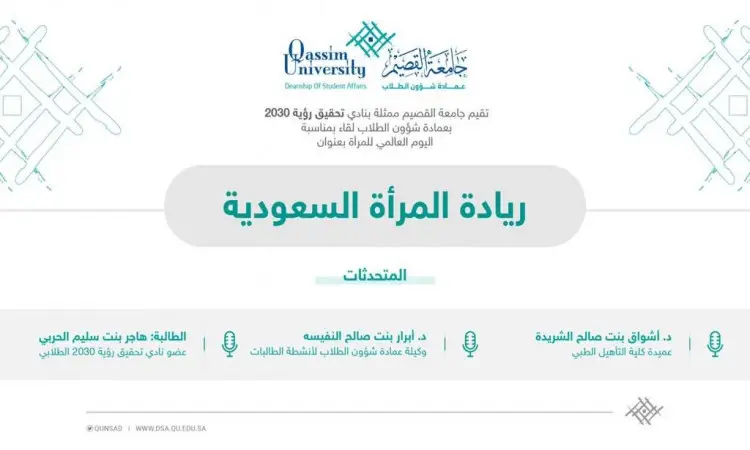
The university celebrates its female staff members on International Women's Day with several events.
Click this link [3]
In its efforts to activate International Women's Day, the university celebrated its female staff members to express the appreciation of the entire university community for the significant role women play within the university as partners in development and progress alongside men. The university includes over 200 female leaders who manage colleges, deanships, departments, and divisions, 1577 female faculty members, 1194 female administrative employees, and 10 female members of the university council, in addition to more than 40,000 female students at various academic levels (Bachelor's - Diploma - Master's - Doctorate).
On this occasion, the university, represented by the Vision 2030 Realization Club at the Deanship of Student Affairs, held an educational meeting yesterday evening, Monday, entitled “Saudi Women's Entrepreneurship.” The meeting was presented remotely by Dr. Ashwaq bint Saleh Al-Sharideh, Dean of the College of Rehabilitation Sciences, and student Hagar bint Salim Al-Harbi, a member of the Vision 2030 Realization Club. The meeting was moderated by student Shahd Abdul Rahman Al-Muzaini.
The meeting discussed the role of Saudi Vision 2030 in empowering women, the current stage of women's empowerment in light of the historic gains achieved during the reign of the Custodian of the Two Holy Mosques, King Salman bin Abdulaziz, women's leadership platforms and the "Qudrah and Wasl" programs, in addition to the role of women in entrepreneurship and women's leadership in the past and present.
For her part, Dr. Ashwaq Al-Shareeda spoke about the role of women in building society, emphasizing that women are the foundation of society's formation and development, and the most important pillars of the family and its construction. She affirmed that women are half of society, and indeed, all of society, in the labor market, politics, medicine, and finally, volunteer work, in addition to the role of women in the family and upbringing, and their importance in the home and in nurturing children.
Student Hajar Al-Harbi also emphasized the role of university female students in volunteer work and activities inside and outside the university, and the distinct and positive impact this has on the university community and the wider community. She added that women have a significant role in achieving the Kingdom's Vision 2030, which is based on three main pillars: “a vibrant society, a thriving economy, and an ambitious nation,” stressing that women's societal participation is a key part of developing a vibrant society.
In turn, the Community Service Unit at the College of Agriculture and Veterinary Medicine at the university, represented by the Department of Food Sciences and Human Nutrition (female section), held a remote awareness event yesterday, Monday, as part of activating International Women's Day, titled “Your Health and Beauty Are in Your Food,” with the participation of a number of specialists.
Center for University Studies for Female Students
Click this link [4]
Dean's word
In the name of Allah, the Most Gracious, the Most Merciful
And with it we seek help
Praise be to Allah, who taught by the pen, taught man what he did not know, and prayers and peace be upon the noblest of messengers, our Prophet Muhammad, and his family and all his companions.
Qassim University strives to provide advanced and accredited university education to prepare well-rounded competencies that meet the needs of the labor market, and to provide distinguished community services and applied research, which uplifts the local community and contributes to building a knowledge economy. It utilizes the latest administrative, technical, and informational methods, activating national and international partnerships, and developing the university's resources. The University Studies Center for Female Students seeks to play an active role in achieving the university's vision, mission, and goals, and is supervised by His Excellency the Vice Rector for Academic Affairs, Professor Dr. Ahmed Al-Tamami. The female sections receive generous support from the university's leadership, represented by His Excellency the President of the University and his deputies, to provide an educational environment that stimulates learning and creativity.
The center includes seven colleges in addition to the Deanship of Educational Services. These colleges are: College of Medicine, College of Dentistry, College of Pharmacy, College of Applied Medical Sciences, College of Nursing, College of Computer Science, and College of Business. It also includes the Deanship of Admissions and Registration Agency for Female Students and the Deanship of Student Affairs Agency for Female Student Activities. The center coordinates between these colleges and these deanships.
This website was created to be a communication bridge and contribute to leveraging technology to provide the desired communication between the Deanship of the Center, faculty members, female employees, and those interested in following the Center's news. We seek to provide services through it to female students and the Center's affiliates. We welcome you to this website, and we look forward to your suggestions and feedback to achieve the vision and mission of Qassim University. I ask God that this website achieves its goal, guides us to what He loves and is pleased with, and helps us serve our religion and then our country.
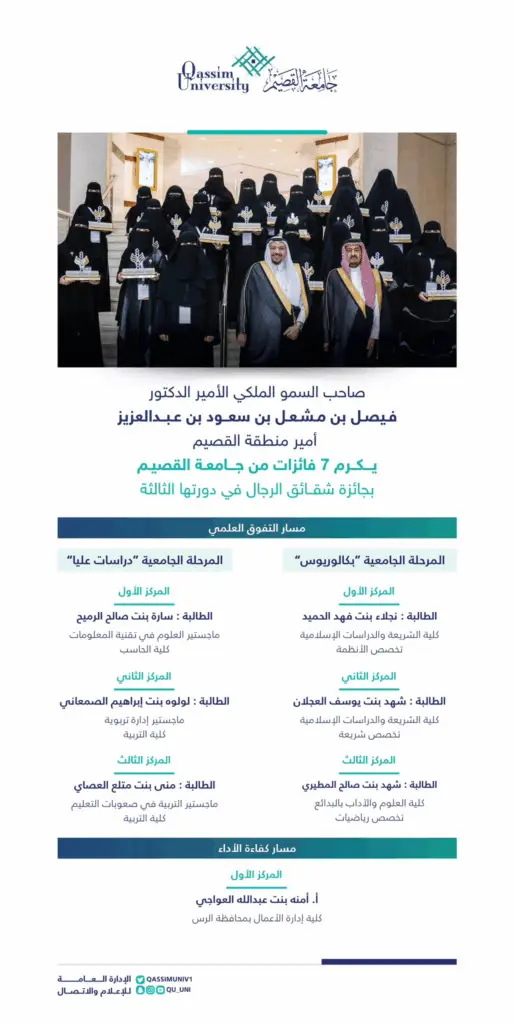
Excellence Congratulations for the female students
Click this link [4]
University President Congratulations to our female students on this excellence, and I ask God for them and for all the students of Qassim University. Good luck in their academic and professional careers.
The University President: Saudi women's role is important in the Kingdom's renaissance... and the decision allowing women to drive is an addition to their rights.
Click this link [5]
His Excellency Professor Dr. Abdulrahman bin Hamad Al-Dawood, President of Qassim University, valued the decision of the Custodian of the Two Holy Mosques, King Salman bin Abdulaziz – may God protect him – yesterday, Tuesday, to implement the provisions of the traffic law and its executive regulations, including issuing driving licenses to males and females alike, while observing the Sharia controls stipulated by our true Islamic religion. The decree set several conditions that must be met to allow women in the Kingdom to drive cars. .
“Al-Dawood” stressed that the decision came to remove many of the obstacles that women faced and their suffering in providing suitable transportation, especially in light of the expansion of employing women in many government and private jobs.
His Excellency clarified that the role of Saudi women is increasing day by day in participating in the Kingdom's renaissance and development in all social, economic, and scientific fields, as the number of girls enrolled in various universities has increased significantly in the past few years, and they have competed with men in several scientific and practical fields, and even surpassed them, which confirms the necessity of providing them with full opportunities for further participation in building the future of our dear homeland.
He explained that the decision to grant women the right to drive will have a positive economic and social impact on society, and that the supreme decision and the expected positive outcomes from allowing them to do so are in accordance with the application and adherence to the necessary Sharia controls. It is not hidden from anyone the observed negatives in the abundance of private drivers in the Kingdom, and the suffering of women in their commutes between home and work and their access to hospitals and universities.
He added that the current social culture and the level of awareness and understanding of women's rights among its members, thanks to the rising level of education and openness to other Islamic societies, have granted this decision social acceptance, ensuring, with God's success, that there will be no problems in its implementation. This is especially true with the directive of the Custodian of the Two Holy Mosques, King Salman bin Abdulaziz – may God protect him – to form a supreme committee from the Ministries of Interior, Finance, and Labor and Social Development to study and put in place the necessary arrangements for the implementation of the decision in accordance with approved Sharia and regulatory controls.
Dr. Al Dowed concluded his statement by asking God for success and guidance for the Custodian of the Two Holy Mosques, King Salman bin Abdulaziz, in a manner that achieves the best interests of the country and society, in accordance with the approach of this blessed state based on the rulings of the benevolent Islamic Sharia.
References
[1] [Online]. Available: .Student Guide
[2] [Online]. Available: .Click this link
[3] [Online]. Available: .Click this link
[4] [Online]. Available: .Click this link
[5] [Online]. Available: .Click this link
- About Goal Five
- Rate of women's enrollment
- Admissions and Enrollment Policy for Women
- Women's Empowerment Programs
- Promoting women in underrepresented fields
- Policy of Non-Discrimination against Women
- Non-discrimination policy
- Maternity policy
- Childcare facilities for students
- Childcare facilities for employees and faculty
- Mentoring and guidance programs for women
- Female graduation rate
- Whistleblower protection policies
- Paternity policy