Official government website of the Government of the Kingdom of Saudi Arabia




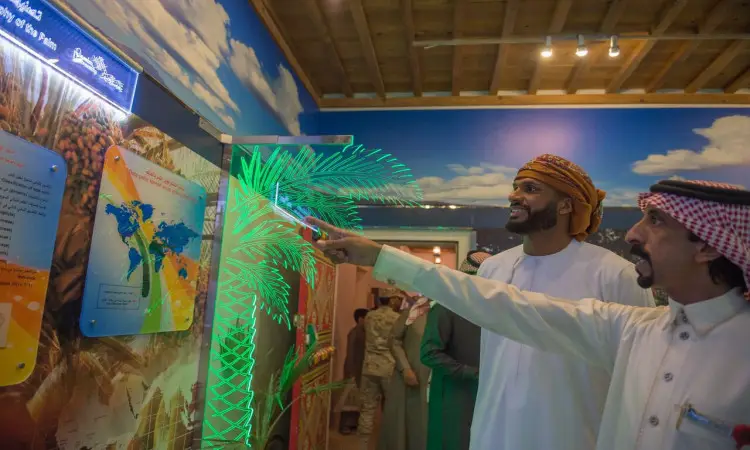
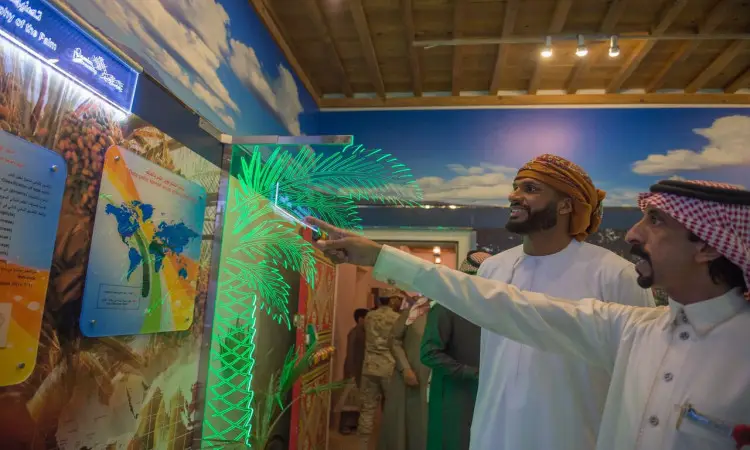
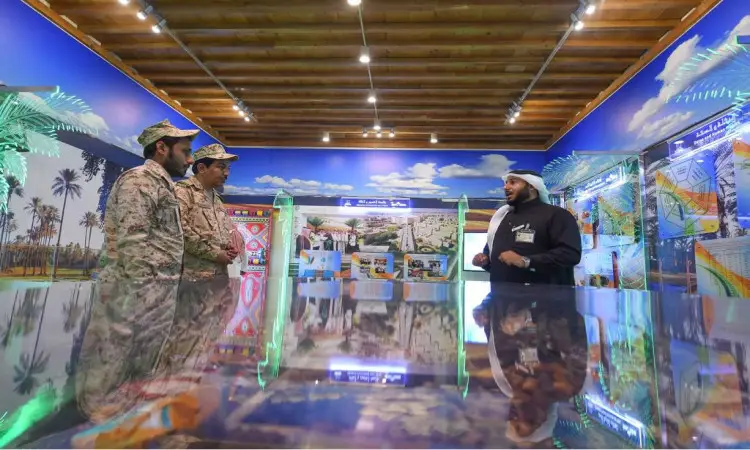
The university's pavilion at the Janadriyah 32 National Heritage and Culture Festival began receiving visitors on Thursday, May 10, 2018. Informational brochures about the university, its colleges, departments, and achievements were distributed to visitors. The pavilion includes an introductory exhibition about the university titled "A Journey and Achievements," as well as a special section on palm trees, their products, and benefits. The pavilion also features exhibits that emulate heritage and significant historical artifacts carrying a cultural legacy for the Kingdom in general and the historical region of Al-Qassim in particular, across various fields. Additionally, a package of activities and programs are offered, along with answers to visitor inquiries. The participation is part of the Al-Qassim region's pavilion, "Heritage of Al-Qassim.".
"Journey and Achievement" exhibition"
The career and achievement exhibition presents a number of distinguished participations showcasing its journey and accomplishments since its establishment. It includes a comprehensive statistic on the number of faculty members, undergraduate students (male and female), graduate students, and staff. It also displays academic programs, the number of colleges and deanships. Additionally, it offers an introductory visual presentation with images and information about the university, highlighting its most important achievements, which are supported by generous contributions from the wise leadership across all levels. The exhibition also covers the international accreditations obtained by the university and several of its colleges, as well as national accreditations. Furthermore, it features agreements signed by the university with international universities and major companies.
The university's origin and journey
The informative panels adorning the university's pavilion contain comprehensive information about the university's origins, its colleges spread across the region, and its multiple specializations. The university is defined as one of the comprehensive governmental universities in the Kingdom, which includes dozens of scientific specializations in various fields: religious, Arabic, and humanities, in addition to scientific, engineering, and health specializations. The university offers all academic degrees after high school.
The panels include the reasons for establishing the university, which was created in implementation of the National Plan for the expansion of higher education and universities. It is among the first modern universities, after the seven universities, in terms of origin, development, and expansion. The Royal Decree No. 7/B/22042 was issued to establish Qassim University in the academic year 1423/1424 AH, which at the time included seven colleges affiliated with the branch of Imam Mohammad Ibn Saud Islamic University and the branch of King Saud University in the Qassim region. However, it has grown and developed rapidly since then, as it currently includes (37) colleges. More than 4,400 faculty members and 3,250 employees are affiliated with it. The number of male and female students enrolled in it exceeds (72,000) male and female students of various nationalities, in addition to 1,850 male and female students in postgraduate studies, and 170 academic programs.
University Partnerships and Agreements for Visitors
The university, through the "March of Achievements" exhibition, is presenting a package of introductory activities. Among the most important of these is national academic accreditation, with the university ranking third in the Kingdom after obtaining institutional accreditation in 2013. The university has also obtained programmatic academic accreditation for several specializations, including Medicine and Surgery, Oral and Dental Medicine and Surgery, Animal Production and Nutrition, Food Sciences and Human Nutrition, Veterinary Medicine, Public Health, in addition to Optics.
The university has obtained several international accreditations for several colleges, including the College of Computer Science, the College of Engineering, the College of Economics and Management, the College of Pharmacy, the College of Medicine, the College of Science, and the Community College of Buraydah.
The university also uses the festival to introduce visitors to universities and research centers with which it has agreements in various fields, including Michigan State University (MSU) in the United States, the University of International Business and Economics in China, Durham University in Britain, China Medical University in Shenyang, Stanford University in the United States, China Agricultural University in Huazhong, Maastricht University in the Netherlands, Peking Health University in China, as well as the University of La Trobe in Australia, the University of Herman Astor in America, and SABIC.
The pavilion also displays research chairs established by the university, including the Date Palm Research Chair, the Sheikh Ibn Uthaymeen Chair for Islamic Studies, the Sheikh Abdullah Al-Rashed Chair for the Service of the Prophet's Biography, and the Sheikh Saleh Al-Sa’awi Chair for Developing Positivity and Achievement in Society. It also introduces the scientific societies at the university, foremost of which are the Saudi Scientific Society for Contemporary Intellectual Studies, the Saudi Scientific Society for the Internet, the Saudi Scientific Society for Medicine, the Saudi Scientific Society for Investment and Finance, the Saudi Scientific Society for Dental Education, the Saudi Society for Islamic Banking, and the Scientific Society for Quality Assurance in Education.
Palm Suite
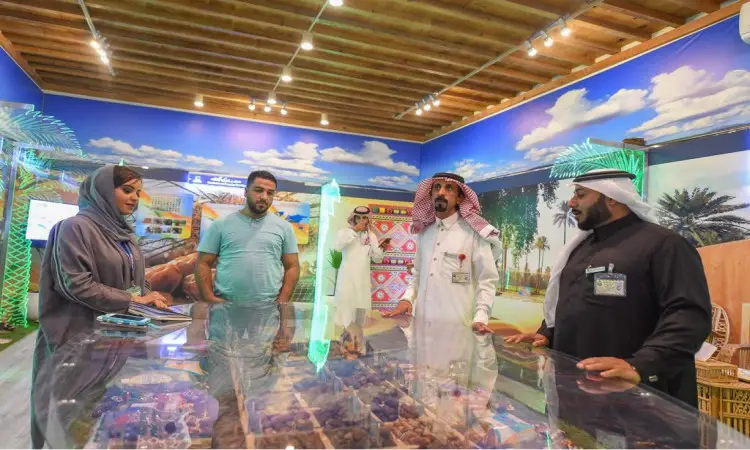
The "Palm Tree" pavilion, implemented by the College of Agriculture and Veterinary Medicine, contains 8 sections, including: Palm tree classification, geography, and care; agricultural practices; prevention of diseases and pests affecting it; as well as palm tree health; in addition to a secondary and transformative industries corner for the palm tree, which shows the extent of its utilization and the diverse and good economic returns from the transformative industries and secondary products based on it.
This integrated pavilion about the date palm comes due to its social and cultural symbolic status, which has made it an economic pillar that is heavily relied upon in light of the Kingdom's Vision 2030, which enhances non-oil revenues. Participants in the pavilion provide an engaging scientific explanation of the date palm, what it contains, and what it offers through simplified scientific facts, reaching individuals of society and those interested in date palms.
The University and Palm Tree Pavilion also showcases the interest, studies, publications, research, and the holding of international and local conferences that Qassim University offers for this blessed tree to advance this vital sector. In addition to a special pavilion for receiving visitors and interested parties, holding side discussions, and answering their inquiries.
Introducing visitors to the types of dates
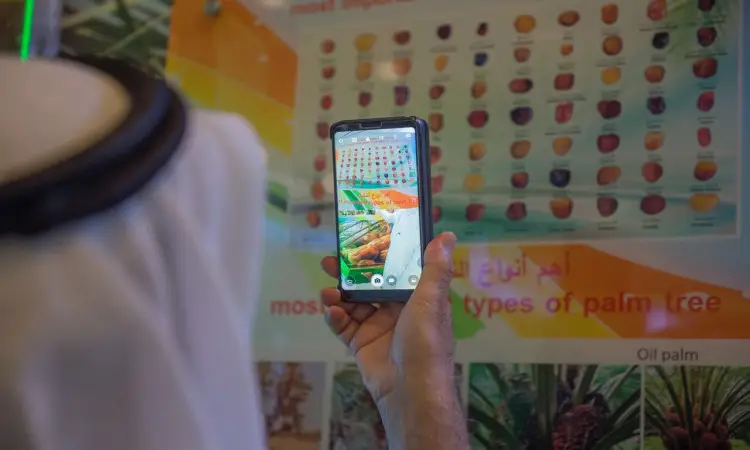
The Palm Pavilion introduces visitors to over thirty types of dates on display, produced in the Qassim region and other areas, especially the most famous varieties. This is due to their social standing and cultural symbolism, which has recently become an economic pillar that many rely on.
Participants in the corner also provide a comprehensive explanation of the palm tree, what it contains, and what it offers through simplified scientific facts to reach community members and interested parties to strengthen this aspect among them. In addition, there is a corner for palm tree classification and geography, which displays the most important types of natural ripe dates in the Kingdom in general and Al-Qassim in particular, which are good for cultivation and production, and what they are famous for, such as Sukari, Sagai, Hishashi, and Qassim Khalas. Several types from outside the region are also displayed, such as Medjool and Ajwa Al-Madinah varieties, among others.
It is reported that the Qassim region has more than seventy varieties of dates, in addition to more than six million palm trees.
Veterinary clinic for camel racing track supervision
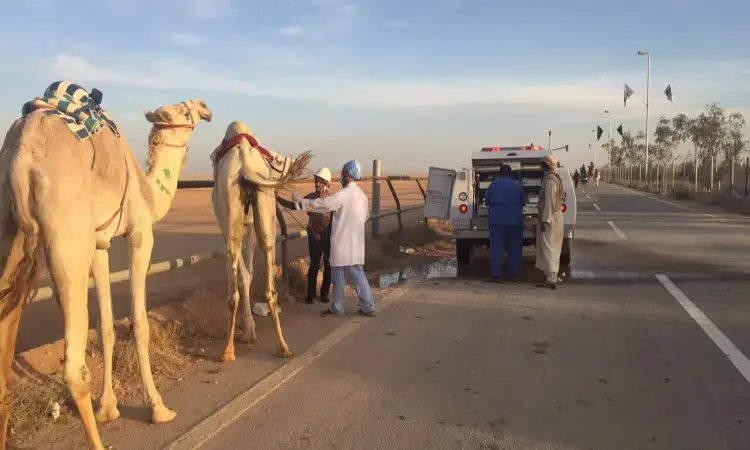
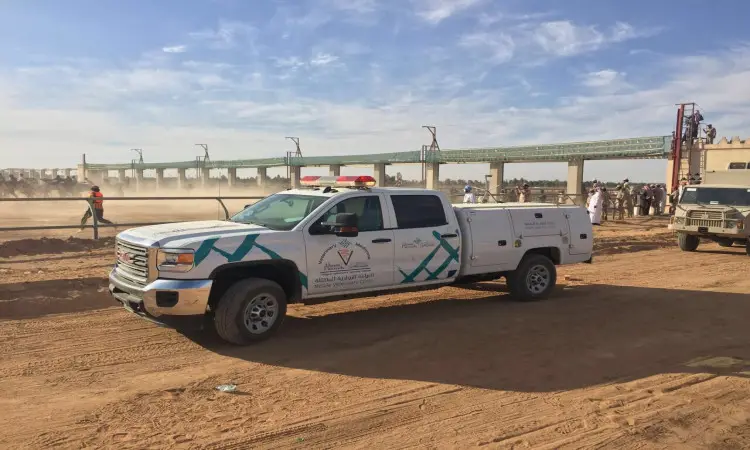
The College of Agriculture and Veterinary Medicine also participates with a fully equipped mobile veterinary clinic, attending to the camels accompanying the festival. This has been their practice every year for over 15 festival editions. A specialized team from the veterinary clinics affiliated with the Department of Veterinary Medicine operates the mobile clinic, providing direct supervision of the race heats as they begin.
The university clinic handles cases resulting from motor injuries and emergency accidents involving participating animals. The mobile clinic also conducts direct clinical examinations before announcing race winners to ensure compliance with the specific requirements of each heat, such as determining age categories and other factors.
The veterinary clinic strives to provide the best services to camel owners in disease screening and prevention, and the best therapeutic methods for injuries of camels participating in camel racing. The mobile clinic also offers many services in various locations surrounding the racing areas, receiving cases that require examination and treatment, and motor injuries. Medium to minor surgeries are performed by the clinic for free for cases that require surgical intervention.
The university's participation in national celebrations aligns with its objectives of serving the community, benefiting it, and enhancing its cultural gains and rich heritage. This strengthens the social partnership that the university upholds and strives for excellence in. It also serves to showcase the university's scientific products, colleges, specializations, research, and ongoing agreements, in addition to offering awareness and educational programs and events to all segments of society.