 Official government website of the Government of the Kingdom of Saudi Arabia




10
10- Reduce inequalities

- Regarding Goal 10
- Programs for Underrepresented Groups
- Expand reach and attract underrepresented groups in the university community
- Diversity Officer or Committee at the University
- Enhance support for underrepresented groups through mentorship and fellowship programs.
- Facilities for people with disabilities
- Disability Support Services
- Disability Access Facilitation Program
Related Content
Anti-discrimination measures
Does your university, as an institution, have a non-discriminatory admissions policy, or does it clarify and explain the rationale for any appropriate affirmative action policies in admissions, which are publicly posted?
Does your university, as an institution, measure/track admissions and enrollment for underrepresented (or potentially underrepresented) groups?
The Diversity and Equity Committee, Office, and Officer for advising on and implementing policies, programs, and training related to diversity, equity, inclusion, and human rights on campus.
Provide peer mentoring/counseling/support programs to support students, staff, and faculty from underrepresented groups.
Housing policy/strategy, including a sufficiently funded mechanism for people with disabilities
Goal 10: Reduce Inequalities
Sustainable Development Goal (SDG) 10 aims to reduce inequality within and among countries, with a focus on marginalized and vulnerable groups. In Saudi Arabia, addressing the inequalities faced by persons with disabilities is crucial for creating an inclusive and just society. Qassim University recognizes the importance of SDG 10 and has implemented measures to enhance accessibility, learning, and facilities for individuals with disabilities.
Accessible learning environments
Al-Qassim University's commitment to Goal 10 is evident through its efforts in creating accessible learning environments. The university ensures its buildings and facilities are designed to accommodate individuals with disabilities, by providing ramps, elevators, and other features that facilitate movement and accessibility.
Comprehensive curriculum and instruction:
The university integrates a comprehensive approach in its curricula and teaching methods. Qassim University faculty are trained to meet diverse learning needs, ensuring students with disabilities receive the necessary support and resources to succeed academically.
Support services for students with disabilities
Qassim University offers a range of support services for students with disabilities. These services include specialized educational resources, assistive technologies, counseling, and academic accommodations. The university aims to create an environment where all students can thrive and fully participate in their educational journey.
Cooperation with disability organizations
The university collaborates with disability organizations and advocacy groups to gain insights into best practices and challenges related to inclusivity. These partnerships facilitate knowledge exchange and the implementation of strategies that promote equitable access and opportunities for individuals with disabilities.
Awareness and Sensitivity Campaigns:
Qassim University is working to raise awareness about the rights and needs of individuals with disabilities through campaigns, seminars, and workshops. The university fosters an inclusive mindset among students, faculty, and staff, creating an environment of respect and understanding.
Comprehensive research initiatives on disability:
The university's research efforts extend to projects related to disability. Qassim University's research contributes to understanding the challenges faced by individuals with disabilities and developing solutions that enhance their quality of life and community participation.
Accessible facilities and services:
Qassim University ensures that its facilities, including libraries, laboratories, and recreational areas, are accessible to individuals with disabilities. The university prioritizes creating an inclusive environment that caters to diverse needs.
Promoting the Rights of Persons with Disabilities
The university advocates for the rights of persons with disabilities and social inclusion within its community and beyond. Qassim University contributes to discussions on policy development, awareness, and advocacy efforts aimed at reducing inequality and promoting equal opportunities.
Empowerment and skills development:
Qassim University aims to empower individuals with disabilities by offering skill development programs, workshops, and vocational training. These initiatives equip individuals with the necessary skills to contribute to the workforce and society at large.
The commitment of Qassim University to the tenth goal is evident through its comprehensive efforts to promote inclusivity and reduce inequalities for individuals with disabilities. By providing accessible learning environments, inclusive curricula, support services, collaborating with disability organizations, raising awareness, conducting research, and advocating for disability rights, the university effectively contributes to establishing a more just and inclusive society in Saudi Arabia. Through its dedication, Qassim University plays a significant role in advancing the tenth goal and ensuring that individuals with disabilities have equal opportunities in education, employment, and access to facilities.
Disability Services Management
Click this link [1]
Introduction
The goal of Vision 2030 is to develop effective plans and programs that contribute to making the Kingdom a role model for the world on all levels. These plans aim to empower people with disabilities to obtain suitable employment and education opportunities that ensure their independence and integration into society as independent and active individuals, and to provide all facilities and tools that help them achieve this success.
In addition to the continuation of the educational process, this significant undertaking indicates that the Kingdom, through the Quality of Life Program, one of the programs emanating from Vision 2030, strives to provide infrastructure facilities throughout the Kingdom that are easily accessible via public transportation and equipped to accommodate persons with disabilities. A person with a disability is defined as any individual suffering from a total or partial impairment that affects their physical, sensory, mental, communicative, educational, or psychological abilities to an extent that reduces their ability to meet the requirements of their ordinary life, similar to those without disabilities. This disability includes one or more of the following types:
Visual impairment
Hearing impairment
Intellectual and psychological disabilities
Mobility impairments
Learning disabilities
Language and speech disorders
Behavioral disorders
and other disabilities requiring special care
Therefore, these individuals need to take necessary measures in medical, psychological, educational, media, and systemic aspects, with the aim of meeting their educational needs and developing their academic abilities.
The committee surveyed a number of cases of individuals with disabilities at the university and their needs, whether in terms of infrastructure, academic, or technical issues. The unit aims to build bridges of partnership between the university's Unit for the Care of People with Disabilities and their representatives in the colleges, in order to provide distinguished and pioneering services to students with disabilities. The Unit for People with Disabilities at the Deanship of Student Affairs also welcomes students with disabilities and seeks to provide a set of comprehensive qualitative services covering all academic, administrative, psychological, social, technical, and infrastructural aspects.
Education for People with Disabilities in University
The Kingdom strives to provide healthcare, social care, and all means of a dignified life for all its citizens across all segments of society. People with disabilities are at the forefront of these segments requiring special care and attention. The Kingdom has focused its efforts on caring for people with disabilities to ensure they access their disability-related rights, enhance the services provided to them, contribute to their well-being, and rehabilitate them to become active members of society.
In line with the Kingdom's Vision 2030, Qassim University has been keen on providing comprehensive care services to all who need them due to their health condition, disability, or social situation. It has contributed by employing medical, social, psychological, educational, and professional services to assist students with disabilities in achieving the highest possible level of competence within the university, enabling them to adapt to the demands of their natural and social environments, and to develop their capabilities to become self-reliant and productive members of society.
The percentage of people with disabilities has recently become 7.1% of the total population of the Kingdom.
According to the Statistics Authority, the number of people with disabilities is as follows:
Hearing Impairments 289,355
Hyperactivity and attention deficit 30,155
Motor impairments 833,136
Autism Spectrum Disorder 53,282
Down Syndrome 19,428
Visual impairments: 811,61
Disability Unit
The Disability Unit has been formed as one of the units of the Deanship of Student Affairs. The unit is concerned with removing all difficulties and challenges facing persons with disabilities among the university's male and female students. It provides a suitable university environment for students with special needs, ensuring their easy access to halls and main departments on campus. The unit also works to raise the awareness of university staff on how to correctly deal with persons with disabilities within the university.
Unit tasks
- Develop policies for identifying and classifying students with disabilities
- Developing scientific tools for identifying and assessing students with disabilities
- Awareness, policy and framework building to integrate students with disabilities into higher education in accordance with their capabilities in less restrictive environments.
- Create equal access opportunities for fair and appropriate university education for all students with disabilities, regardless of gender, social background, geographic location, or the nature of their special needs.
- Provide personalized learning opportunities that address the specific needs of gifted and creative students.
Types of services provided by the unit for people with disabilities at the university:
Visual impairment
- Academic Needs (Academic Adjustment / Effective Communication Services / Material Services)
- Psychological Needs (Academic Adjustment / Effective Communication Services / Material Services)
- Social Needs (Academic Adjustment / Effective Communication Services / Material Services)
Hearing Impairment
- Academic Needs (Academic Adjustment / Effective Communication Services / Material Services)
- Psychological Needs (Academic Adjustment / Effective Communication Services / Material Services)
- Social Needs (Academic Adjustment / Effective Communication Services / Material Services)
- Mobility impairment
- Academic Needs (Academic Adjustment / Effective Communication Services / Material Services)
- Psychological Needs (Academic Adjustment / Effective Communication Services / Material Services)
- Social Needs (Academic Adjustment / Effective Communication Services / Material Services)
– Other disabilities
- Academic Needs (Academic Adjustment / Effective Communication Services / Material Services)
- Psychological Needs (Academic Adjustment / Effective Communication Services / Material Services)
- Social Needs (Academic Adjustment / Effective Communication Services / Material Services)
After the student/person with a disability identifies their needs within the university, they are interviewed in person and assessed according to the Ministry's approved special education criteria by special education specialists. Subsequently, the type of service is determined, they are classified, and the appropriate procedure is identified:
1- Academic support for students with disabilities
Increase the time allotted for mid-term and final exams by half/double
Individual test
Adjusting assessment and teaching methods in coordination with center management
Enlarge or read the question line
Table separate from chair
Exemption from automatic correction
Considering health status during the lecture
In-hall accompaniment for note-taking
Dividing the scientific material for the test over two days
Replace offers with student-appropriate activities
Provide a laptop during the test
Allow breaks for the student/lecturer
Addressing the student directly to ensure understanding of the questions
Faculty member documenting student answers verbally (if needed) for visually impaired students
Do not conduct more than one test per day
Accepting excuses for lateness
Submit and present offers before and after the lecture
Break down long-term tasks
Provide short, clear instructions.
Grant additional time to complete tasks
2 - Social Services
-
Organizing visits, trips, seminars, meetings, and exhibitions related to disability issues
-
Participation in national events
-
Participation in global events such as the International Day of Persons with Disabilities, World Autism Awareness Day, and Deaf Awareness Week
-
Facilitating participation in student clubs such as art, literary, and sports clubs
-
Participating in outdoor events
Psychological Services
-
Introducing the “Guide Me” program for diagnosing conditions and referring to specialists when needed.
-
Building bridges of understanding between university staff and students with disabilities
-
Determining the level of psychological compatibility and overcoming difficulties
-
Working to overcome challenges during the educational journey according to regulations
-
Providing Educational Consultations for the Department of Persons with Disabilities
Educational Consultations for the Disability Services Unit
| specialization | Scientific degree | Member Name | |
|---|---|---|---|
| Learning disabilities | Professor | Abdullah Ali Al-Rabiaan | M.D. |
| Talent and excellence | associate professor | D. Naif Fahd Al-Fraih | |
| Language and literacy learning difficulties“ | associate professor | D. Mohamed Ahmed Al-Obaid | |
| hearing impairment | associate professor | D. Theeb Triheb Al-Mutairi | |
| Learning disabilities | associate professor | D. Nora Abdullah Al-Khatib | |
| Talent and excellence | Assistant Professor | Dr. Mohamed Abdel Rahman El Hanaya | |
| Dysfunction in language | reading and writing | Assistant Professor | D. Mohamed Ibrahim Al-Ajlan |
| intellectual relationship | Assistant Professor | D. Abd El-Aziz Abd El-Rahman Al-Wazan | |
| Hearing impairment - behavioral disorders | Assistant Professor | D. Jihad Abdullah Al-Na'im | |
| hearing impairment | Assistant Professor | D. Mohammed Saleh Al-Ajlan | |
| Behavioral disorders | Assistant Professor | Dr. Sulaiman Saleh Al-Othaim | |
| hearing impairment | Assistant Professor | D. Sara Mansour Al-Ajajji | |
| Autism spectrum disorder | Assistant Professor | D. Hadeel Ali Al-Harbi |
Sports and Cultural Facilities
Student Guide [2]
The university is keen on developing its sports and cultural facilities, and is currently establishing a “Sports Facilities Complex,” most of whose units have been completed.
This complex houses a range of high-level sports facilities, featuring a comprehensive collection of fields, courts, and services dedicated to university affiliates, including faculty, students, and staff. These facilities include:
Bowling and amusement arcade
Multipurpose sports hall (soccer, basketball, volleyball, etc.)
Hall Services Building
Building with a swimming pool equipped for championship events
Social building equipped with social lounges and cafeterias
A collection of outdoor fields
The total area of this complex is approximately 89,800 square meters, and its total cost was 89 million Saudi riyals.
The complex has been built according to the latest designs and is well-equipped to serve faculty, students, all university affiliates, and visitors.
The university also has many well-equipped halls for conferences, meetings, and celebrations, which are distributed across the main university building and its branches.
The main university building's courtyard has also been equipped to host major events and gatherings such as graduation ceremonies and public conferences.
Medical care
Student Guide [2]
Medical care is a student right. Therefore, the university offers Free medical care for its students through its medical clinics at the university city in Al-Mullaidah. These clinics include:
General clinics
Surgical clinics
Specialty clinics
Dental clinic
These clinics provide medical care for university staff members as well as students.
In addition Public hospitals Comprehensive medical care for Saudi citizens, including students, as well as providing care for international students.
and the university is currently establishing and equipping University Hospital At its headquarters, a comprehensive medical project, and is part of Medical City which will serve all university employees as well as the community.
Eyeglass Assistance
Student Guide [2]
Some university students suffer from poor eyesight and need to wear glasses (to correct vision problems). This service is provided according to special regulations that govern its use, where the fund assists them by covering 50%% of the cost of the glasses, after their need has been proven by a specialist at the university health unit.
Rules for Providing Financial Assistance for Eyeglasses:
- This service is available to all university students
- The student must submit a written report from a specialist at the university health unit confirming their need for glasses.
- Students must adhere to the directives of the Deanship of Student Affairs, such as carrying their university ID card and maintaining good conduct in appearance and behavior.
- The student must bring the original invoice for the purchase of the glasses from a specialized store, showing the student's name, date of purchase, and the official stamp of the store.
- The Student Finance Department covers 50% of the value of approved glasses on the invoice, provided that the glasses do not exceed 500 riyals.
- A student is not entitled to apply for more than one scholarship during their studies.
University housing
Student Guide [2]
On-campus housing is an essential part of the university environment, contributing to a comfortable and suitable atmosphere for students to facilitate their university studies, motivate them academically, and utilize their free time through services provided within the university.
The University General Administration was keen to provide housing for students by signing the first and second phases for the construction of 6 buildings in the university city, accommodating approximately 1050 students per phase, and including service facilities for each phase.
Also available:
University housing for students of the College of Science and Arts in Al-Rass Governorate.
University housing for students of the College of Health Sciences in Al-Rass
University housing for students of the College of Health Sciences in Al-Bikairiyah Governorate (under preparation)
A university dormitory in Al-Baqiyyah Governorate that can accommodate 105 students, including scholarship students, which is rented from the Holy Quran Memorization Society.
Housing for Filipino scholarship students in the South Branch, accommodating 9 students.
Residence in the Central District for 53 students
Housing in Al-Khuwib district for Yemeni scholarship graduate students (3 students)
The Deanship of Student Affairs has established a unit to follow up on university housing and external residences, and to coordinate with deanships and private housing administrations to develop appropriate programs for student awareness, skill development, and time utilization.
The Housing Administration has also provided transportation for all student housing, met their needs, and conducted regular follow-ups.
Student loans
Some students require financial support to cover their study expenses. Therefore, the Student Finance Administration is keen to provide the necessary financial resources to help them overcome these needs and provide them with psychological stability. This service is offered according to special regulations.
Student Loan Repayment Rules:
- Financial assistance is provided to all regular university students.
The student must be eligible for the monthly reward.
The student must fill out the loan application form and pledge to repay the full amount.
The student determines the amount of support they need, provided it does not exceed the allowance allocated by the Student Finance Administration.
The student must adhere to the Deanship's instructions, such as carrying their university ID and maintaining good conduct.
Payment is made in monthly installments via automatic deduction from the bonus.
All installments must be paid before the end of the semester in which the loan was disbursed.
A student is not entitled to apply for more than one loan in the same semester if the previous loan has been paid off.
The loan will be canceled if its disbursement is delayed by more than two weeks from the approval date.
If the student wishes to postpone or withdraw, they must repay the loan before clearance.
The student is not eligible for the loan in the following cases:
First-level new student
The student whose scholarship was suspended due to warnings or exceeding the standard study period
A student who has not repaid a previous loan
The student with prior dues to the Finance Department
A student who has received a disciplinary penalty that deprives them of university benefits
College of Education organizes an awareness campaign for people with special needs
Click this link [3]
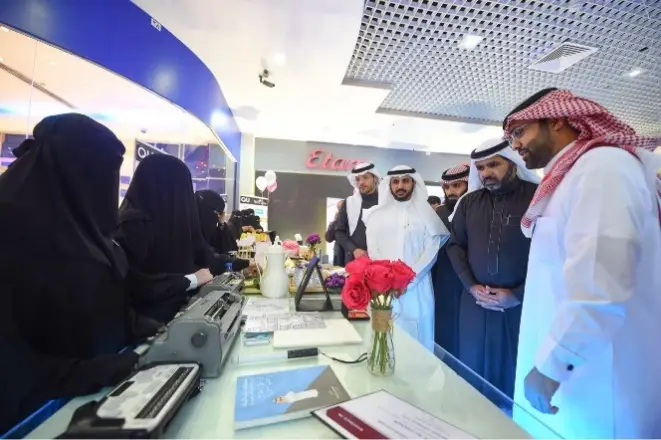
The College of Education, represented by the Special Education Department, implemented an awareness and educational campaign under the slogan “With You and For You” last Thursday. The campaign was inaugurated by Dr. Ali Al-Seif, the Vice President for Educational Affairs, at the Athaim Mall complex in Buraidah. The aim of the campaign was to educate the community about the special educational and rehabilitative programs used with individuals with special needs. Participants in the campaign educated visitors about these programs, as well as how to support this group in all areas, especially in education, training, and employment. The campaign also aimed to introduce them to the community, promote the concept of integrating individuals with special needs into society, encourage their self-confidence and abilities, and enhance the capabilities of those working with individuals with special needs.
The campaign also included several stations, such as: a station on autism spectrum disorder, a station on giftedness and excellence, a station on learning disabilities, a station on intellectual disability, speech and language disorders, and visual impairment. Each station included a definition of the concept it represented, its causes, characteristics, diagnosis, and training and therapeutic programs. In addition, it provided guidance for parents on how to deal with individuals with special needs. There was also a special station for providing consultations to mothers of children with special needs. Visually impaired students from the education department attended and presented some of their work to the attendees.
Under the auspices of the Emir of Al-Qassim, the university and the Education Department sign an agreement to strengthen partnership and exchange expertise between them.
Click this link [4]
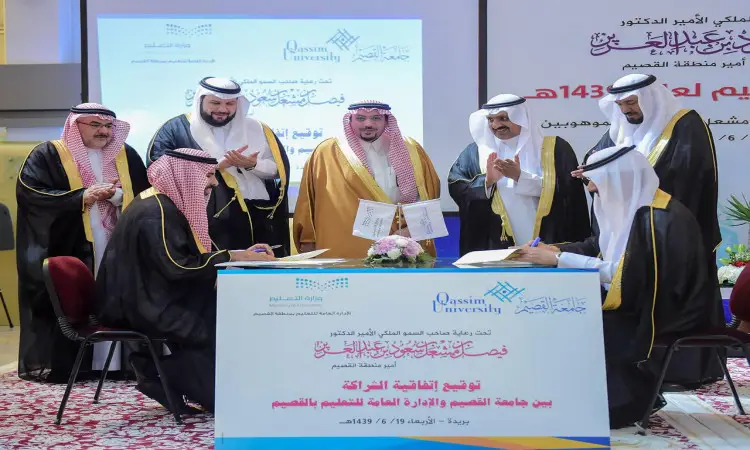
Qassim University signed a joint cooperation agreement with the General Administration of Education in Qassim region, in the presence of His Royal Highness Prince Dr. Faisal bin Meshal bin Saud, Governor of Qassim region. The agreement aims to strengthen the ties of work and partnership between the two entities, exchange expertise and means to develop the educational process, and enhance students' skills, activities, and programs. Additionally, it will focus on caring for gifted students, utilizing youth time, activating scientific research, and identifying cooperation mechanisms and their implementation between them.
This agreement, signed by Dr. Ali Al-Saif, Vice President for Academic Affairs, on behalf of the university, and Mr. Abdullah bin Ibrahim Al-Rakyan, Director General of Education in the Qassim region, on behalf of the Directorate of Education, comes in line with the directives of His Highness the Governor of the Qassim region, regarding the integration of efforts and strengthening cooperation and partnership relations between various development entities in the region, and in support of cooperation and partnership relations between the university and the General Directorate of Education in the Qassim region.
The two parties signing the agreement aspire to achieve their common goals, which are to build the student's Islamic, national, and intellectual character, cognitively, skillfully, and ethically, and to work on strengthening national loyalty and belonging and consolidating correct concepts among male and female students. In addition to providing advanced and accredited education to prepare fully qualified competencies that meet the needs of the labor market, supporting sustainable development programs and projects in the Qassim region, and contributing to building a knowledge society.
The agreement also aims to provide distinguished community services and applied research that elevates the local community and contributes to building a knowledge-based economy. This will be achieved by utilizing the latest administrative, technical, and informational methods, and by contributing to community service through training and continuous education. It also aims to consolidate concepts of sustainable development, environmental preservation, and information literacy, in addition to making various information resources available for sound educational, research, and applied purposes, especially those related to community issues. This includes the building, development, and maintenance of those resources.
Dr. Ali Al-Seif, the University's Vice President for Academic Affairs, affirmed that this agreement is expected to enhance cooperation between the General Administration of Education in Qassim, and the university's colleges and deanships, in the areas of public lectures, seminars, specialized training programs, and specialized scientific research and studies, participating in the implementation of special programs for people with special needs, and encouraging scientific studies and research in these fields.
Al-Saif added that this agreement will establish joint working groups between the two entities, hold workshops, meetings, and visits as needed for joint programs and activities, and provide mutual facilitation from both parties to achieve the optimal environment for implementing joint programs and activities.
A university graduate overcomes disability, and His Highness the Prince of Qassim includes her in the "Sisters of Men" award, and His Excellency the President of the university directs her admission to postgraduate studies.
Click this link [5]
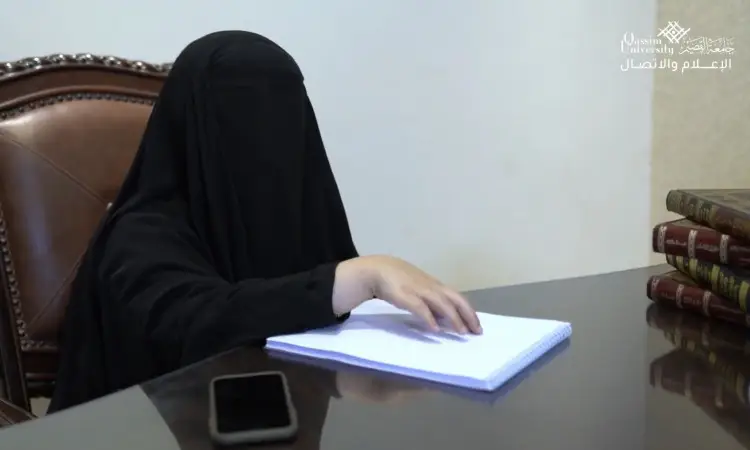
She lost her sight, but not her insight, her passion for life and excellence, her love of knowledge, her eagerness to learn, and her desire to dive into life, challenging all the difficulties she faced. She overcame her visual impairment at first, then she moved step by step towards achieving her ambitions, which are no less than those of her healthy peers, and even excelled them with determination, perseverance, and conquering challenges.
She is the visually impaired student, Jihan Mohammed Al-Majdal, one of the graduates of the eighteenth batch from the university. She graduated with honors from the Islamic Sharia specialization at the university, relying on her abilities, self-confidence, and skill in using modern technology, adapting it to suit her needs and health condition, which enabled her to excel and succeed in all her academic stages.
Graduate “Jihan” presented a role model of perseverance and determination that our dear kingdom possesses. She is one of the daughters of this giving nation, whose wise government – may God protect it – supports all its citizens, especially those with special needs, who receive state care and attention to help them achieve their ambitions and aspirations.
From this perspective, His Royal Highness Prince Dr. Faisal bin Mishaal bin Saud bin Abdulaziz, Governor of Al-Qassim Region, upon hearing and seeing the story of the blind graduate “Jihan,” while he was graciously sponsoring the graduation ceremony of the eighteenth batch at the university, hastened to announce the inclusion of “Jihan” in the "Shaqaiq Al-Rijal" (Sisters of Men) Award of the Al-Qassim Region Emirate, wishing her to be among its winners, God willing. He also announced that a mechanism would be sought to benefit from her in the judging committee, as she is an honorable example.
His Highness said: “We thank God that we have found among our sons those who are armed with faith in God Almighty, and possess this will, determination, and self-reliance. Congratulations to the nation for having such examples of distinguished students in the Qassim region and throughout the Kingdom.”.
From his side, His Excellency Professor Dr. Abdulrahman bin Hamad Al-Dawood, President of the University, announced the acceptance of graduate Jihan Al-Majedil into the postgraduate program in appreciation of her struggle and excellence, and for being one of the honorable role models from the university.
Maps and Directions

Click this link [6]
Accessible parking map
The Deanship of Student Affairs at the university is organizing the “Pioneers for People with Disabilities” program.”
Click this link [7]
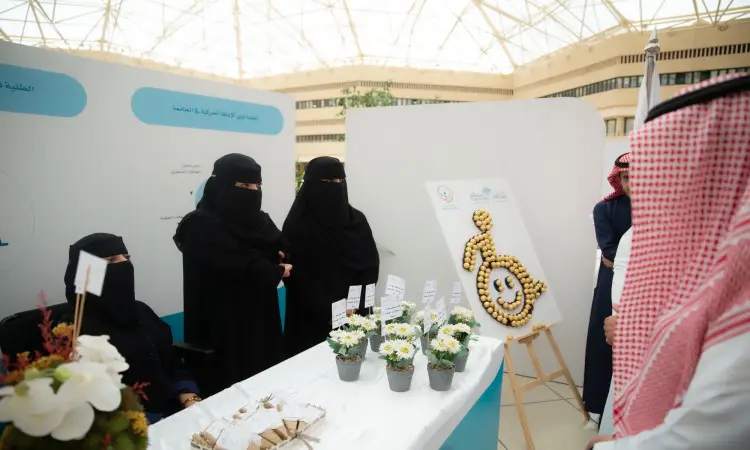
International Day of Persons with Disabilities, where the program included the organization of several events consisting of an exhibition, workshops, and consultations, in the main atrium of the university city, in the presence of His Excellency the Vice President of the University for Educational Affairs, Dr. Mohammed Al-Shargi.
The exhibition showcased the Kingdom's efforts to support people with disabilities, as well as the university's efforts in this area by preparing infrastructure and facilitating their access to services. The university established a permanent committee for the care of people with disabilities, in addition to providing them with advisory and guidance support. It also coordinates with colleges and deanships to provide the necessary support for these students, offers academic guidance and support, and facilitates communication with external entities.
The role of the Standing Committee for the Care of Persons with Disabilities at the university was also reviewed. This committee is responsible for considering the social, psychological, and academic problems faced by persons with disabilities, helping them find appropriate solutions, and creating opportunities for them to express their talents and develop their abilities to empower them to make informed decisions. It also oversees the referral of severe cases to the relevant authorities, identifies necessary infrastructure development projects at the university to accommodate persons with disabilities, and organizes activities and programs for persons with disabilities through participation in various events.
It is reported that the number of male and female students with disabilities studying at the university is 272 students in various colleges, including 150 male and female students with mobility disabilities, 86 male and female students with visual impairments, in addition to 36 male and female students with hearing impairments.
The university holds several meetings as part of the virtual «Himam» program on the occasion of the International Day of Persons with Disabilities.
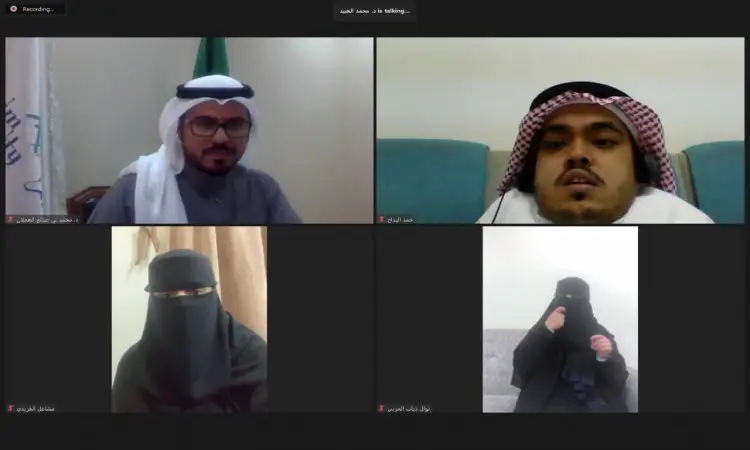
Click this link [8]
The university, represented by the Deanship of Student Affairs, organized several scientific meetings within the virtual program held on the occasion of the International Day of Persons with Disabilities, titled «Aspirations.» This event was held in collaboration with the Special Education Department of the College of Education on Thursday, 18/4/1442 AH. The program included several virtual meetings that addressed various aspects of the academic lives of students with disabilities, and showcased some of their university experiences and academic excellence in successfully completing their university studies.
The first meeting, titled “People with Disabilities in the University Environment,” was presented by Dr. Mohammed Al-Ajlan, Chairman of the Standing Committee for the Care of People with Disabilities at the University and Dean of Student Affairs, and Dr. Mohammed Al-Obeid, a member of the committee and Head of the Special Education Department. The meeting discussed several axes, including: preparation in the university environment, assistive educational services, and support services.
The second meeting, titled “Student Insights,” with a group of university students with disabilities, addressed several topics: the experiences of students with disabilities at the university (the deaf, those with mobility impairments, and the visually impaired).
The third and final meeting, titled “Global Trends in Disability,” was held and presented by Dr. Dheeb Al-Mutairi, Associate Professor of Special Education in the Department of Special Education. He spoke about universal access, support, and inclusion for persons with disabilities.
References
[1] [Online]. Available: .Click this link
[2] [Online]. Available: .Student Guide
[3] [Online]. Available: .Click this link
[4] [Online]. Available: .Click this link
[5] [Online]. Available: .Click this link
[6] [Online]. Available: .Click this link
[7] [Online]. Available: .Click this link
[8] [Online]. Available: .Click this link
- Regarding Goal 10
- Programs for Underrepresented Groups
- Expand reach and attract underrepresented groups in the university community
- Diversity Officer or Committee at the University
- Enhance support for underrepresented groups through mentorship and fellowship programs.
- Facilities for people with disabilities
- Disability Support Services
- Disability Access Facilitation Program