 Official government website of the Government of the Kingdom of Saudi Arabia




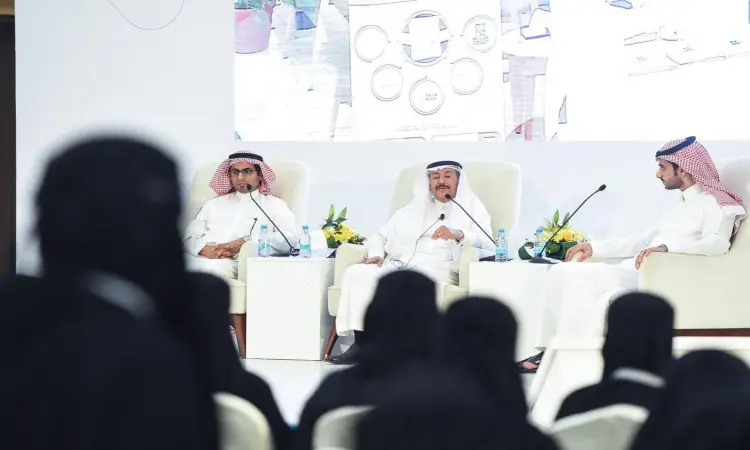
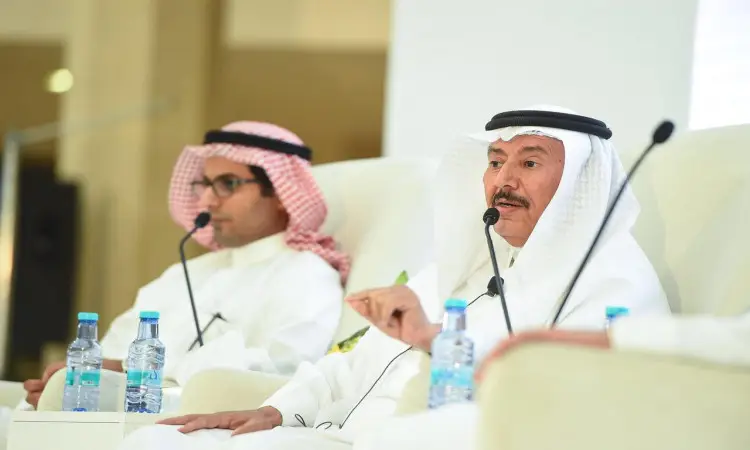

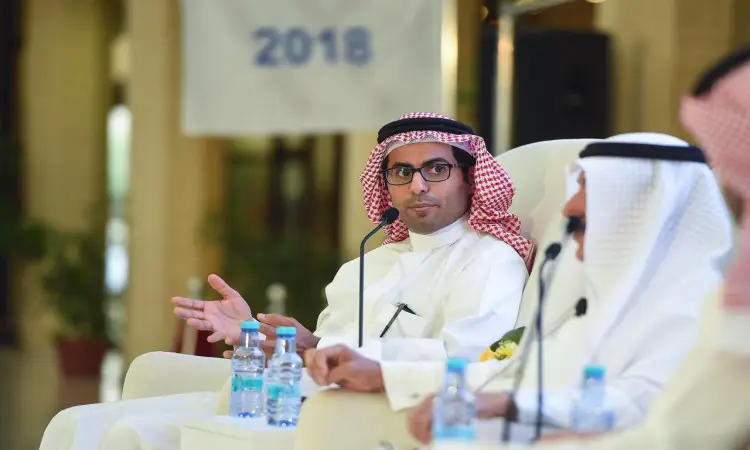
The university held a session titled "Success Chats"This took place on Tuesday evening, corresponding to 1/8/1439 AH, in the main foyer, as part of the tenth Career Day activities hosted by the university. The session was moderated by the General Supervisor of the Media and Communication Center and Head of the Career Day Media Committee, Mr. Fahad bin Noumah. Mr. Saud Al-Muhaimid, Chairman of the Board of Directors of Saud Al-Muhaimid Group, presented "Fan Jin Kayf," and Mr. Adel Al-Ghamdi, CEO of "YEM Technology," shared their successful experiences during the session. The seminar was also attended by a large audience from both male and female attendees.
Al-Mahamid presented the steps for establishing his own project, which is the "Fan Gin Cave" cafe, whose idea emerged ten years ago from the desire to create a project that keeps pace with modern changes for youth and is distinguished by its product and classification. He pointed out that any commercial business is subject to economic recession because it is subject to supply and demand, which is known to merchants around the world. He said: "Youth must realize this and weigh matters appropriately, and it is important to focus on the product. There are well-known companies whose lineage has continued from grandfathers to sons because of their product's excellence. Youth must be patient, as I lived in the cafe for 3 years without financial profit.".
Regarding the reason for its continuity over the years, "Al-Muhaymid" confirmed that the project aimed to understand the nature of society. He explained that a project owner should not expect immediate success and that the first three, four, or eight months are where their gain and benefit lie. Our society enjoys experimentation, and after a period, customers who love the product offered become apparent. This then becomes the metric that is important to continue measuring to increase sales.
Al-Mahamid affirmed that Saudi youth are capable of overcoming difficulties, are competent for work, and always win bets. This has been proven within our company despite tight deadlines, the abundance of Saudization, and its difficulties. Now we see them as branch, restaurant, and cafe managers, and soon as regional managers, then company managers, and engaging in the training field.
"Al-Mahamid" explained that the "food truck" project is positive in all aspects. It gives young people the freedom to choose their preferred location and move it without paying rent for a shop. This aligns with the financial capabilities of young people who want to start a small business. Furthermore, this project is low-risk and profitable. He called on companies and businessmen not to invest in this field and to leave it for the youth, supporting them and not competing with them. This is a source of livelihood for the nation's youth, and companies can benefit by selling and exporting materials to them.
Professor Adel Al-Ghamdi, CEO of "Yem Technology," spoke about his experience, having worked in the private sector, then the government sector, and then moving to his private sector venture. He said: "Initially, I set aside a personal sum of money to support my family in case of any interruption in income for a year, as the capital for my private project is about 120,000 riyals. We lived through difficult first 6 months because no clients came to us, and our work was purely introductory. We focused on building electronic infrastructure for companies, servers, networks, and security systems. We couldn't compete as we were new to the market. The first 3 months passed without any clients, while employee salaries and shop rent were ongoing, and we incurred losses because technology work is project-based, not product sales, until we started working on parts of projects and took off. It is important for young people to forget and discard the idea of an eight-hour workday and seriously consider working 18 hours.".
Regarding financial crises, Al-Ghamdi revealed that they offer a technological product and solutions, not a product that can be liquidated. As for his beginnings, he confirmed that he initially faced slowness in completing projects and some partners complained and sold their shares. He added that he repeatedly said during meetings that the project was beginning to grow and that he was waiting for the results, and he asked for a six-month grace period, but the partners refused, and a settlement was reached by buying their shares in the company.
Al-Ghamdi emphasized that the Saudi woman is sometimes more competent than the Saudi man and has many advantages in the field of technology, the most important of which is the application of the Ministry of Labor's agreement for remote work. This reduces operating costs for companies, contributes to raising productivity, and lowers costs for women by not having to pay for transportation, especially since women often have no other obligations and are usually at home, and they excel in maintenance, programming, and customer service.
Al-Ghamdi urged e-commerce stores not to raise prices or exaggerate them, as this alienates society from this project and because the technical field is constantly growing, which leads to costs decreasing day by day. He called on young people to register their stores on the Ministry of Commerce's "Ma'rouf" program, in addition to registering with Social Development for protection during difficult circumstances, such as accidents. They will be supported, and upon retirement, they will receive a monthly stipend. These opportunities must be seized.
At the end of the session, the head of the media committee, Mr. Fahd bin Nuwma, directed a message to the attendees not to use job security as an excuse for not working in the private sector and being creative. He emphasized that individuals prove their worth for the work they do, and age is not an obstacle. He pointed out that no company will abandon someone who possesses the distinguished required qualifications. He urged young people not to use this excuse to seek government jobs, as the coming period will witness a new term: "productivity," in accordance with Vision 2030. If a person is not productive, they will not be needed.

