 Official government website of the Government of the Kingdom of Saudi Arabia




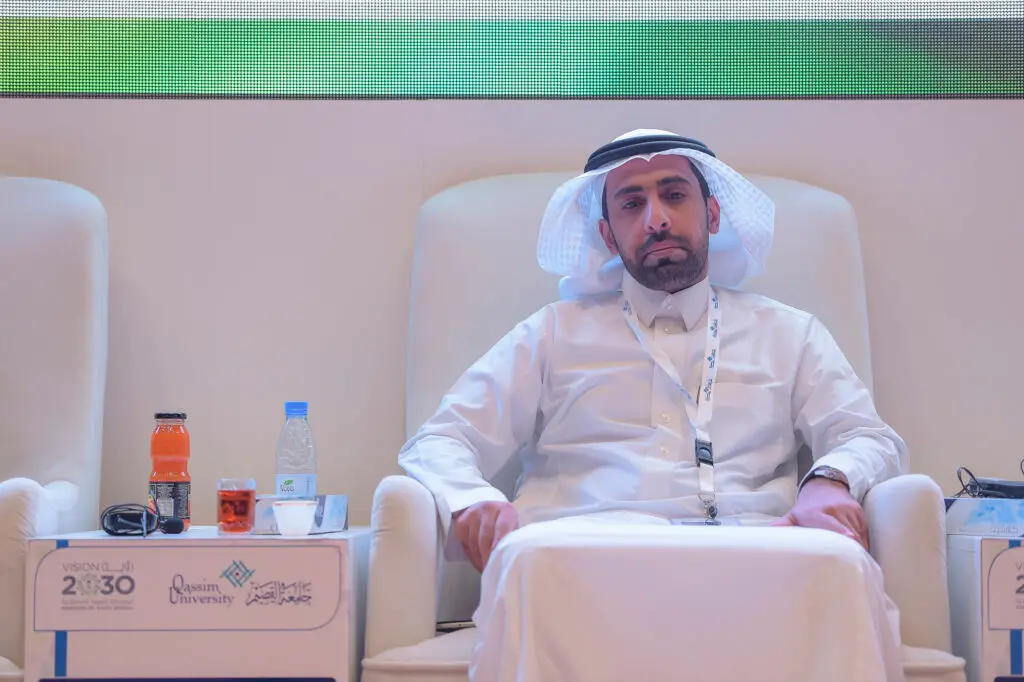
During the conference on the role of universities in activating Vision 2030
Discussing the importance of improving the educational environment and working to bridge the gap between higher education outcomes and the demands of the labor market
Media and Communication Center:
Participants in the "Role of the Saudi University in Activating Vision 2030" conference, which concluded at Qassim University last week, discussed a study
"University application requirements for strategic management to achieve Vision 2030, in the session chaired by Asma bint Saleh Al-Amro, Dean of the College of Science and Arts in Ri'ad Al-Khabara Governorate at Qassim University, with the participation of Dr. Khaled bin Abdulaziz Al-Shamelan from the Saudi Management Association, and Al-Jawhara bint Suleiman Al-Fawzan from King Saud University. The session aimed to identify the most prominent features of strategic management requirements with their dimensions, which are: (revising university strategies and analyzing available alternatives, applying and implementing the strategic plan, periodic monitoring and evaluation of the strategic plan), as well as identifying the most prominent features of strategic management requirements stemming from the Kingdom's Vision 2030 related to its administrative and educational dimensions.
The descriptive survey method was used in this study. The sample consisted of (287) members of the Saudi Management Association. The study reached several conclusions, including that the requirements for strategic management received a high degree of importance in all its dimensions to keep pace with Vision 2030. Members of the Saudi Management Association also see the importance of administrative and educational requirements for those responsible for strategic management in Saudi universities to ensure the achievement of the Kingdom's Vision 2030. They also emphasized the importance of information systems that facilitate decision-making for those responsible for strategic management in Saudi universities, with attention to the availability of knowledge in strategic management processes in accordance with Vision 2030, and working to bridge the gap between higher education outputs and labor market requirements, and the importance of improving the educational environment that stimulates creativity and innovation in Saudi universities.
Dr. Raghadah Mohammed Al-Atyawi, a professor at Qassim University Analytical studyFor some dimensions in the strategic plan of Qassim University in light of the Kingdom's Vision 2030, the study reviewed the basic concepts and some experiences in strategic planning in universities. It also reviewed the components of the strategic plan of Qassim University, explained the methodology used in its preparation, and clarified its distinguishing features and how it can contribute to achieving the Kingdom's Vision 2030, enhancing its developmental role, and improving its outputs and services in light of the highest quality standards in higher education.
The session also discussed a research paper titled "University Governance in the Kingdom of Saudi Arabia to Achieve Vision 2030." The paper was presented by Dr. Noura bint Munayye' bin Abdul Karim Al-Munayya' and Dr. Tahani bint Mohammed bin Nasser Al-Khunaijan from Imam Mohammad Ibn Saud Islamic University. The study recommended, among other things: enacting more laws and legislative regulations, forming a legislative council under the name "University Board of Trustees," establishing a consultative center named "Academic Governance Center," focusing on internal supervision and control systems, appointing a competent and ethical external auditor for the university, and activating a proposal for structuring internal and external accountability, audit, and evaluation committees. The study also recommended eliminating routine and bureaucracy in universities by improving work procedures, which means re-engineering university processes to meet the needs and satisfaction of students and the public. Furthermore, it recommended developing legislation that ensures the genuine independence of universities and promoting a culture of governance.
Dr. Al-Jawhara bint Sulaiman Al-Fouzan from King Saud University presented a research paper titled "A Proposed Framework for Activating the Governance of Saudi Universities to Achieve Vision 2030." The paper recommended enhancing the effectiveness of universities and increasing their internal and external efficiency by creating a conducive work environment, achieving transparency through clear mechanisms and frameworks, enabling employees to fully perform their duties, and ensuring fairness and equality based on competence and merit among university staff to achieve high performance from all affiliates, guaranteeing their rights and interests. It also recommended enhancing the participation of all university affiliates, including faculty members, researchers, administrators, and students, in decision-making processes, and strengthening competitiveness in task performance, thereby securing advanced positions in international rankings. This is a key tool in achieving the requirements of Vision 2030.

