 Official government website of the Government of the Kingdom of Saudi Arabia




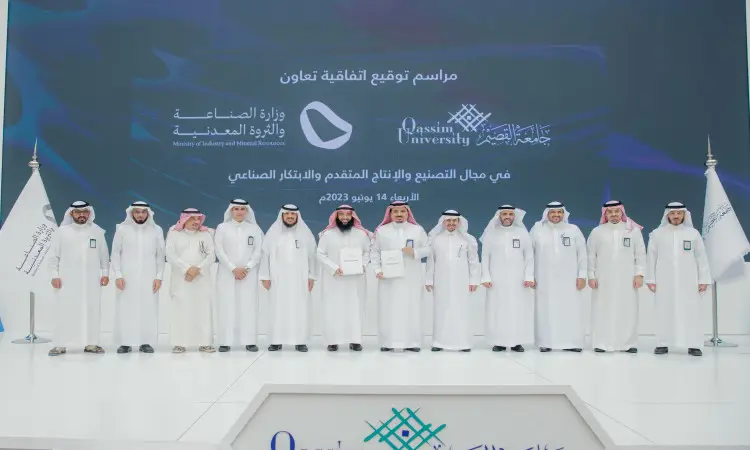
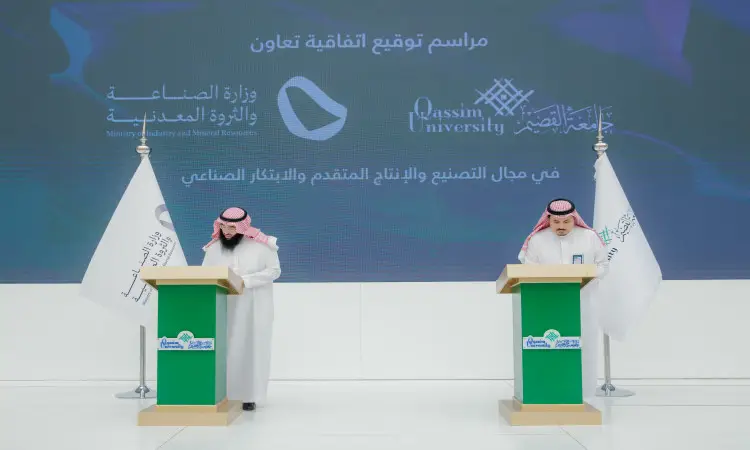
His Excellency Professor Dr. Abdulrahman bin Hamad Al-Dawood, President of the University, and His Excellency the Deputy Minister of Industry and Mineral Resources, Eng. Osama bin Abdulaziz Al-Zamil, signed a cooperation agreement today, Wednesday, 25/11/1444 AH, between the Ministry of Industry and Mineral Resources and Qassim University. This agreement is for the establishment and construction of an advanced production and innovation factory on university lands. The signing was attended by His Excellency the Vice President of the University, Dr. Mohammed bin Abdulrahman Al-Saoui, His Excellency the Vice President for Postgraduate Studies and Scientific Research, Dr. Mohammed bin Fahad Al-Sharakh, His Excellency the Vice President for Planning, Development, and Quality, Professor Dr. Khalid bin Bani Al-Harbi, His Excellency the Vice President for Academic Affairs, Dr. Fahad bin Suleiman Al-Ahmad, and a number of deans from the relevant faculties.
This agreement aims to establish an advanced production and innovation factory at the university, train university staff through on-the-job training, and stimulate research, development, innovation, and invention by encouraging the factory to collaborate with relevant university entities. Both parties seek to cooperate in advanced manufacturing, production, and industrial innovation, which are fundamental pillars for contributing to the industrial realization of the Kingdom's Vision 2030. These areas contribute to increasing the industrial sector's contribution to GDP, creating jobs, and increasing the volume of non-oil exports to achieve sustainable development, diversify income sources, and contribute to improving competitiveness and innovation indices, by focusing on industry as a strategic choice.
Areas of cooperation between the two parties, according to the provisions of this agreement, include: activating the "Rafed" program, which is concerned with establishing and building advanced production and innovation factories on university land, setting the necessary standards for granting investors industrial licenses to establish industrial projects within the Rafed program, as well as designing incentives and support services for the program, in addition to setting performance indicators for the program in the cooperation area between the two parties, and training university staff.
This agreement also contributes to stimulating research, development, innovation, and invention by encouraging the factory, in cooperation with the relevant university entities, to leverage the expertise of both parties in operating the program. This includes developing new academic programs or enhancing existing ones that support the objective, attracting professional and academic partners with expertise to transfer knowledge and enrich the program, and establishing and activating scientific research and innovation plans in advanced manufacturing fields. Furthermore, it supports cooperation and partnership with global partners in both academic and commercial sectors who are leaders in advanced manufacturing technologies through the program. This involves considering the connection of faculty members and postgraduate students with industrial establishments and expertise houses to conduct studies and support industrial research for improving factory operational efficiency and implementing advanced manufacturing solutions.
