 Official government website of the Government of the Kingdom of Saudi Arabia




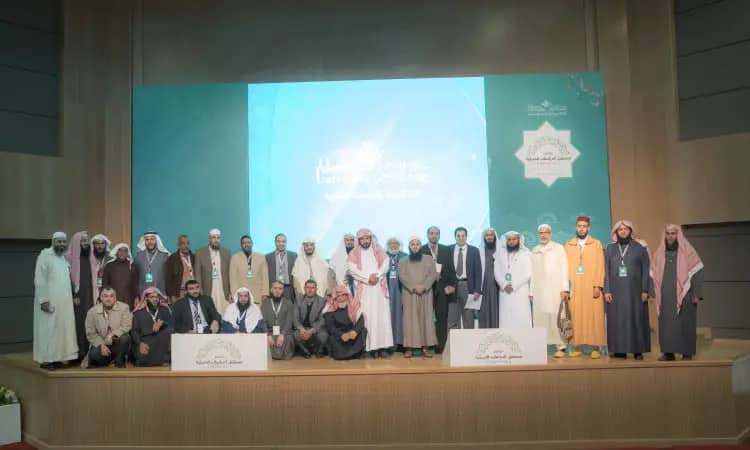
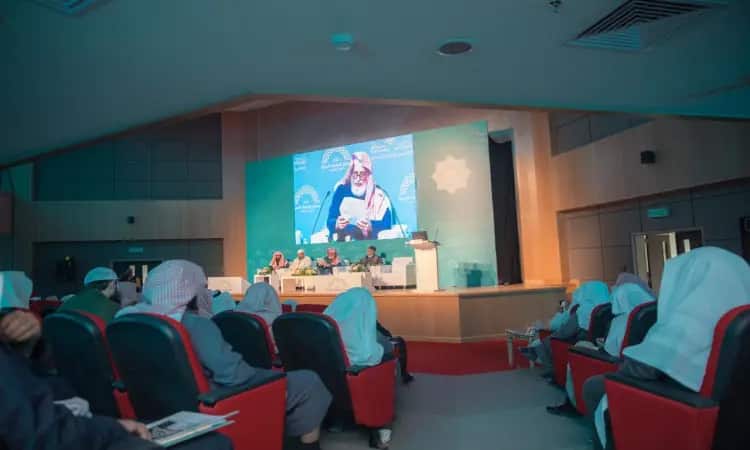
The University, represented by the College of Shari`ah and Islamic Studies, issued the recommendations resulting from the scientific sessions held at the International Scientific Conference on the Future of Hadith Studies in the Prophetic Sunnah, which was held on Tuesday and Wednesday, 9-10/5/1440 A.H., at the University Clinics Theater in Al-Malidah, under the title "The Future of Hadith Studies. The participants presented 46 recommendations at the conclusion of the conference, and the recommendations were as follows:
1. Developing a directory of research topics in Hadith and its sciences that still need further research and study, supervised by a specialized scientific body to invest the efforts of researchers in universities and research centers to implement them to develop Hadith studies.
2 - Opening new fields for contemporary scientific research in the Prophetic Hadith through openness to the sciences of the era to achieve communication, education, and scientific cross-fertilization.
3 - The need to direct researchers to terminological research that envisages the terminological methodology through the study of terms and the historical development of their meanings, applications, relationships and issues in the system of modern concepts.
4 - The need to single out some of the nuances of Isnad, so that the genre is reviewed by a broad study that tries to highlight its importance and its relevance to issues of narration, narrators, and anomalies.
5 - Continuing to provide training programs to meet the needs of students of Hadith, especially in the field of Hadith criticism and what is related to the work of the critical Imams to understand their words.
6 - The need to move from the theoretical aspect of training to the applied aspect.
7 - The need to use specialists in this field in preparing training programs to ensure the correct way to ensure the success of the training.
8 - The need to pay attention to the humanities in general and try to invest in their investigations to stabilize the legitimate text and transform them from a tool used by others to question the authenticity of the hadith narratives to a tool that can be used to prove the reliability of these narratives.
9 - Establishing a scientific research chair concerned with reconciling scientific facts with the established prophetic traditions. Its members will consist of a group of researchers interested in the Sunnah, empirical science, and linguists, and they will consider the problematic hadiths that are thought to conflict with one of them and issue a verdict according to the consideration of all.
10 - The need to confront doubts and challenges to the Sunnah through preventive and therapeutic means in an accelerated and attractive manner.
11. The importance of caring for Hadith fragments and developing strategies that correct the path towards them through: Spreading awareness of their importance and usefulness, taking care of scientific studies of them, developing and introducing publishing techniques through various fields, such as collecting parts with the same topic, building a database for them, collecting them in one parameter, arranging them alphabetically, collecting them on the masnids, supporting universities by authorizing them in master's and doctoral theses, and financially supporting their publication and printing.
12 - Working to link the Prophetic Hadith with other sciences in the light of contemporary theorizing of medicine, astronomy, psychology, education, sociology, ethics, management, economics, military science and other sciences, and highlighting its precedence in concepts that have an effective impact on cognitive and civilizational progress, and its superiority over many contemporary knowledge.
13 - Issuing an encyclopedia that includes all hadiths that are related to other sciences according to their contemporary concepts and terms, and then presenting them to specialists to benefit from them in formulating and controlling these sciences in the light of the directives contained in the Prophet's hadiths.
14 - The need for universities or faculties of Shari'ah and Sunnah departments to dedicate special departments for communicating the Book and Sunnah remotely, allocate trained cadres for this purpose, keep pace with the rapid technological development witnessed by the world, and revive the councils of hearing and reading Hadith in these electronic departments, and perhaps the pillars of community service will supervise this.
15 - The need to review and evaluate the development of studies in the Sunnah and the new developments in this chapter through writing, analyzing, and studying.
16. Higher education institutions should produce books on the terminology of hadith that are based on the laws of quality in principle and employ the wealth of modern information in both the historical and electronic aspects, and utilize the mechanisms of statistics in a way that does not affect the depth of knowledge, and does not turn quality into a quantitative issue.
17. Encouraging joint research between specialists in Sunnah, education and psychology.
18 - Paying attention to analytical studies of the hadiths to derive practical approaches to behavioral education.
19 - Holding training courses by the university for professors to train them to use the COOL strategy in the classroom.
20. Encouraging Shari'ah Colleges and Heads of Year Departments to encourage professors of modernized curriculum courses to use the self-scheduling strategy in teaching students to enable them to utilize their skills in directing the thinking and learning processes and taking personal responsibility in learning based on the principle of self-learning.
21 - Activating programs that specialize in teaching Hadith in an interactive electronic way through applications and distance education, and displaying them on websites in Arabic and English to facilitate the study and understanding of the science of Hadith.
22 - Working hard to start creating a large and comprehensive Hadith encyclopedia.
23 - Establishing a special endowment for Sunnah technology to expand the use of technology in the usual way and establish the production of smart technology in its comprehensive meaning.
24 - Creating an association or body that brings together influential Sunnah technology makers and those concerned with this subject in order to coordinate, integrate, communicate and support each other and stop the continuous bleeding of waste due to the absence of such coordination and integration.
25. Establishing research centers or chairs in universities for Sunnah technology to work on the subject in an organized academic manner.
26 - Sensitizing printing and publishing houses to the enormous tasks of publishing books and Hadith research by holding conferences and workshops.
27 - Establishing endowment centers for the Hadith book, considering contemporary Hadith research as its priority, and having two committees: a scientific committee with high efficiency and a publicity committee with effective activity.
28. Establishing local and regional chairs to set standards for journals and other research publishing journals and ensure high-quality, international, peer-reviewed publishing venues.
29 - Urge universities to have publishing houses that contribute to the publication of their students' research.
30. Utilizing general and special computerized encyclopedias on the Sunnah in creating research ideas needed by postgraduate students.
31. Urge universities to teach their students intensively the databases related to the Hadith to enable them to identify and categorize them.
32 - Conducting new statistical studies in the light of the five forward-looking dimensions (innovative, innovative, complementary, developmental, traditional applied, encyclopedic, and forward-looking).
33 - Establishing an encyclopedic digital center for the science of Hadith, linked to a website on the World Wide Web, so that digital information is close to readers to start interrogative studies.
34 - Establish an annual digital journal that provides access to all new research and studies.
35 - The need to take the reins of the Sharia scientific initiative from the jurists of the era and specialized researchers to consider hypothetical issues and anticipatory issues and ground them in the general texts of the Sharia.
36 - Advocating for facilitating the learning of Hadith and combining originality and ease by facilitating words and methods in accordance with the understanding of the people of the era.
37 - Hadiths must be protected from being abused by tamers and ignorant people by applying them to reality without conditions, rules, standards or controls.
38 - Taking care to print the books of the Sunnah, especially the seven books, and collecting them in one set, along with their strangeness as needed.
39 - Care should be taken to translate the approved books of the Sunnah, especially the seven books, into living languages.
40 - Careful use of media outlets to disseminate the Sunnah, such as satellite channels and audio-visual electronic programs and applications.
41 - The need to intensify studies on what was practiced according to the hadith in the era of the Companions in order to understand the contextual significance of the hadith in order to apply the correct one to the intended reality.
42. Encourage terminological studies of the Sunnah corpus because of its impact on the standardization of understanding the Sunnah and understanding the Prophet's intentions, may Allah bless him and grant him peace.
43. Urge lawyers, judges and jurists to pay attention to Hadith texts in order to maximize their use in the legal field.
44 - The need to teach a special course on Hadith texts and their legislative connotations to address the poor drafting of legal texts.
45. Encourage in-depth studies on thinking skills with the aim of employing them in understanding the Sunnah.
46 - The need to carry out serious linguistic studies on the linguistic term and meaning and to identify their characteristics and their role in indicating the legal purposes of the prophetic text because of their importance in deriving jurisprudential rulings.
