 Official government website of the Government of the Kingdom of Saudi Arabia




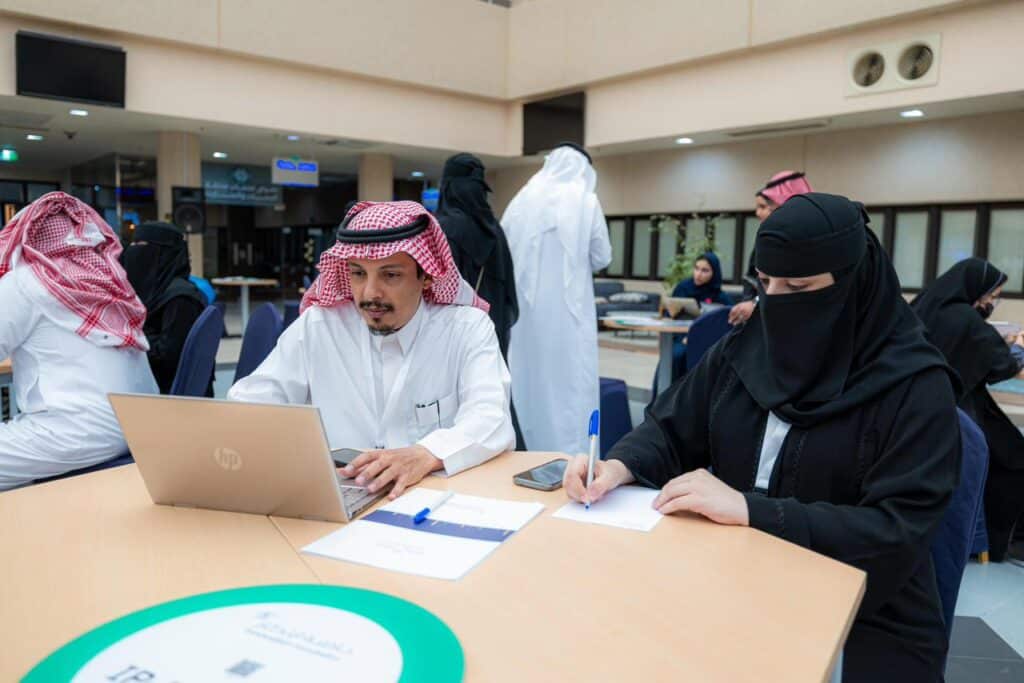
In a human experiment mixed with scientific passion, a couple participating in the fifth iteration of an innovation incubator, organized by the university, succeeded in transforming a health challenge facing thousands of families into a technological innovation with a humanitarian dimension. They jointly developed the “Smart System for Monitoring Children with Diabetes,” an innovation aimed at enhancing the quality of life for children with type 1 diabetes through smart clothing that monitors blood sugar levels in real-time and triggers immediate visual alerts when any disturbance occurs.
The innovation was co-developed by a university alumna, Dr. Raghad Abdullah Al-Attiyah, who specializes in the philosophy and production of clothing, along with her husband, Dr. Mohammed Saleh Al-Marzouqi, a faculty member at the College of Applied Sciences and a specialist in clinical chemistry. This endeavor was the fruit of the integration between their fields of expertise. Dr. Raghad contributed her experience in designing and producing smart clothing, while Dr. Al-Marzouqi utilized his medical and laboratory expertise to devise an innovative solution that addresses the daily challenges faced by families of children with diabetes, particularly the constant anxiety over sudden drops or spikes in blood sugar levels, especially during sleep, study, or in situations where continuous monitoring with traditional devices is difficult.
Innovation relies on integrating wearable technology with smart healthcare, through designing clothing equipped with sensor technologies and optical fibers that display immediate light signals, allowing for rapid intervention and reduction of potential health risks, in addition to providing psychological support for children through a practical product that makes them feel secure without the complexity of traditional medical devices.
This project was not just a research idea within the laboratory; it evolved into an international achievement after receiving the gold medal and a special award for excellence at the International Exhibition of Inventions and Innovations in Jeddah, reflecting the capability of local scientific research to provide innovative solutions to health issues that directly impact society.
The couple believes that innovation doesn't stop at the research idea, but rather holds promising opportunities for expansion towards commercial manufacturing and building partnerships with hospitals and organizations supporting medical technologies, a step that could make this smart solution a daily companion for diabetic children and their families.
