 Official government website of the Government of the Kingdom of Saudi Arabia




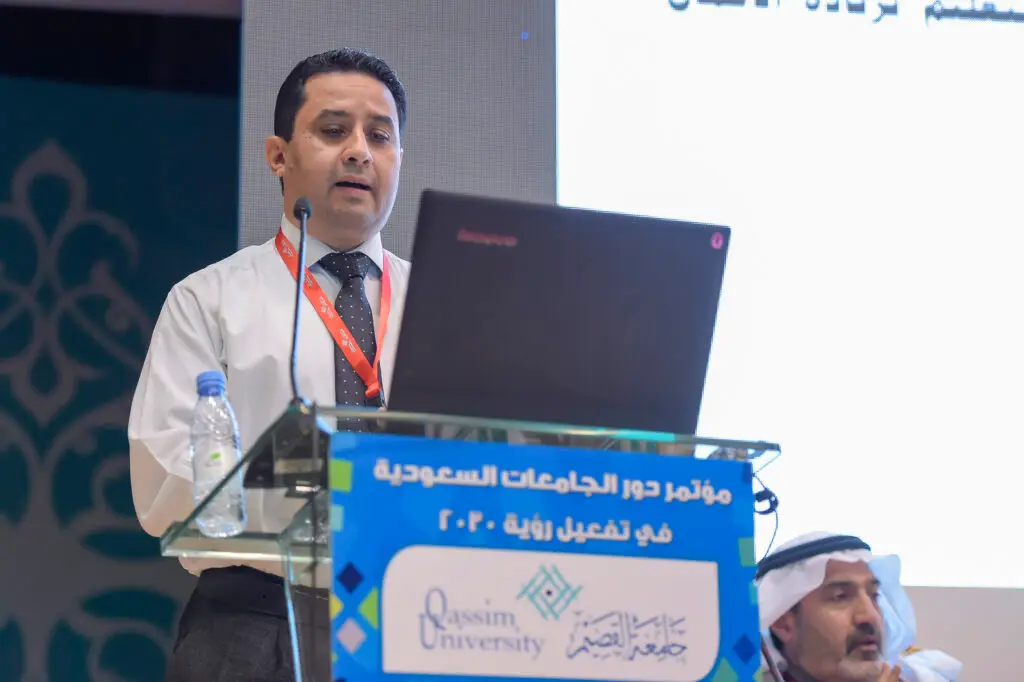
A call to activate community service and volunteer work in universities and expand vocational education.
Media and Communication Center:
Participants and researchers at the conference, which was held at the university last week under the theme "The Role of Saudi Universities in Activating Vision 2030," presented a vision regarding the necessity of activating the university's role in community service and voluntary work for Saudi society.,
During the session chaired by Dr. Awatif bint Ali Al-Saif, Dean of the Center for Studies AlClick this linkat the Qassim University for Girls, and Dr. Awatif bint Marzouq Al-Hazmi presented a research paper titled "A Proposed Vision for the Role of Saudi Universities in Activating the Vision in the Field of Volunteer Community Service." The paper addressed the volunteer fields offered by Saudi universities to the community and their obstacles. The researcher proposed some means and mechanisms necessary for activating and engaging Saudi universities in volunteer work and developed a proposed vision aimed at assisting Saudi universities in activating volunteer work, drawing from the Holy Quran and the noble Sunnah, and aligning with the nature of Saudi society.
Dr. Ahlam Hussein Al-Sadiq and Dr. Iqbal Mohammed Saleh Nasr from Imam Abdulrahman Bin Faisal University (formerly Dammam University) also called for expanding technical and vocational education alongside academic education. They stressed the necessity of changing teaching methods and curricula, striving for publication in peer-reviewed scientific journals, and developing a strategic plan for scientific research in universities with clearly defined priorities that contribute to solving societal problems.
Dr. Maha Mohamed Zaki Ali, a professor at Taif University, emphasized the importance of universities as pillars of the educational system in achieving a vibrant society and a prosperous economy. She outlined the steps to be taken in designing a knowledge management strategy and addressed the most significant problems and obstacles facing universities by implementing a knowledge management strategy to improve job performance, enhance service quality, and save time.
Dr. Fatima Ayed Fawaz Al-Salmi, a professor at King Saud University, presented a study on "The Role of Higher Education Institutions in Community Development from the Perspective of Faculty Members." The study demonstrated that faculty members' assessments of ways to activate the role of higher education institutions in community development were high. She recommended the necessity of consolidating efforts to achieve the desired deepening and continuity of the relationship between university institutions and local community institutions.
Researchers discussed global university rankings in a session chaired by Dr. Abdulrahman bin Hussein Al-Wazzan, Assistant Undersecretary of the Qassim Region. A research paper titled "The Unified Matrix for Global University Rankings and Strategic Starting Points for Activating the Vision," presented by Dr. Osama Ahmed Abdul Qadir, Professor at Imam Abdulrahman Bin Faisal University, was discussed. He developed a unified matrix comprising eleven criteria that help achieve an advanced global ranking among universities, in addition to proposing ten strategic starting points for building a global identity while preserving national constants.
Dr. Abdulmalik bin Taher Al-Makhlafi, a professor at King Saud University, presented a study on "Government Entrepreneurship Education and Its Role in Achieving Vision Goals." The study addressed weaknesses in the entrepreneurship education system in government universities, including a lack of focus on organizing field visits for students to entrepreneurial companies, the absence of sufficient courses to equip students with high entrepreneurial ability and spirit, the non-adoption of modern teaching methods for entrepreneurship, and the weak relationship between government universities and the entrepreneurial sector in the Kingdom.
A research paper prepared by Dr. Ali Mohammed Al-Shaeri, Dr. Hamid Abdul Jabbar Al-Alwani, Dr. Raed Abdul Rahman, Dr. Sahel Abdullah Waheeb, Dr. Al-Taher Azhar, and Dr. Mohammed Yousef, professors at Umm Al-Qura University, was also presented. The paper is titled "The Third Mission of Universities and Its Role in Enhancing the Vision and Defining the Features of Universities' Role Within It, and How to Develop Their Main Missions in Education and Training, Research in Knowledge and Technology Transfer and Localization, and in Supporting Innovation and Entrepreneurship, so as to Contribute to Building Intellectual Capital and Achieving the Requirements of Comprehensive Sustainable Development.".
As suggested by Dr. Abdulmohsen bin Hussein Al-Arfaj, a professor at King Faisal University, integrated professional standards for faculty members towards students in light of the vision should be established. This would include an initial list of practices based on the researcher's experience in the higher education sector, followed by developing the proposal based on meetings with a group of faculty members. Finally, it would be presented to deans of colleges and their deputies for academic affairs, as well as department heads and members of quality committees and curriculum development committees at King Faisal University.

