 Official government website of the Government of the Kingdom of Saudi Arabia




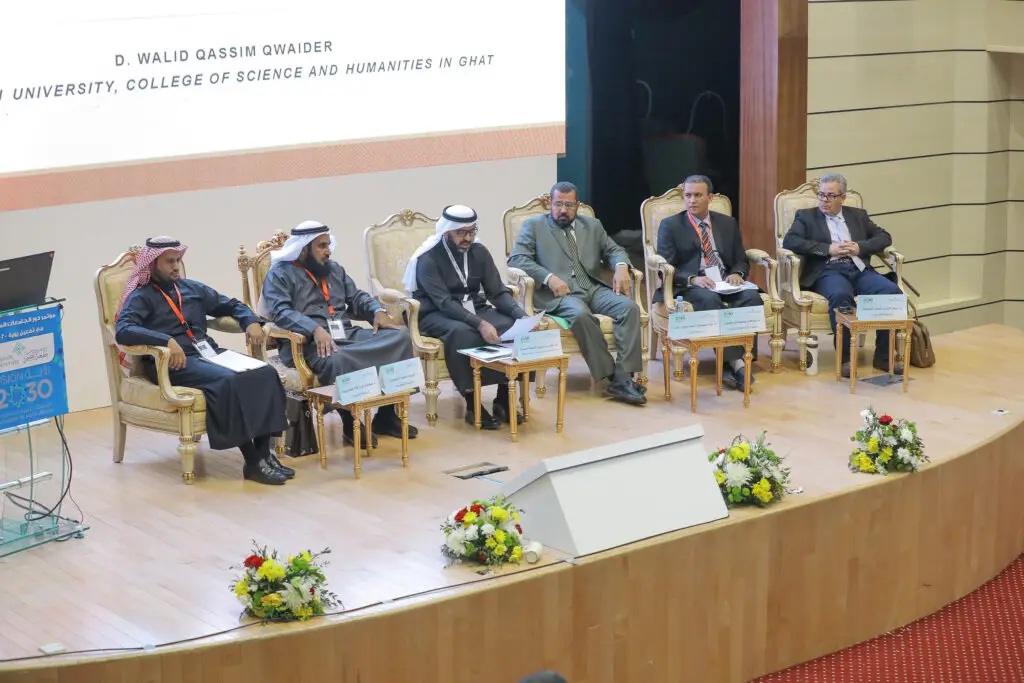
Conference on the Role of Universities in Activating Vision 2030 Calls for Increased Investment in Higher Education and Teacher Development
Media Contact Center:
Researchers and participants in the conference on the role of Saudi universities in activating Vision 2030, held at Qassim University, stressed the necessity of developing a "proposed vision for the outcomes of teacher preparation programs in light of the Kingdom of Saudi Arabia's Vision 2030." This came during a session chaired by Professor Dr. Ali bin Mohammed Al-Seif, Vice President of Qassim University for Academic Affairs. Dr. Ahmed bin Mohammed Al-Tuwaijri and Dr. Sultan bin Abdullah Al-Muhaymid from Qassim University presented a research paper on how to prepare teachers and develop their skills. The study's results, derived from data analyzed from focus groups, indicated that the experts involved in the study determined the relative weight of the outcomes for the teacher preparation programs for Sharia Sciences and English Language according to the integrative system. They assigned the highest percentage to the specialized aspect, followed by the professional aspect, then the cultural aspect. They also developed a vision for the outcomes of the Sharia Sciences teacher preparation program and a vision for the outcomes of the English Language teacher preparation program in light of Vision 2030's educational component. .
Dr. Abdul Mohsen Ahmed Mohammed Ali, from Najran University, presented a study on "Investing in Higher Education and Improving its Outcomes to Achieve the Goals of Vision 2030," focusing on private university education and its role in supplying the labor market with human resources, the concept of higher education outcomes, the importance of higher education outcomes, evaluating learning outcomes, planning methods for evaluating learning outcomes, a general framework for improving private higher education outcomes, procedural steps for improving and developing higher education learning outcomes, and a method for preparing targeted learning outcomes for academic programs.
The session discussed a research paper on "Insights into Some Economic and Social Dimensions of Economic Diversification in Light of Saudi Vision 2030," presented by Dr. Emad El-Deen Ahmed Al-Musabeh, Professor at Qassim University. This paper sought to emphasize the importance of economic diversification and the role of social factors as a necessary variable to support Saudi Vision 2030, which is one of its goals. The paper focused on the issue of social change and education, two intertwined variables that are interactively linked to the Vision. The paper also reviewed economic diversification indicators in the Kingdom to prove the hypothesis that the Saudi economy suffers from concentration in its GDP and exports. To this end, we developed an indicator we named the Economic Concentration Index, along with a set of recommendations that can be translated into practical programs.
Dr. Khalid Al-Johani and Dr. Mujahed Mohammed Abu Al-Fadl, professors at Al-Qassim Colleges, presented a research paper on "A Proposed Framework Based on Lifelong Learning to Bridge the Gap Between Higher Education Outcomes and Labor Market Requirements to Achieve the Goals of Vision 2030." The paper presents a proposed framework after it was reviewed by a group of specialized referees to assess its suitability. This framework is based on the role of Deanships of Community Service through three processes: planning, implementation, and evaluation. This clarifies the role of higher education institutions (Deanships of Community Service) in bridging the gap between higher education outcomes and labor market needs, thereby contributing to the achievement of the goals of Vision 2030.
