 Official government website of the Government of the Kingdom of Saudi Arabia




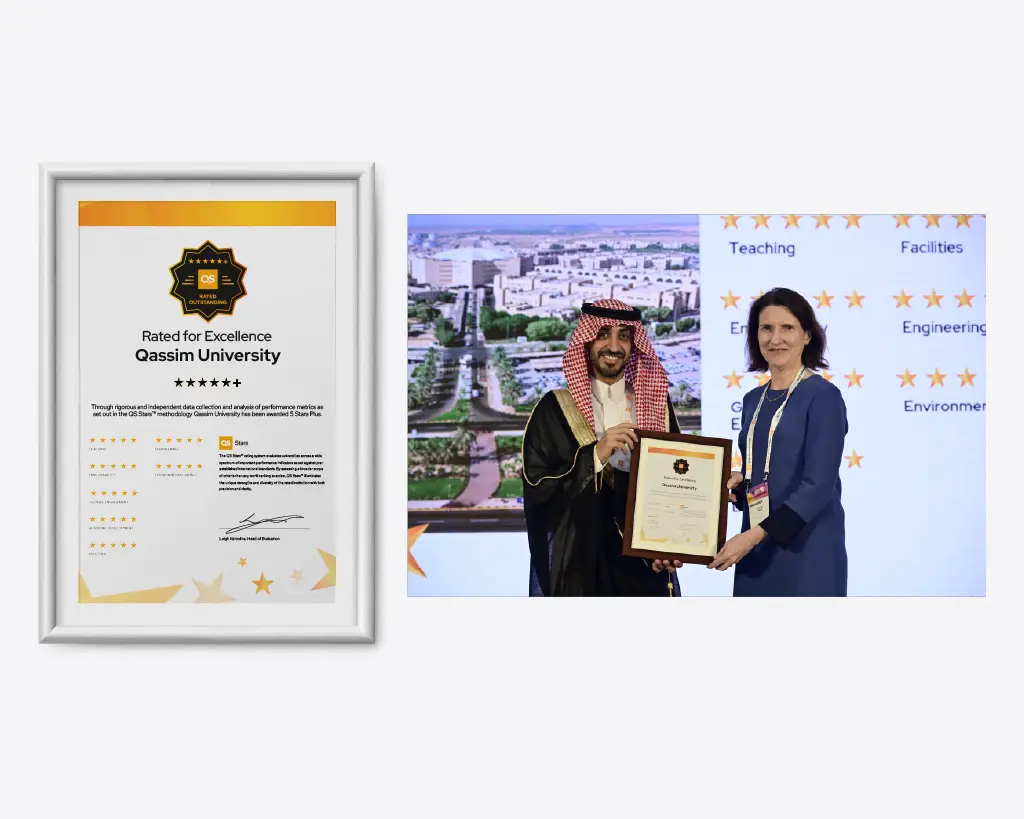
Al-Qassim University has achieved a new institutional milestone by obtaining the highest category (5 Stars Plus) in the QS Stars rating from the international QS organization, in recognition of its excellence in a number of academic, research, and institutional aspects, which reflect the quality of its programs and integrated institutional performance, making it the first Saudi university to receive this rating.
Comprehensive evaluation according to international standards
The university underwent rigorous and repeated evaluations according to QS Stars criteria, which encompass a wide range of academic areas such as quality of teaching, scientific research, graduate employability, innovation, social responsibility, and infrastructure. The evaluation was conducted by independent reviewers, through periodic reports issued by the QS organization, until the final assessment and accreditation of the results were achieved.
Continuous improvement in organizational performance
The University's Vice President for Business Development and Community Partnership, Dr. Majed Al-Anzi, explained that the university was able to achieve this advanced rating based on its distinguished institutional performance. In 2021, it received a (5-star) rating, before achieving the highest category this time, (5-star plus), which reflects continuity in developing academic, research, and administrative performance.
He added that this achievement represents international recognition of the university's institutional discipline and affirms its commitment to global academic quality standards. He pointed out that this qualitative assessment is a continuation of previous successes, as the university has previously obtained full institutional accreditation, in addition to many programmatic accreditations and national awards, which have strengthened its position in international academic rankings and improved its outcomes.
Positive implications for the university's competitiveness
This evaluation emphasizes the advanced position of Qassim University in the academic landscape, both locally and internationally. It represents a new step towards achieving its strategic goals in enhancing academic excellence, supporting scientific research, and raising the quality of education and its outcomes. This contributes to increasing the university's global competitiveness and solidifying its position among leading educational institutions.
