 Official government website of the Government of the Kingdom of Saudi Arabia




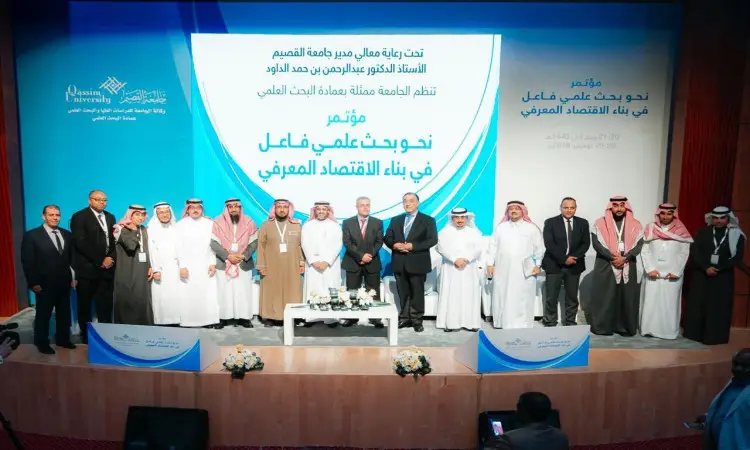
The conference "Towards Effective Scientific Research in Building the Knowledge Economy," organized by the university, concluded its work which lasted for two days, Wednesday and Thursday, corresponding to 3/20-21/1440 AH, at the university city campus in Al-Mulaida. Thirteen specialists from various universities and research centers inside and outside the Kingdom presented their research papers during the conference sessions, proposing many ideas contained in their research and studies, discussing their results, and how to develop scientific research in the Kingdom and benefit from its outputs in building a knowledge-based economy.
The conference sessions witnessed scientific discussions and dialogues between specialists, interested parties, and attendees to identify the best ways to connect researchers and scientists on the one hand, and officials and project owners on the other. It also addressed many ideas and proposals that may contribute to the development and progress of the Kingdom and the achievement of its Vision 2030. The sessions were as follows:
The first session, presided over by Dr. Mohamed Al-Saoui, Vice President of the university, began with his welcome to the conference participants, praying to God for its success, correctness, and guidance. He emphasized that the 20th century was called the century of industry, while the 21st century is undoubtedly the century of knowledge because its characteristic is built on knowledge. This means that future societies are built upon it. In the past, land, labor, and capital were the basis of the economy, but now a new element has entered, which is knowledge based on human resources and the development of the human element, based on creativity and intelligence.
During the session, the General Supervisor of the Research and Development Office at the Ministry of Education, Dr. Hisham bin Abdulaziz Al-Hadlaq, spoke about his scientific paper, titled "The Research and Development Program at the Ministry of Education and the Pioneering Role of Universities." He emphasized that the Ministry of Education has adopted an ambitious program aimed at supporting scientific research and development in universities. The session also covered introducing the mission and objectives of the Research and Development Program, and emphasized the coordination and integration between the government and private sectors and universities in the R&D ecosystem to achieve the Kingdom's Vision 2030. Challenges facing the R&D sector were reviewed, and success factors were highlighted through competition, adoption of priority national directions, performance management, and R&D funding to ensure success and sustainability of work.
For his part, Dr. Nasser bin Mohammed Al-Oqeili, Vice President of King Fahd University of Petroleum and Minerals for Graduate Studies and Scientific Research, presented his paper titled "University Research and Innovation and the Requirements for Creating a Knowledge-Based Economy in the Kingdom," noting that research and innovation are an urgent necessity for economic transformation and one of the most important ways that lead to economic transformations and an important factor in achieving the Kingdom's vision. This is because, when considering the economy based on traditional natural resources, it is observed that it usually relies on low-wage and low-skilled labor, and innovation areas appear isolated from industry and business, as well as the absence of effective communication between innovation areas. To achieve a prosperous economy with sustainable growth, initiatives based on academic-industrial cooperation should be undertaken, which would generate a knowledge environment based on innovation and creativity, multiply the gross domestic product, and reduce reliance on natural resources.
Al-Aqili pointed out that generating knowledge-based jobs and providing leadership with an adventurous entrepreneurial mindset would achieve a prosperous economy with sustainable growth. This is where the role of building an integrated national system for research and innovation comes in, which would contribute to transforming ideas into economic values and rescuing universities from the dilemma of research accumulation and their inability to justify expenditure on this research without linking it to the needs, requirements, and expectations of societies.
Dr. Ahmed bin Salem Al-Ameri, Vice President of King Saud University for Postgraduate Studies and Scientific Research, spoke about "The Role of Research and Development in Building and Enhancing the Knowledge Economy." During his presentation, he reviewed the concept and indicators of the knowledge economy, addressed the mechanisms for marketing research to build the knowledge economy, and provided examples of high-impact innovations in building the knowledge economy. He also highlighted the role of universities in building the knowledge economy and the importance of partnership between universities and industry in research, development, and technology transfer. The research also reviewed global experiences in adopting research, development, and innovation to build the knowledge economy, such as the Malaysian experience towards a knowledge economy driven by R&D and innovation, and the experience of MIT University and its contribution to building the American knowledge economy. The research also touched on the Kingdom of Saudi Arabia's position on the global map, the opportunities available to the Kingdom, strategic directions, as well as obstacles and challenges.
Several research papers were discussed in the second session, chaired by Dr. Ibrahim bin Saleh Al-Omr. Dr. Alam Al-Nour Othman, President of the Global Organization for Sustainable Development in Britain, spoke on the paper "Activating Scientific Research to Serve the Sustainable Knowledge Economy in the Kingdom of Saudi Arabia." He emphasized the necessity of enhancing the role of science, innovation, and research to achieve the seventeen Sustainable Development Goals of the 2030 Agenda for Sustainable Development. The presentation addressed the prominent and future role of higher education institutions in the Kingdom and how to develop their research to achieve the Kingdom's Vision 2030 and achieve knowledge-based sustainable development. He added that managing science, innovation, and research, and improving human capabilities to increase human and social capital, are success factors that have become of utmost importance in the process of competition between nations. Successful management of science, innovation, and research requires adopting new methods and approaches to keep pace with the challenges and opportunities of the new digital revolution and the knowledge-based sustainable economy.
Dr. Mohammed bin Abdullah Al Abbas, a member of the Shura Council, presented his paper titled "The Literature of the Knowledge Economy in the Kingdom Towards Building a Research Pathway." In it, he defined the knowledge economy as products and services that rely on knowledge-enhanced activities contributing to accelerating scientific and technological development, as well as rapid progress. Pro.
At the end of the second session, Dr. Muneef Rafeh Al-Zoubi, Director General of the Academy of Sciences in Jordan, spoke about his paper titled "Development and Leadership through Science, Technology, and Innovation in Arab Countries: Future Prospects." He stated that it highlights the current need, more than ever before, to focus on the science, technology, and innovation sector in Arab countries as a strategic sector with a pivotal role in achieving development policies, building a strong economy, and driving innovation and technological advancement. This also contributes to raising the competitiveness of Arab economic sectors, creating job opportunities for large numbers of university graduates, and ensuring the integration of Arab economies into regional and global circles.
As briefly addressed in the paper, a critical examination of the science, technology, and innovation ecosystem in Arab countries in terms of policies, institutions, and legislation, and then presents some recommendations that enable the decision-maker to launch appropriate initiatives to advance the science, technology, and innovation ecosystems for economic and social development and entrepreneurship in Arab countries.
The third session was chaired by Dr. Mohammed bin Abdulaziz Al-Dughairi, Director of the Center for Cooperation and Knowledge Exchange at Qassim University. Dr. Yousef bin Abdulaziz Al-Turki, Vice President of King Abdulaziz University for Higher Studies and Scientific Research, participated in it. The session, titled "Directing Scientific Research and Capacity Building towards the Knowledge Economy," stated that the knowledge economy is one of the most prominent concepts that have begun to spread widely in the third millennium. The knowledge economy often receives a large share within the economic activities of countries with advanced economic growth. However, the distinctive characteristic of this new economy remains the central position that knowledge and information occupy in wealth creation and economic production.
This research also included a case study of scientific research at King Abdulaziz University during the last five years, observing its extent of compatibility with the specifications of the knowledge economy, represented by peer-reviewed scientific publishing and patents, and the extent of the university's scientific research capability to compete in the knowledge economy and to compete with scientific research in developed countries or their emerging counterparts.
At the conclusion of the third session, Dr. Emad El-Din Ahmed Al-Masbah, Professor of Economics at Qassim University, spoke about "The Role of Human Capital and Total Factor Productivity in Promoting Economic Growth: A Comparative International Study." The study aimed to test for a direct relationship from human capital and total factor productivity to economic growth in a group of countries and the Kingdom of Saudi Arabia. The study used the ARDL method on data from 1950-2014. The results revealed a varying impact of human capital. In developed countries generally, there was no significant impact, unlike in emerging countries. In the Kingdom of Saudi Arabia, there was no relationship between human capital and economic growth. The study also showed that total productivity in all countries, except Egypt, had no impact. The study recommends continuing to accumulate human capital and directly integrate education outputs into the production process.
On the second and final day, the fourth session began, chaired by Dr. Nasser bin Mohammed Al-Aqeel, Vice President of King Fahd University of Petroleum and Minerals for Higher Studies and Scientific Research. In this session, Dr. Mahmoud bin Mohammed Saqr, President of the Academy of Scientific Research and Technology in Egypt, spoke about "Egypt's Vision 2030 and the Knowledge-Based Economy Methodology with a Case Study." He discussed how Egypt, with its Vision 2030, is moving towards a knowledge economy with positive efforts and steps accompanied by implementation plans at various levels to achieve the state's strategic goals in the areas of knowledge, innovation, and scientific research. This includes creating an encouraging and supportive environment for science, technology, and innovation, encouraging the application of scientific research outcomes, and deepening local manufacturing. The vision of the Ministry of Higher Education and Scientific Research, represented by the Academy of Scientific Research and Technology, has embarked on implementing plans to address several challenges related to empowering knowledge and innovation.
"Saqr" added that the Academy of Scientific Research and Technology seeks to support Egyptian human resources, considering them the basis of comprehensive development based on the knowledge economy, by developing the system of education, scientific research, and innovation. In light of these goals, the Academy offers a package of programs and activities aimed at supporting innovation and entrepreneurship to achieve economic growth based on knowledge and innovation. It is imperative to monitor and understand the reality and the changing challenges. Therefore, the establishment of the Egyptian Observatory for Science, Technology, and Innovation was an important step to diagnose the current situation. This presentation also mentioned successful examples, models, and experiences in establishing the knowledge-based economy in the Arab Republic of Egypt.
The session featured a presentation of a research paper by Dr. Muhammad bin Rafdan Al-Hajhouj, Director of the Center of Excellence for Research on Palms and Dates at King Faisal University, on "The Role of the Center of Excellence in Palm and Date Research in Developing Products from Palms, Dates, and Their Derivatives to Contribute to the Knowledge Economy." He explained that according to 2017 economic data, oil accounts for approximately 80% of Saudi Arabia’s gross national income, and since an economy based on a single resource may face challenges in the long term and is considered unsustainable, the Kingdom has sought to find other alternatives to diversify the economy, including a knowledge-based economy. It is noted that universities and research centers play an important role in contributing to the knowledge economy, Saudi Vision 2030 encourages universities and research centers to play a vital role in producing knowledge and transforming it into products that contribute to the Kingdom’s transition to a knowledge-based economy, thereby achieving economic growth independent ofon petroleum resources.
"Al-Hajhuj" explained that the Research Excellence Center for Palm Trees and Dates at King Faisal University has strived to increase the utilization of palm trees and dates and to create added value from them. Through this, the center has obtained numerous tangible and intangible products in past years, including: 21 products in several fields, such as pharmaceutical and medical fields like an antibiotic from dates, and a medical antiseptic gel from bioethanol derived from date palm biomass, in addition to date extracts for the prevention of liver cancer, and date extracts for the treatment of myocardial infarction, as well as food products from dates such as carbonated beverages, baker's yeast, bio-fortified yogurt, and others. Furthermore, in the field of palm tree pest control, this includes repellents for the red palm weevil, smart traps, and other light traps for controlling various insects, as well as products for water conservation.
Dr. Mohammed bin Abdulaziz Al-Duhairi, Director of the University's Center for International Cooperation and Knowledge Exchange, spoke about "The Promising Research Center's Experience in Biocontrol and Agricultural Information at Qassim University in the Knowledge Economy." He emphasized the Qassim University Promising Research Center's commitment since its establishment in 1432 AH to directing research projects through its research groups towards research that results in knowledge products that significantly contribute to sustainable agricultural development and environmental preservation in the Qassim region and other regions of the Kingdom. Researchers at the center have developed a number of promising products in the biological control of agricultural pests using safe and environmentally friendly methods that largely eliminate the need for chemical pesticides, which are harmful to the environment and public health.
Al-Dughairi pointed out that these biological products were obtained from the local environment and have proven their effectiveness on a laboratory and field scale and have completed the experimental stages. In addition, the center has focused on finding alternatives to chemical fertilization that play a prominent role in reducing reliance on the addition of chemical fertilizers, which their overuse leads to environmental pollution and the accumulation of some elements in plants at levels harmful to public health. These promising products require continued efforts to develop and test them on a wider scale and bring them to the final investment and marketing stage. He indicated that the promising products obtained by the center include bacterial biopesticides, a fungal biopesticide, the ladybug insect predator, the predatory mites (1 and 2), improved liquid compost, and biofertilizers. The center is still trying to find partners to develop and market its products so that the agricultural community in the region and other regions of the Kingdom can benefit from these products, and for the center to generate self-income from selling these products to ensure continued work on conducting innovative research that contributes to the knowledge economy of the Kingdom and to establish high-quality partnerships with international universities, specialized institutes, and research centers.
The final session of the conference was presided over by Dr. Khalid bin Abdulaziz Al-Sharida, Professor of Sociology at Qassim University. During the session, Dr. Hussein Mohammed Amer Al-Obeid, Associate Professor of Economics at King Khalid University, presented his paper titled "A Comparison of Technopole Models Enhancing the Knowledge-Based Economy in Europe's Rebelecs Region and Silicon Valley in America." His paper explained that since the end of the last century, a systematic industrial and commercial linkage has emerged to support the knowledge-based economy through three axes: research, manufacturing, and export. This linkage is evident in two geographically distant regions: Silicon Valley in California, USA, and the European "Rebelecs" region, which comprises four areas in four European countries. These areas are nominally linked through global marketing, positioning themselves as four engines for Europe: the Rhine region in Germany, Baden in France, the Lombardy region in Italy, and Catalonia in Spain.
These two regions have played a pivotal role in promoting the knowledge economy globally, with the American model – Silicon Valley – in the San Francisco Bay Area having emerged over the past four decades and leading the digital, technological, and information industries through a system of prominent companies such as Apple, Cisco, Microsoft, Google, Oracle, and others, which have created added value for national and institutional economies alike. Meanwhile, the "Republike" region has established a symbiotic relationship between industrial areas, research centers, and export channels to drive the knowledge-based economy to advanced competitive levels. It was confirmed that this scientific material for this topic has been prepared to present an analytical comparison of the most prominent features of these two models and how they can be utilized to support knowledge-based economies in developing countries and organizations, while shedding light on South Korea's experience in adopting the American model and Turkey's experience in adopting the European model.
Dr. Othman bin Zakaria Barnawi, Director of Yanbu Technical Institute at the Technical and Institutes Sector of the Royal Commission, then spoke about "The Role of Higher Education Institutions in the Kingdom of Saudi Arabia in the Era of the Knowledge Economy: Between Authenticity and Tradition," stating: In our current era, which is witnessing a major shift towards a knowledge-based economy, higher education institutions play a key role in producing and disseminating knowledge, and in building scientific research capabilities to achieve national development, in addition to laying the necessary foundations for economic prosperity and social integration. But what do we specifically know about the role that Saudi higher education institutions play in this era characterized by the knowledge-based economy? What are the roles that Saudi higher education institutions play in nation-building, and what about global expectations regarding the new liberal movement in our current era? And how do higher education institutions today view and celebrate research and development efforts, and how do they legitimize them?.
At the end of the session, Dr. Allam Al-Noor Othman, President of the World Organization for Sustainable Development in Britain, presented "Challenges and Opportunities for Saudi Universities to Activate the Knowledge Economy in Accordance with the Kingdom's Vision 2030." During the presentation, he discussed the important role of higher education institutions in helping Arab countries maximize the benefits of the knowledge-based economy. The presentation raises some questions, including: What is the role of Saudi higher education institutions in promoting economic and social development in the Kingdom? What are the main obstacles facing higher education institutions in the Kingdom and some other Arab countries? Are there governmental components in this process? What is the societal role in this process? How can these challenges and obstacles be addressed and overcome? What is the role that the presentation emphasized Saudi universities must play in facing the current reality and keeping pace with complex and rapid contemporary changes? Saudi and Arab universities must also absorb the youth of their societies and graduate cadres capable of seizing the opportunities offered by the knowledge-based economy.


