 Official government website of the Government of the Kingdom of Saudi Arabia




15
15. Life on Land

- About SDG 15
- Events about sustainable use of land
- Ethical sourcing policy
- Maintain and extend current ecosystems’ biodiversity
- Educational programmes on ecosystems
- Sustainable management of land for agriculture (educational outreach)
- Sustainable management of land for tourism (educational outreach)
- Policy on sustainable use, conservation, and restoration of land
- Monitoring IUCN and other conservation species (policies)
- Local biodiversity included in planning and development
- Collaboration for shared land ecosystems
- Water discharge guidelines and standards
- Policy on plastic waste reduction
- Policy waste disposal - hazardous materials
Related Content
SDG 15: LIFE ON LAND
Nurturing Biodiversity and Ecosystems: Qassim University’s Role in Advancing SDG 15 in Saudi Arabia
Sustainable Development Goal 15 (SDG 15) focuses on protecting, restoring, and promoting sustainable use of terrestrial ecosystems, forests, and biodiversity. This essay delves into Saudi Arabia’s endeavors to achieve SDG 15, with a specific emphasis on Qassim University’s contributions towards safeguarding land ecosystems and promoting biodiversity.
SDG 15 in Saudi Arabia
Saudi Arabia, endowed with diverse landscapes ranging from deserts to mountains, recognizes the significance of preserving its terrestrial ecosystems. The country has initiated various measures in alignment with SDG 15:
- Desertification Combat: Saudi Arabia has taken measures to combat desertification through afforestation projects, soil conservation efforts, and sustainable land management practices. These actions aim to mitigate the degradation of fertile land.
- Biodiversity Conservation: The nation has established protected areas to conserve its rich biodiversity, including rare and endangered species. These efforts contribute to maintaining ecological balance and promoting sustainable use of resources.
- Rangeland Management: Recognizing the importance of rangelands, Saudi Arabia has implemented policies and practices that support sustainable grazing and prevent overgrazing, helping to preserve fragile ecosystems.
- Wildlife Protection: The country has adopted measures to protect wildlife from poaching and illegal trade, thereby preserving biodiversity and contributing to the health of terrestrial ecosystems.
Qassim University Initiatives
Qassim University plays a crucial role in advancing SDG 15 through its commitment to protecting land ecosystems and promoting biodiversity:
- Research and Conservation: The university conducts research on local plant and animal species, their habitats, and the impacts of human activities on ecosystems. This knowledge informs conservation strategies and supports the sustainable management of natural resources.
- Restoration Projects: Qassim University participates in land restoration projects, including afforestation and reforestation initiatives. These projects contribute to enhancing ecosystem resilience and combating desertification.
- Educational Programs: Qassim University integrates environmental education into its curriculum, raising awareness among students about the importance of land conservation and biodiversity. This fosters a culture of responsible land use among future generations.
- Community Engagement: The university collaborates with local communities to promote sustainable land management practices. Through workshops and awareness campaigns, Qassim University empowers communities to take active roles in protecting their local ecosystems.
- Partnerships for Conservation: Qassim University collaborates with governmental bodies, non-governmental organizations, and international agencies to develop and implement conservation programs. These partnerships amplify the impact of the university’s initiatives.
Challenges and Future Outlook
Challenges to achieving SDG 15 in Saudi Arabia include water scarcity, urbanization, and the need for sustainable land management practices. However, through dedicated efforts, these challenges can be addressed to ensure a sustainable future for the country’s terrestrial ecosystems.
The protection of terrestrial ecosystems is essential for biodiversity, ecological balance, and sustainable development. Saudi Arabia’s commitment to SDG 15 reflects its dedication to preserving its unique landscapes and diverse species. Qassim University, through research, education, and community engagement, is a driving force in advancing these goals. By nurturing land ecosystems and promoting biodiversity, Saudi Arabia and Qassim University pave the way for a more sustainable and harmonious relationship between humans and nature, ensuring the well-being of present and future generations.
UQU President Witnesses the Signing of a Memorandum of Understanding between the College of Business and Economics and Taqraa Business Services
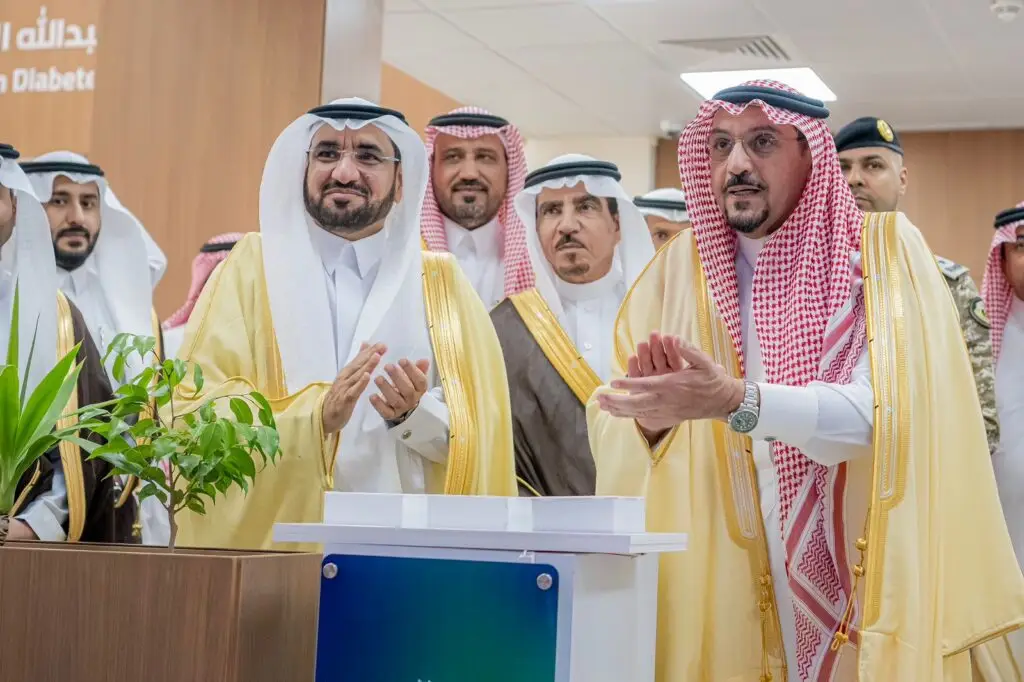
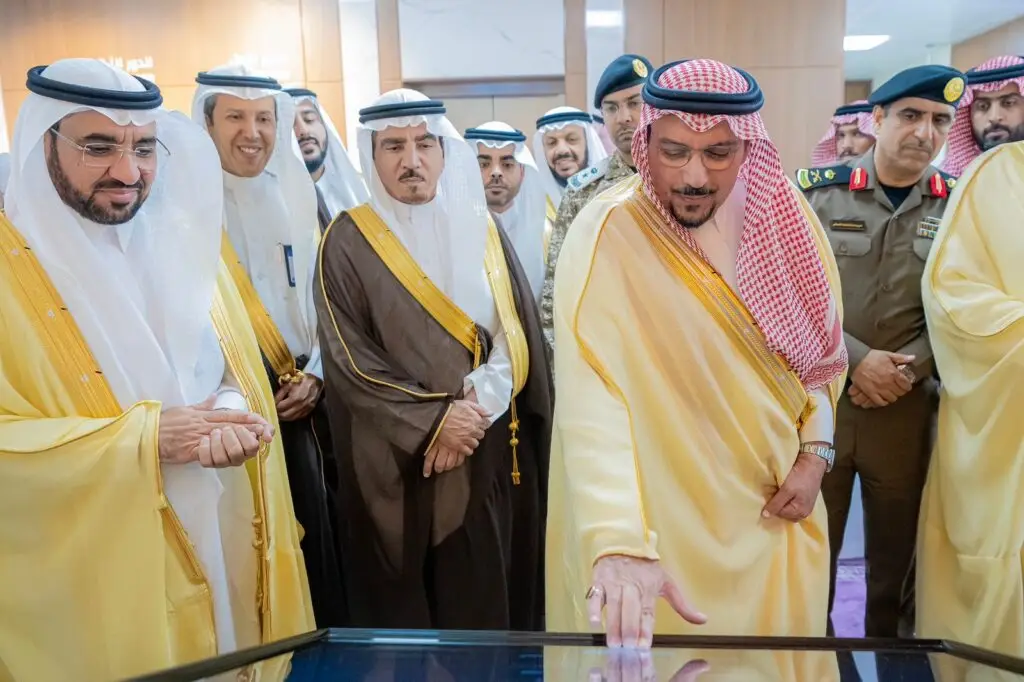
On Sunday, November 17, 2024, His Excellency the President of the University, Prof. Dr. Muhammad bin Fahad Al-Sharekh, witnessed the signing of a memorandum of understanding between the university, represented by the College of Business and Economics, and Taqraq Business Services Company, in the presence of His Excellency the Vice President for Educational Affairs, Dr. Fahad bin Sulaiman Al-Ahmad, His Excellency the Vice President for Postgraduate Studies and Scientific Research, Dr. Walid bin Saleh Al-Battah, and the Supervisor of Knowledge Exchange and Scientific Events, Dr. Mishari bin Saleh Al-Enezi, at the headquarters of the University City.
The MoU was signed by Dr. Faisal bin Abdullah Al-Fahid, Dean of the College of Business and Economics, and Mr. Saeed bin Saad Al-Shahrani, CEO of Iqraaq Business Services, to support and develop the skills and knowledge of accounting students through the Distinguished Accountants Program.
The memorandum also aims to strengthen cooperation in the field of qualifying accountants for the labor market, helping students acquire the skills of preparing financial statements and the ability to read them and make decisions based on them, in addition to sufficient knowledge of the most important tax and zakat treatments, and the ability to prepare returns according to the regulations in force in the Kingdom.
The areas of cooperation in the MoU include introducing students to the most important professional certificates that qualify them more for the labor market, providing them with effective communication skills in organizations, and the ability to present their CVs in a clear and professional manner.
Prince of Qassim sponsors the signing of a memorandum of understanding between the university and the National Center "Waqa"
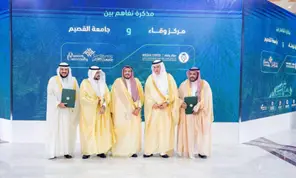
His Royal Highness Prince Dr. Faisal bin Meshal bin Saud bin Abdulaziz, Emir of Qassim, witnessed the signing of a memorandum of understanding between Qassim University and the National Center for Prevention and Control of Plant Pests and Animal Diseases "Waqa", in the presence of HE Minister of Environment, Water and Agriculture Engineer Abdulrahman bin Abdulmohsen Al-Fadhli, HE President of Qassim University Prof. Dr. Mohammed bin Fahd Al-Sharekh, and HE CEO of the National Center for Prevention and Control of Plant Pests and Animal Diseases, Engineer Ayman bin Saad Al-Ghamdi, at the Emirate Office.
The memorandum was signed by His Excellency the UQU Vice President for Educational Affairs, Dr. Fahad bin Sulaiman Al-Ahmad, and the Director General of the National Center "Waqa" branch in Qassim, Dr. Omar bin Abdullah Al-Misnad, in the presence of the Dean of the College of Agriculture and Food, Dr. Hani Al-Fahid, and the Supervisor of the Knowledge Exchange and Scientific Events Department, Dr. Mashari Al-Enezi.
This memorandum aims to keep pace with the requirements of the sustainable development process in the Kingdom's agricultural fields and to activate joint cooperation between the two parties that meets their common goals in the academic, scientific, research, training, development, community service and other fields that promote positive partnership in serving the community and the nation.
This memorandum also serves cooperation between researchers and technicians in both parties to the memorandum to conduct joint projects. In the scientific, research, training, development, and community service fields, and encouraging the exchange of academic, scientific, research, and training visits between the two parties to the memorandum in support of its fields.
UQU announces the schedule for the Sustainable Management of Natural Resources and Solid Waste Conference
The University has announced the schedule of the "First International Conference on Sustainability of Natural Resources: Sustainable Solid Waste Management", organized by the University's College of Engineering, during the period from 6-9 Rabiul Awwal of next year 1441 AH, with the aim of contributing to the preparation of a vision on the sustainable management of solid waste at the national and global level, indicating the size of wasted natural and economic resources and estimating the environmental cost of waste.
The receipt of abstracts of research papers wishing to participate in the conference will begin on 26 Sha'ban by registering on the university's website at the link: sdc2019/. On the 10th of Ramadan, the acceptance of abstracts will be announced, with early registration closing on Shawwal 12, 1440 A.H. The reception of full research papers will begin on the 4th of Dhu al-Hijjah, and the announcement of their acceptance on Muharram 16, 1441 H, before the conference is held in the month of Rabi' Al-Awwal.
For his part, Prof. Dr. Khalid bin Bani Al-Harbi, UQU Vice President for Development and Quality and Chairman of the Organizing Committee, stressed that this international conference came at this time in line with the Kingdom's vision, which promotes the concepts of sustainability, especially with natural resources to preserve them and invest them in the right way to ensure their permanence and survival for future generations, God willing, pointing out that the per capita consumption rates globally in general and in the Kingdom in particular for some goods and services are among the highest rates, which in turn generates a huge volume of solid waste, which in turn depletes these important resources.
Al-Harbi added that the concept of sustainable development comes to frame this dealing with resources in a moderate manner to ensure their sustainability and preserve them for future generations, hence the importance of applying sustainable solid waste management to achieve optimal utilization of natural resources and maximize their use, and from this comes the importance of encouraging these initiatives aimed at improving sustainable waste management, optimizing the application of modern technologies in this field, and raising community awareness of the nature of the risks resulting from their mismanagement.
The head of the conference's organizing committee believes that raising the level of performance in waste management achieves the sustainability of natural resources, optimal utilization of them, and reducing their depletion, stressing the importance of holding such specialized scientific meetings aimed at shedding light on everything new in this vital field. Qassim University sensed the importance of this topic and adopted the first international conference for the sustainability of natural resources and highlighting the sustainable management of solid waste from its pioneering community role to contribute to raising the efficiency of natural resources management to achieve optimal societal development.
The conference will discuss the necessary measures to transform sustainable food systems in which food waste is minimized, stimulate integration between partners from different disciplines to manage waste sustainably, study opportunities to stimulate investment in the field of developing waste recycling technologies in the Kingdom, study the obstacles to investment in the field of waste conversion industries, build and establish a system for awareness, education and environmental training with the participation of individuals and communities, and link research and studies at Saudi and international universities to the requirements of development and confronting national challenges.
The first theme deals with sustainable waste management practices at all stages, from generation, source separation, collection, transportation, transformation and disposal, and at all levels: planning, management, operation, maintenance and investment, while the second theme deals with how to manage food loss and food waste at the production and consumption level, the third theme discusses investment in waste recycling and downstream industries, and the fourth theme deals with rational waste management from a legal and cultural perspective.
The University sought to organize this conference due to the high per capita consumption rates in the Kingdom of Saudi Arabia for some goods and services, which are among the highest rates globally, which increased the volume of solid waste generated, and the natural resources in the Kingdom are depleted and degraded due to high consumption rates that conflict with the application of sustainable development concepts, in addition to the need to transfer and localize modern international technologies in the field of waste management in accordance with the conditions of the Kingdom, and the need to address the challenges resulting from waste, which is the responsibility of every member of society.
The university also aims to raise community awareness of the risks resulting from waste generation, encourage initiatives aimed at improving sustainable waste management, and provide an opportunity to exchange experiences and knowledge among specialists in waste management and sustainable development.
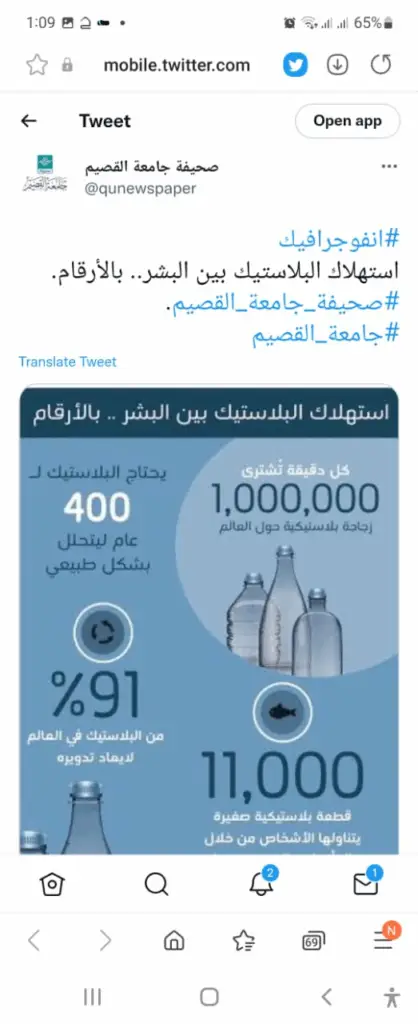
Statistics on plastic consumption
University launches awareness campaign with posters on containers and compressors
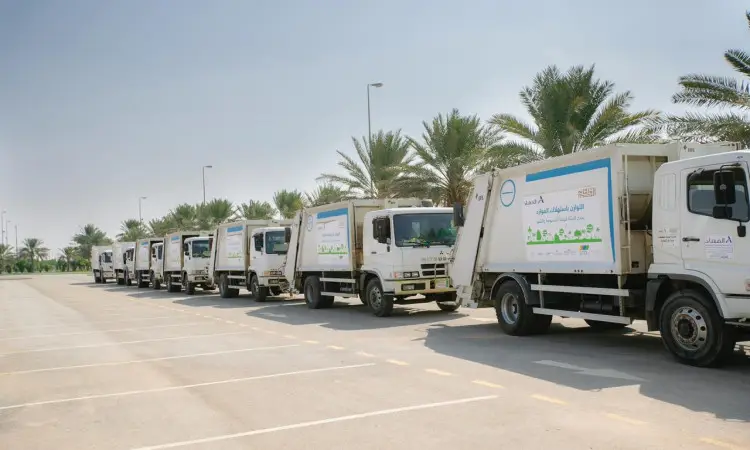
The University, represented by the College of Engineering, held an awareness campaign at the level of the Qassim region on Thursday, 3/3/1441 A.H., by placing posters with awareness statements about waste on cleaning vehicles, as part of the preparations for the first international conference on sustainability of natural resources "Sustainable Management of Solid Waste", which will be organized by the university on Tuesday and Wednesday next week.
Awareness posters were placed on the 30 mobile "compressor" vehicles inside and outside the university city, and these posters contained a number of awareness and guidance phrases, including: "The earth has no tongue to speak of environmental injustice. "Sustainability is about meeting the needs of ourselves and those who come after us," and "Sustainability is about meeting the needs of those who come after us. "Preserve the place for your children, be a friend to the environment, your positive environmental behavior is a charity to yourself", "Desertification is a cancer of the environment; contribute to its treatment, awareness and behavior", "Balanced consumption of resources gives the environment opportunities for sustainability and growth", and other awareness phrases.
Through this conference, the university seeks to contribute to the preparation of a comprehensive vision on solid waste management at the national and global level, and to indicate the size of wasted natural and economic resources and estimate the environmental cost of waste, with the participation of a number of speakers who will review the latest developments of modern science in this field, and will discuss many relevant scientific papers and research papers.
The conference includes a number of themes, including: Sustainable practices of waste management at all stages "from generation, source separation, collection, transportation, transformation and disposal" and at all levels "planning, management, operation, maintenance and investment", while the second theme deals with how to manage food loss and food waste at the production and consumption level, the third theme discusses investment in waste recycling and transformation industries, while the fourth theme deals with rational waste management from a legal and cultural perspective.
6 Organizations Participate in the "First International Conference on Natural Resources Sustainability" Exhibition


The exhibition accompanying the first international conference on the sustainability of natural resources, which was launched yesterday morning, Tuesday, 8/3/1441 A.H., at the university, attracted the attention of conference visitors, participants, university students and affiliates. On its first day, it hosted more than 750 visitors, who toured all corners of the exhibition, in which 6 different entities participated, including the University's College of Engineering, Qassim Municipality, the University's Sustainable Development Center, Cement Company, strategic sponsor of the conference, Alfahad Company, and Cleaning Machinery Company.
For his part, Dr. Fawaz Al-Harbi, the supervisor of the exhibition, Vice Dean of the College of Engineering at the university, explained that the exhibition, which lasted for two days during the conference, attracted visitors from university students and specialists in the field of sustainability and environmental engineering, as the exhibition focused on the experiences of government agencies and private companies in the field of recycling and sustainability of natural resources.
Al-Harbi added: The accompanying exhibition included 6 exhibitions including: A pavilion for the College of Engineering, which includes a display of student projects and scientific research, the exhibition of the Cement Company, the strategic sponsor of the conference, which presents the company's experience in preserving the environment by using alternative energy, and the pavilion of the University Sustainability Center, which shows the university's initiatives in the field of sustainability and conservation of natural resources.
The exhibition also included a pavilion for the Qassim Municipality, the supporting partner, which showcases the Municipality's modern experience in waste disposal, the exhibition of Al Fahad Company, the silver sponsor of the conference, which displays modern containers that compress and transform waste into fertilizers that can be used, and the exhibition of the Cleaning Machinery Company, which displays their experience in using modern equipment to sort waste according to the quality of the material of manufacture.
The conference, hosted by the university, aims to demonstrate the magnitude of wasted natural and economic resources and estimate the environmental cost of waste, as well as discuss the necessary measures to shift to sustainable food systems in which food waste is minimized, stimulate integration between partners from different disciplines to manage waste sustainably, and study opportunities to stimulate investment in the field of developing waste recycling technologies in the Kingdom of Saudi Arabia.
Earth Hour 2023
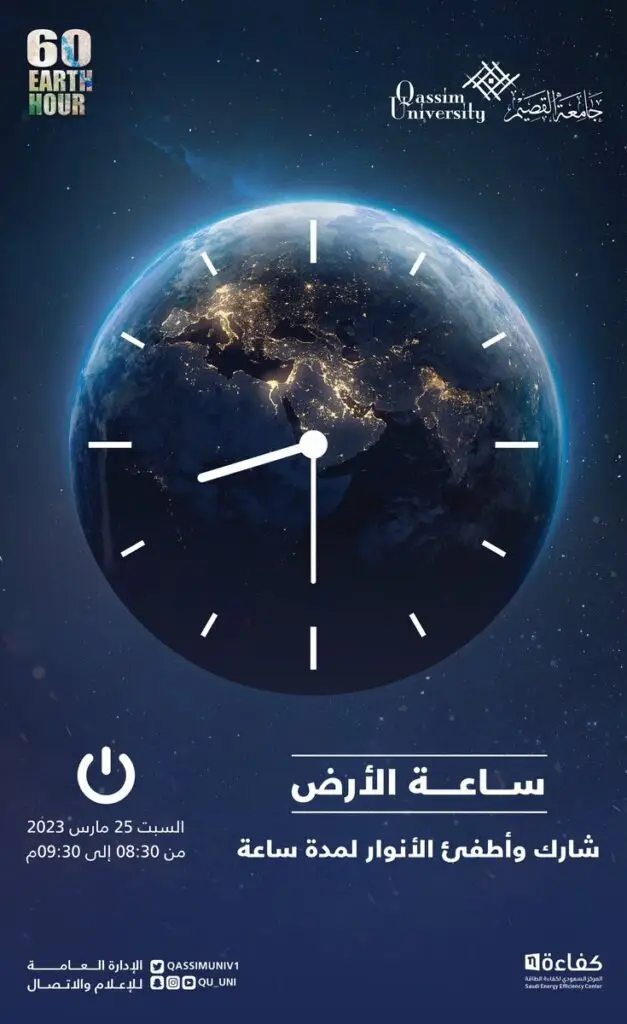
# Qassim University is participating in the global environmental event # Earth Hour this evening, Saturday, March 25, 2023, from 8:30 pm to 9:30 pm.
Saudi Green Initiative

As part of the # Saudi Green initiative and in fulfillment of the goals of the Kingdom's Vision 2030.
# at Qassim University contributes to increasing the area of vegetation cover within the university city and utilizing about 524,000 cubic meters of treated water to reduce the effects of desertification
# World Day to Combat Desertification and Drought
Student participation in community activities and services related to sustainability and climate change
Key initiatives:
A. Increase student engagement in activities related to sustainability and climate change.
Key performance indicators:
Number of student organizations related to sustainability (including climate change).
Number of cultural activities on campus (e.g., cultural festival) including virtual activities that incorporate sustainability concepts (including climate change).
Number of community services organized to address sustainability and climate change concepts.
"Our environment is our life. Don't destroy it with our own hands. Be responsible and keep the environment safe."

References
[1] [Online]. Available: .https://www.qu.edu.sa/content/news/1238
[2] [Online]. Available: .https://twitter.com/QassimUniv1?ref_src=twsrc%5Etfw%7Ctwcamp%5Eembeddedtimeline%7Ctwterm%5Escreen-name%3AQassimUniv1%7Ctwcon%5Es2.
[3] [Online]. Available: . https://www.qu.edu.sa/content/news/1524.
[4] [Online]. Available: . https://www.qu.edu.sa/content/news/1536.
[5] [Online]. Available: .https://twitter.com/QassimUniv1/status/1639643832605110272.
[6] [Online]. Available: . https://twitter.com/QassimUniv1/status/1670478362530181120.
[7] [Online]. Available: .https://www.qu.edu.sa/wp-content/uploads/2025/05/Updated-Sustainability-Climate-Policy.pdf
[8] [Online]. Available: . https://twitter.com/QassimUniv1/status/1635948481301839872.
- About SDG 15
- Events about sustainable use of land
- Ethical sourcing policy
- Maintain and extend current ecosystems’ biodiversity
- Educational programmes on ecosystems
- Sustainable management of land for agriculture (educational outreach)
- Sustainable management of land for tourism (educational outreach)
- Policy on sustainable use, conservation, and restoration of land
- Monitoring IUCN and other conservation species (policies)
- Local biodiversity included in planning and development
- Collaboration for shared land ecosystems
- Water discharge guidelines and standards
- Policy on plastic waste reduction
- Policy waste disposal - hazardous materials