 Official government website of the Government of the Kingdom of Saudi Arabia




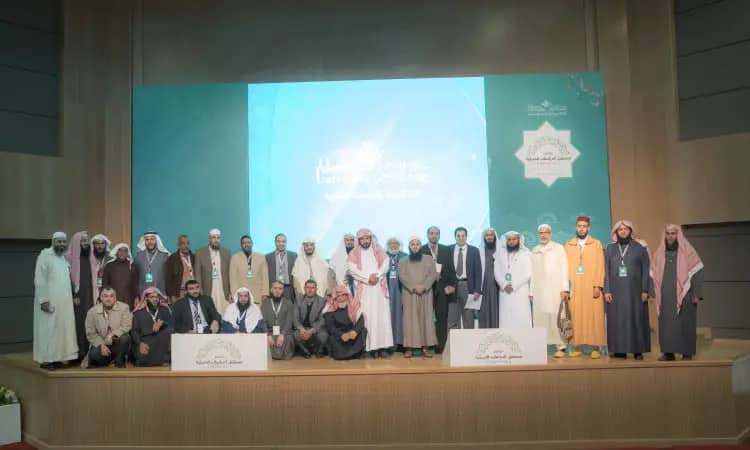
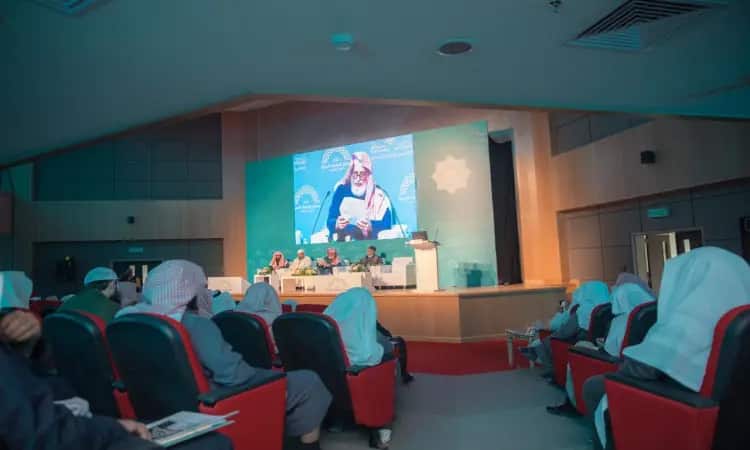
The University, represented by the College of Sharia and Islamic Studies, issued the recommendations resulting from the scientific sessions held at the International Scientific Conference on the Future of Hadith Studies in the Prophetic Sunnah. The conference was held on Tuesday and Wednesday, 9-10/05/1440 AH, at the University Clinics Theater in Al-Muleida, with the theme "The Future of Hadith Studies: A Forward-Looking Vision." Participants presented 46 recommendations at the conclusion of the conference's work, which are as follows:
1 – Develop a guide for research topics in Hadith and its sciences that still require further research and study, supervised by a specialized scientific authority, to leverage the efforts of researchers in universities and research centers to implement them for the development of Hadith studies.
2 – Opening new fields for contemporary scientific research in the Prophetic Hadith through openness to modern sciences, leading to communication, education, and scientific cross-pollination.
3. The necessity of directing researchers to terminological research that adopts the terminological methodology through studying terminology, the historical development of its meanings, its applications, its relationships, and its issues within the modern conceptual system.
4. The need to isolate certain nuances of isnad so that the type can be reviewed through extensive study that attempts to highlight its importance and its connection to issues of narration, narrators, and authentications.
5. Continue to provide training programs to meet the needs of Hadith students, especially in the field of Hadith criticism and its relation to the methods of the critical Imams to understand their words.
The necessity of transitioning from the theoretical to the practical side of training.
7. The necessity of consulting specialists in the field when preparing training programs to ensure the correct approach to achieving training success.
8 - The necessity of caring for the humanities in general and attempting to invest in their studies to consolidate the religious text and transform it from a tool used by others to cast doubt on the authenticity of hadith narratives into a tool to infer the reliability of these narratives.
Establish a scientific research chair concerned with reconciling scientific facts and authentic Prophetic hadiths. Its members will consist of an elite group of researchers interested in the Sunnah and experimental science, and linguists. They will examine problematic hadiths, those that appear to contradict one of the others, and their judgment will be issued by the consensus of all.
10. The necessity of confronting doubts and challenges to the Sunnah of the Prophet (peace be upon him) with preventive and therapeutic methods, in a rapid and engaging manner.
11 – The importance of caring for hadith collections and developing strategies to correct the approach towards them by: raising awareness of their importance and benefits, paying attention to scientific studies on them, and developing and innovating publication techniques through multiple areas such as collecting collections with a single subject, building a database for them, compiling them into a single, alphabetically arranged volume, collecting them on musnads, supporting universities through their inclusion in Master's and Doctoral theses, and providing financial support for their publication and printing.
12 - Working on connecting the Prophetic Hadith with other sciences in light of contemporary theorizing in medicine, astronomy, psychology, pedagogy, sociology, ethics, management, economics, military sciences, and other sciences, and highlighting its precedence in concepts that have an effective impact on cognitive and civilizational progress, and its superiority over many contemporary fields of knowledge.
13 – Issuing an encyclopedia that includes all hadiths related to other sciences according to their contemporary concepts and terminology, and then presenting it to specialists for them to benefit from in formulating and refining these sciences in light of the directives contained in the noble prophetic hadith.
The need for universities or Sharia colleges and Sunnah departments to establish special remote transmission centers for the Quran and Sunnah, and to dedicate trained staff for this purpose, keeping pace with the rapid technological development the world is witnessing, and reviving the assemblies for listening and reciting the noble Hadith in these electronic centers. Perhaps the Deanships of Community Service can oversee this.
15 – The necessity of reviewing and evaluating the development of studies in the Sunnah and recent developments in this area in terms of authorship, analysis, and study.
16. Higher education institutions should produce books on Hadith terminology, initially based on quality standards, employing modern Hadith informational resources in both their archived historical and contemporary electronic forms, and utilizing statistical mechanisms without compromising intellectual depth or transforming quality into a quantitative issue.
Encouraging joint research between specialists in the prophetic tradition, education, and psychology.
18. Paying attention to analytical studies of Prophetic hadith to extract practical methodologies in behavioral education.
19. The university conducts training courses for professors on using the (CoLL) strategy in the classroom.
Encouraging Sharia faculties and Heads of Sunnah departments to encourage professors of modern methodology courses to use the self-study (KOL) strategy in teaching students to enable them to employ their skills in directing thinking and learning processes and taking personal responsibility in learning based on the principle of self-learning.
21. Activating programs specializing in teaching Hadith through interactive electronic methods via applications and distance learning, and displaying them on websites in Arabic and English to facilitate the study and understanding of Hadith science.
22 – Diligent work in starting the creation of a large and comprehensive Hadith encyclopedia.
23 - Establishing a private endowment for Sunnah technology to expand the use of technology in the customary way and to lay the foundation for the production of smart technology in its comprehensive sense.
24 – Establishing a union or body to bring together influential figures in tech innovation and enthusiasts for the purpose of coordination, integration, mutual advice, and mutual support, and to stop the continuous bleeding of waste due to the absence of such coordination and integration.
Establishment of university research centers or chairs for Sunnah technology, dedicated to this area in an organized academic manner.
26 – Raising awareness of the role of printing and publishing in the vital tasks of disseminating new books and modern research through organizing conferences and workshops.
27. Establishing Waqf centers for Hadith, considering contemporary Hadith research as their priority, and having two committees: a highly competent scientific committee and an active promotional committee.
28 – Establishment of local and regional committees concerned with setting standards for journals and other research publication periodicals, and ensuring publication outlets of high-quality, peer-reviewed international standing.
29 - Urge universities to have publishing houses that contribute to the dissemination of their students' research.
30 – Utilizing general and specialized computational scientific encyclopedias in Hadith studies to generate research ideas needed by postgraduate students.
Urge universities to intensively teach their students databases related to the Prophet's Hadiths so they can enumerate and classify them.
32. Conduct new statistical studies in light of the five prospective dimensions (innovative-novel, complementary-developmental, applied-traditional, encyclopedic dimension, extrapolative dimension). .
33 – Establishment of an encyclopedic digital center for Hadith sciences, linked to a website on the World Wide Web, so that digital information is accessible to readers to begin investigative studies.
34 - Create an annual digital magazine that provides all new research and studies.
35. The necessity for contemporary jurists and specialized researchers to take the scientific and religious initiative in considering hypothetical and preemptive emergent issues, and to derive their rulings (ta'sil) from the general texts of Islamic law.
36 - The call to facilitate the learning of hadith and combine authenticity with ease by simplifying terminology and methods in a way that aligns with the understanding of contemporary people.
37 - The obligation to protect hadith from the tyranny of those who tamper with it or are ignorant of it, by applying it to reality without conditions, rules, standards, or controls.
38. Taking care of the printing of the Sunnah books, especially the Seven Books, and collecting them into one set with their rare counterparts as needed. .
39. Caring for the translation of the approved hadith books, chief among them the Seven Books, into living languages.
40 – Care in using media for disseminating the Prophetic Sunnah, such as satellite channels, visual and audio electronic programs, and applications.
41 – The necessity of intensifying studies on what was common practice according to hadith during the era of the Companions in order to understand the contextual status of the hadith for applying the authentic hadith to the intended reality.
42. Encouraging terminological studies of the prophetic Sunnah texts due to their impact on establishing the understanding of the prophetic Sunnah and the intent of the Prophet, peace be upon him.
43. Urging lawyers, judges, and legal scholars to pay attention to hadith texts to maximize their benefit in the legal field.
44 - The necessity of teaching a specialized course on Hadith texts and their legislative implications to address the weakness in drafting legal texts.
45 - Encouraging in-depth study of critical thinking skills for their application in understanding the Sunnah.
46 – The necessity of conducting serious linguistic studies on literal and linguistic meaning, understanding their characteristics and their role in clarifying the divine intentions from the Prophetic text, due to their importance in deriving jurisprudential rulings.
