The Standing Committee for Scholarships and Training
Overview
The Standing Committee for Scholarship and Training is a regulatory body responsible for overseeing scholarship and training policies at the university, ensuring the development of human competencies and raising the level of qualification in line with job requirements and strategic objectives.
Committee Objectives
- Achieving excellence in human resource development by supporting scholarship and training programs in line with the university's strategic plan.
- Studying scholarship and training requests and providing appropriate recommendations that serve the university's interests.
- Ensuring fairness and transparency in scholarship procedures among applicants in accordance with approved regulations and controls.
- Enhancing the scientific and professional efficiency of university staff, contributing to the improvement of academic and administrative performance quality.
- Supervise the application of regulations and laws governing scholarships and training, and ensure compliance with them.
- Contributing to the preparation of qualified academic and administrative cadres capable of supporting institutional excellence, scientific research, and community service.
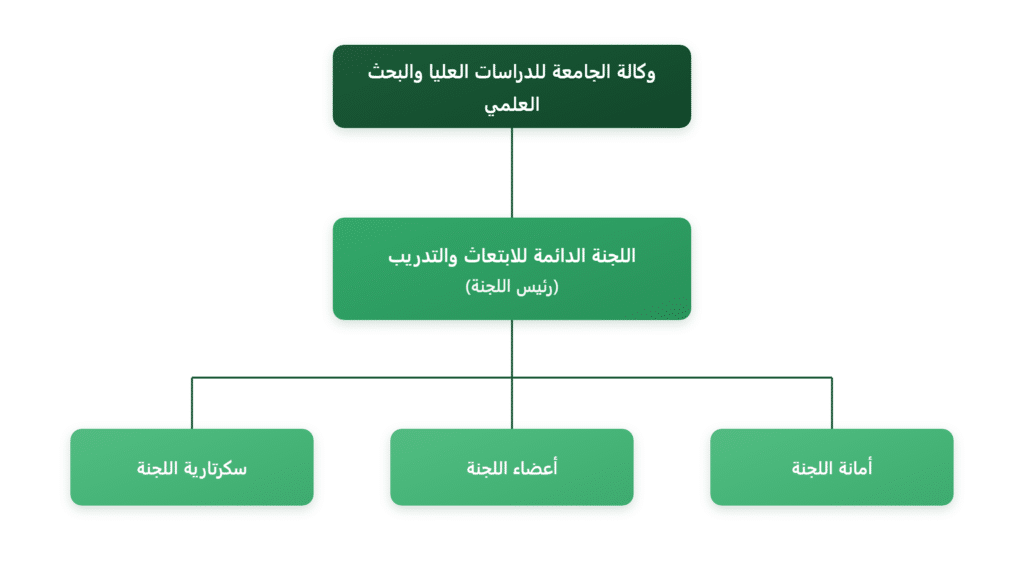
Organizational structure
Committee Mandates
- Studying scholarship and training requests submitted by university affiliates and verifying their compliance with conditions and regulations.
- Recommending to approve or reject scholarship and training requests and submitting them to the authorized person for approval.
- Reviewing scholarship, training, and development plans and ensuring their alignment with the university's needs and strategic priorities.
- Studying requests for study extensions, changes in study destination, specialization, or any other modifications, and providing recommendations regarding them in accordance with the governing regulations.
- Following up on periodic reports for scholarship students and trainees, and evaluating their academic or training performance level.
- Follow-up on scholarship programs and ensure trainees and scholarship students adhere to regulations and instructions.
- Organizing and developing policies and procedures related to scholarships and training to contribute to improving performance efficiency and achieving the university's goals.
- Preparing periodic reports on the committee's work and submitting them to the authorized person.
Principles of Work in the Committee
Compliance with rules and regulations Application of all procedures in accordance with the regulations, instructions, and policies governing scholarships and training.
Justice and Equality: Treat all applicants according to uniform standards without discrimination.
Transparency Clarity of scholarship procedures, competition, decision-making, and communication of these with stakeholders.
Integrity and impartiality Making decisions objectively, free from any conflict of interest or personal influence.
Objectivity Basing recommendations on clear standards and documented information when studying applications.
Efficiency and Effectiveness Completing the committee's work in a timely manner and with the best use of available resources.
Corporate work Enhancing cooperation and coordination between the committee and relevant entities within the university.
Continuous improvement Periodically review and develop committee procedures to contribute to improving the quality of scholarship and training services and achieving the university's strategic goals.
Committee Services
Study internal and external scholarship applications and delegations to ensure they meet the requirements.
Review and approve nominations and submit recommendations to the competent authorities at the university.
Preparing the annual scholarship and training plan in line with the needs of colleges and departments.
Monitoring the status of scholarship students during their studies and coordinating with colleges and relevant authorities.
Study of requests for extending scholarships, changing university, major, or study location in accordance with approved regulations.
Consider requests for deferral, apology, or termination of scholarships when necessary.
Proposing policies and regulations for scholarships and training and following up on their implementation.
How does the committee hold its meetings?
The Scholarship and Training Committee holds its meetings in accordance with the regulations organizing the work of committees at the university, and the meeting proceeds as follows:
- Meeting invitation.
- Quorum check.
- Adopt the agenda.
- Discussing topics.
- Take recommendations.
- Prepare meeting minutes.
- Confirm the minutes and follow up on implementation.
How does the committee work?
The committee operates according to a structured procedural path that goes through the following stages:
Order taking
The committee receives applications for scholarships or training submitted by faculty members or employees through the college or deanship. .
Review orders
It checks the fulfillment of conditions and requirements, such as the compatibility of the specialization with the university's needs, the completeness of documents, and compliance with regulatory controls.
Demand Study and Evaluation
The committee discusses the request in terms of its academic or professional feasibility, and its alignment with the strategic plan and the entity's needs.
Issuance of recommendations
Recommend approval, rejection, or a request for additional information, then submit the recommendation to the authorized body for decision approval.
Implementation follow-up
After approval, the committee or relevant authority proceeds with the scholarship or training procedures, such as issuing decisions, coordinating with relevant parties, and following up on the program's commencement.
Follow-up of scholarship students
Review periodic reports, assess adherence to the study plan, and consider requests for extensions, deferrals, or changes as needed.
Evaluation and Improvement
The committee reviews the outcomes of scholarship programs, measures their goal achievement, and proposes policy and procedure improvements.