The Standing Committee for the Management of Knowledge Exchange and Scientific Events
Overview
The Standing Committee for Knowledge Exchange and Scientific Events Management is an institutional committee affiliated with the Deanship of Graduate Studies and Scientific Research at Qassim University. Its reshaped membership was issued by the university president. The committee is responsible for overseeing the university's academic and research cooperation system by studying Memoranda of Understanding and Partnership Agreements, following up on their implementation, and reviewing requests for organizing scientific events and conferences.
Committee Objectives
- Developing knowledge exchange management software and achieving its strategic goals.
- Enhance academic and research partnerships with local and international entities.
- Improving the quality of outputs from agreements, partnerships, and service contracts.
- Ensuring the quality of scientific events and their compliance with university regulations and instructions.
- Submitting periodic reports to the university president on the committee's most important work and achievements.
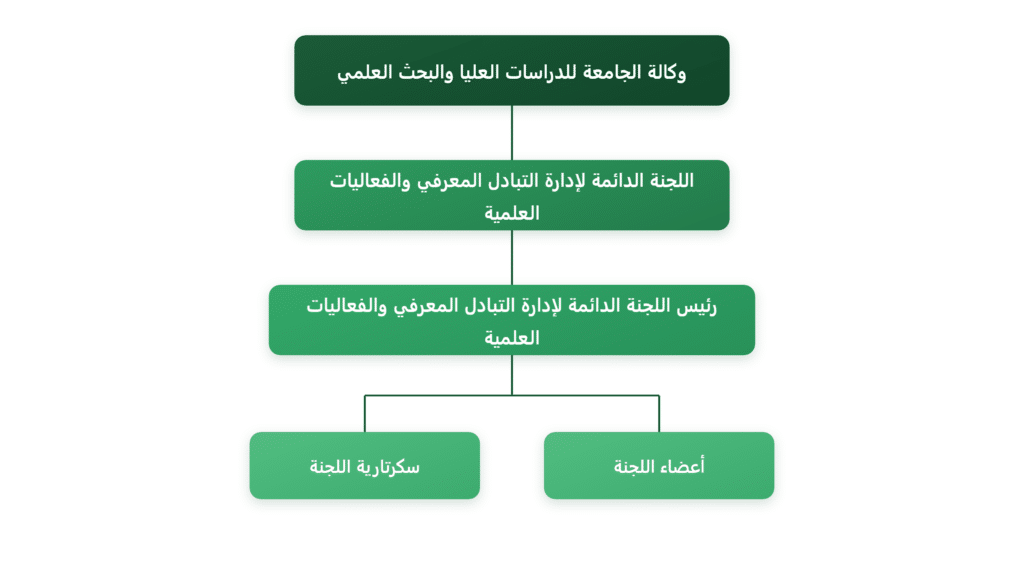
Organizational structure
Committee Mandates
- Proposing plans and strategies that enable management to develop its programs and achieve its goals.
- Study of Memoranda of Understanding (MoUs), cooperation agreements, partnerships, service contracts, and twinning projects, and submitting recommendations on them.
- Identifying appropriate mechanisms for following up on the implementation of agreements, partnerships, twinning arrangements, and service contracts.
- Define performance measurement indicators and output quality, address the obstacles they face, and conduct periodic follow-up according to customized models.
- Develop an annual plan for visiting professor programs with the aim of promoting scientific and research exchange at the university.
- Studying requests for the residency of conferences, seminars, workshops, and scientific events at the university, verifying their compliance with university regulations and instructions, and evaluating their scientific and research feasibility.
- submit its meeting minutes to the university president for approval.
- Submit an annual report to the University President reviewing the committee's most important work at the end of the fiscal year.
Principles of Work in the Committee
Transparency and accountability Submit all minutes and recommendations to the university president for approval.
Objectivity Evaluating requests and projects according to specific scientific and research criteria.
Institutional cooperation: Coordination with relevant colleges and university units.
Quality and Impact: Focus on measuring the outputs of agreements and partnerships and their actual impact.
Sustainability Establish mechanisms for periodic follow-up to ensure the continuous implementation of agreements and partnerships.
Adherence to regulations Observing university regulations, instructions, and approved organizational frameworks in all of its decisions.
Committee Services
Studying Memoranda of Understanding and cooperation agreements submitted by internal and external parties and providing recommendations on them.
Review of applications for residency of conferences, seminars, workshops, and scientific events within the university.
Assessing opportunities for academic and research partnerships with local and international entities.
Follow up on the implementation of existing agreements and partnerships and monitor their performance level.
How does the committee hold its meetings?
- The committee meetings are held periodically, or whenever necessary at the call of its chairman.
- The Vice President for Graduate Studies and Scientific Research chairs the meetings.
- The supervisor of knowledge exchange and scientific events management undertakes the duties of the committee secretary and prepares the agenda.
- The secretary takes meeting minutes and distributes them to the members.
- Minutes are submitted to the university president for final approval after being signed by the members.
- The committee may seek the assistance of whomever it deems experienced and specialized to carry out its tasks, without them having the right to vote.
How does the committee work?
The committee operates according to a structured procedural path that goes through the following stages:
Reception
The committee receives applications and files referred to it by the administration or relevant authorities.
Study and evaluation
The Technical Secretariat studies the files and prepares explanatory memos that are submitted to the members before the meeting.
Deliberation
Members discuss files in regular or emergency meetings and reach decisions or recommendations.
Submit for approval
The minutes and recommendations are submitted to the university president for approval.
Follow-up
The committee follows up on the implementation of approved decisions and monitors their results.
Annual Report
The committee submits a comprehensive report at the end of the fiscal year that reviews its most important work and achievements.
Evidence and Models
Scientific Cooperation and Knowledge Exchange Regulations and Procedures
Frequently Asked Questions
Which entity does the committee report to?
Who heads the committee?
How can one apply to host a conference or scientific event at the university?
What is the processing time for Letters of Intent and Agreements?
Can we partner with international entities?
Yes, the committee specializes in studying draft agreements with both local and international entities, and submitting appropriate recommendations regarding them.
What are the criteria used to evaluate scientific event proposals?
Applications are evaluated based on: their compatibility with university regulations and instructions, scientific and research feasibility, and their alignment with the university's strategic objectives.