 Official government website of the Government of the Kingdom of Saudi Arabia



Standing Committee for Postgraduate Studies
Overview
The committee shall oversee postgraduate studies, propose and follow up on general policies related to admissions to postgraduate programs, their conditions and quotas, recommend the approval of postgraduate programs and study plans, standards, and oversee the evaluation of postgraduate programs and study comprehensive reports prepared about them. It shall also consider regulations for forming supervision committees and discussing scientific theses, establish general frameworks and standards for exams, graduation research projects, research plans, and the rules governing the writing of scientific theses and related matters. The committee shall also review college proposals regarding developmental initiatives related to postgraduate studies, recommend the determination of financial fees for postgraduate programs, and address matters concerning scholarships, the closure or suspension of postgraduate programs, and any issues referred to it by the University President or the University Council for study and opinion.
Committee Objectives
- Achieving the desired goals of postgraduate studies and caring for them.
- Contribute to building and developing pioneering graduate programs.
- Enabling outstanding students to continue their postgraduate studies and encouraging them.
- Graduating distinguished and specialized scientific and professional competencies qualified intellectually and professionally.
Organizational structure
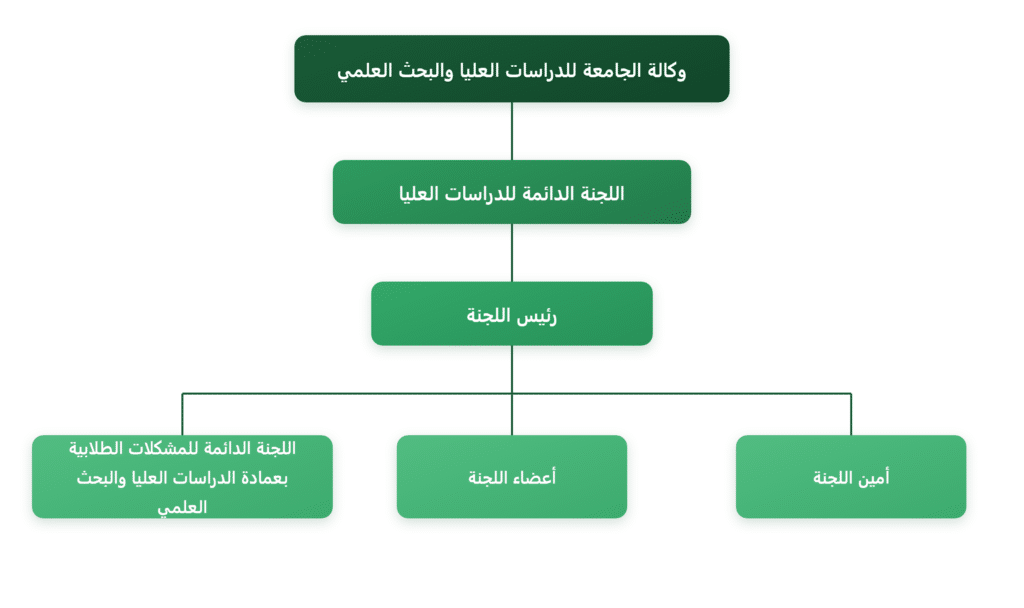
Committee Mandates
- Proposing public policy for postgraduate studies at the university, and following up on its implementation after its approval by the university council.
- The recommendation to approve and update the admission requirements for postgraduate programs, based on the proposal of the relevant department councils, faculties, and institutes.
- Supervision of joint postgraduate programs.
- Recommending the approval and amendment of postgraduate programs - after their study and peer review - to the University Council, based on a proposal from the department council, and with the endorsement of the proposal by the college council.
- Recommendation to approve the study plans and detailed standards to the University Council, based on a proposal from the department council, and with the endorsement of the college council, according to international benchmarks and comparisons.
- Proposal for postgraduate program standards for approval by the University Council.
- Propose regulations for evaluating graduate programs for approval by the University Council.
- Supervising the periodic review of the university's graduate studies programs through specialized committees or bodies from within or outside the university.
- Studying the comprehensive report prepared by the executive management on the university's graduate programs, the results of evaluating those programs, and submitting them to the University Council.
- Recommending approval of college council proposals regarding postgraduate programs that align with community needs, the Kingdom's plans and visions, and global trends for ratification by the University Council.
- Approval of proposals for the determination of academic degree classifications, certificates, and their titles in both Arabic and English, based on the proposals of the department and college councils.
- Recommending the number of students to be admitted each academic year to postgraduate programs to the University Council, based on proposals from the relevant department councils and endorsements from the college councils.
- Proposal for controls/regulations on the formation of supervision committees and discussion of scientific theses.
- Setting general frameworks and standards for comprehensive exams and graduation research.
- Establishing the general framework for research plans, the regulations governing the writing, printing, formatting, and submission of scientific theses, and the preparation of discussion committee report templates and thesis evaluation criteria.
- Review of periodic reports on postgraduate studies submitted by the university's academic departments.
- Proposal to offer postgraduate programs off-campus and to submit it to the University Council for appropriate action.
- Recommendation to approve the colleges' proposals regarding graduate studies development initiatives for the university's financial resource development.
- Recommendation to determine the financial consideration for applying to graduate programs, and the financial consideration or tuition fees for programs, and the financial consideration for auxiliary services related to graduate studies, based on proposals from department and college councils.
- Recommendation to allocate free scholarships for students - full or partial - according to the regulations approved by the University Council.
- Recommendation to close or suspend graduate programs that do not meet quality standards or align with the university's strategy.
- Consideration of matters referred to it by the Chairman of the Standing Committee, the President of the University, or the University Council for study and opinion.
Principles of Work in the Committee
Transparency and accountability Submit all minutes and recommendations to the university president for approval.
Objectivity Evaluating requests and projects according to specific scientific and research criteria.
Institutional cooperation: Coordination with relevant colleges and university units.
Quality and Impact: Focus on measuring the outputs of agreements and partnerships and their actual impact.
Sustainability Establish mechanisms for periodic follow-up to ensure the continuous implementation of agreements and partnerships.
Adherence to regulations Observing university regulations, instructions, and approved organizational frameworks in all of its decisions.
Committee Services
Studying Memoranda of Understanding and cooperation agreements submitted by internal and external parties and providing recommendations on them.
Review of applications for residency of conferences, seminars, workshops, and scientific events within the university.
Assessing opportunities for academic and research partnerships with local and international entities.
Follow up on the implementation of existing agreements and partnerships and monitor their performance level.
How does the committee hold its meetings?
Periodically with the presence of the committee chairman and at least two-thirds of its members.
How does the committee work?
The committee operates according to a structured procedural path that goes through the following stages:

Reception
The committee receives applications and files referred to it by the administration or relevant authorities.
Study and evaluation
The Technical Secretariat studies the files and prepares explanatory memos that are submitted to the members before the meeting.
Deliberation
Members discuss files in regular or emergency meetings and reach decisions or recommendations.
Submit for approval
The minutes and recommendations are submitted to the university president for approval.
Follow-up
The committee follows up on the implementation of approved decisions and monitors their results.
Annual Report
The committee submits a comprehensive report at the end of the fiscal year that reviews its most important work and achievements.
Evidence and Models
Graduate Studies Regulations
Frequently Asked Questions
Which entity does the committee report to?
Who heads the committee?
How can one apply to host a conference or scientific event at the university?
What is the processing time for Letters of Intent and Agreements?
Can we partner with international entities?
Yes, the committee specializes in studying draft agreements with both local and international entities, and submitting appropriate recommendations regarding them.
What are the criteria used to evaluate scientific event proposals?
Applications are evaluated based on: their compatibility with university regulations and instructions, scientific and research feasibility, and their alignment with the university's strategic objectives.