 Official government website of the Government of the Kingdom of Saudi Arabia




9
9. Industry, Innovation and Infrastructure

SDG9: INDUSTRY, INNOVATION AND INFRASTRUCTURE
Qassim University’s Role in Advancing SDG 9: Promoting Industry, Innovation, and Infrastructure in Saudi Arabia
Sustainable Development Goal 9 (SDG 9) focuses on building resilient infrastructure, promoting inclusive and sustainable industrialization, and fostering innovation. In Saudi Arabia, achieving these objectives is critical for economic diversification, technological advancement, and sustainable development. Qassim University recognizes the significance of SDG 9 and actively contributes to promoting industry, innovation, and infrastructure through its various initiatives.
Collaboration with Industries:
Qassim University’s commitment to SDG 9 is evident through its collaboration with industries to bridge the gap between academia and real-world applications. The university partners with industries to develop research projects, share expertise, and provide students with practical experiences that align with the needs of the local and national economy.
Entrepreneurship and Innovation Programs:
The university fosters entrepreneurship and innovation among its students and faculty members. Qassim University offers workshops, competitions, and incubation programs that encourage the development of innovative ideas and the establishment of startups. These initiatives contribute to the growth of a vibrant entrepreneurial ecosystem.
Research for Technological Advancements:
Qassim University actively engages in research projects that contribute to technological advancements and industrial innovation. The university’s research efforts address various fields, including engineering, agriculture, healthcare, and more, aiming to develop solutions that enhance productivity, efficiency, and sustainability.
Infrastructure Development:
The university’s commitment to infrastructure development aligns with SDG 9. Qassim University invests in state-of-the-art facilities, laboratories, and research centers that provide a conducive environment for learning, research, and innovation. This infrastructure supports interdisciplinary collaboration and fosters a culture of innovation.
Skills Development for Industry:
Qassim University offers educational programs that equip students with the skills and knowledge required by industries. The university’s curriculum is designed to align with industry needs, ensuring that graduates are well-prepared to contribute effectively to various sectors, thereby promoting economic growth and industrial development.
Mental Health Support:
Recognizing the importance of mental health, Qassim University provides counseling and mental health support services to its students. The university’s counselors offer a safe and supportive environment where students can discuss their concerns, seek guidance, and receive assistance in managing mental health challenges.
Promotion of Advanced Technologies:
Qassim University promotes the adoption of advanced technologies in various industries. The university provides training and workshops on emerging technologies such as artificial intelligence, Internet of Things (IoT), and robotics, enabling students and professionals to stay updated with the latest trends.
Industry-Academia Partnerships:
The university fosters partnerships with industries through research collaborations, internship programs, and joint initiatives. These partnerships enhance knowledge exchange, facilitate technology transfer, and create opportunities for students to gain practical industry experience.
Support for Small and Medium Enterprises (SMEs):
Qassim University supports the growth of SMEs by offering resources, expertise, and guidance to aspiring entrepreneurs. The university’s initiatives help SMEs overcome challenges and promote the development of local industries.
Infrastructure for Research and Development:
Qassim University establishes research and development centers that focus on specific industries, providing a platform for innovation and collaboration. These centers contribute to the creation of new products, processes, and solutions that enhance industrial competitiveness.
Qassim University’s dedication to SDG 9 is demonstrated through its multifaceted efforts to promote industry, innovation, and infrastructure. By collaborating with industries, fostering entrepreneurship, conducting research, developing infrastructure, providing skills training, and nurturing industry-academia partnerships, the university actively contributes to advancing Saudi Arabia’s economic diversification, technological growth, and sustainable development. Through its commitment, Qassim University plays a pivotal role in building a resilient and innovative society that drives industrialization and promotes inclusive growth.
During the third Global Artificial Intelligence Summit UQU and SEDAYA sign MoU to train and develop cadres in the fields of artificial intelligence
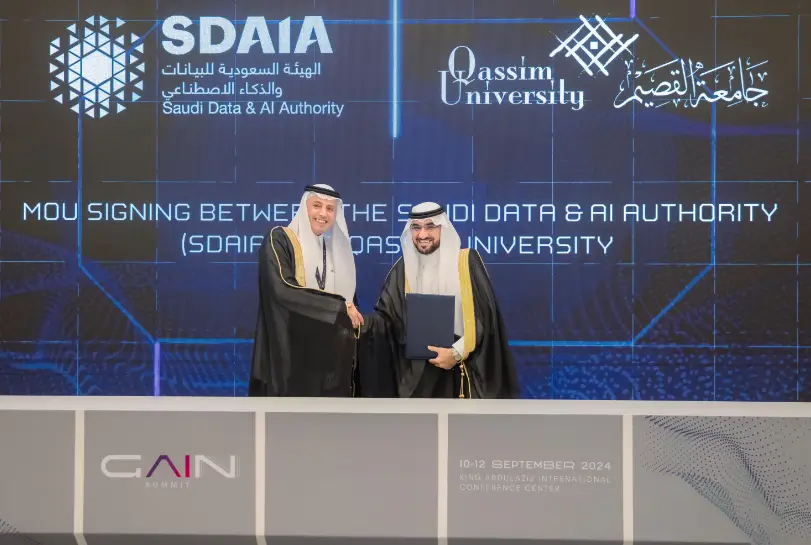
On Tuesday, September 10, 2024, the University and the Saudi Data and Artificial Intelligence Authority (SDAIA) signed a memorandum of understanding to cooperate in the field of education by training and developing national cadres, promoting awareness in the field of data, artificial intelligence and modern technologies, organizing career development programs for university graduates and job seekers in this field, as well as discussing ways of cooperation in the field of research and innovation and promoting the Kingdom's progress in the field of data and artificial intelligence.
The agreement was signed by His Excellency the President of the University, Prof. Dr. Mohammed bin Fahad Al-Sharekh, along with His Excellency the Director of the National Information Center, Dr. Essam bin Abdullah Al-Waqit, in the presence of His Excellency the Vice President for Business Development and Community Partnership, Dr. Majid bin Fadhi Al-Enezi, and the Dean of E-Learning and Information Technology, Prof. Saleh bin Mohammed Al-Bahli, during the third edition of the Global Artificial Intelligence Summit held in the city of Riyadh.
The MoU aims to enhance cooperation between SDAIA and faculty members, researchers, and graduate students at the university in providing and publishing knowledge studies and research related to data and artificial intelligence, giving them the opportunity to attend conferences, meetings, and events, and enabling them to provide training courses and scientific consultations to SDAIA according to the organizational regulations, in addition to discussing ways to cooperate in holding hackathons and challenges in the field of data and artificial intelligence in the Qassim region.
The memorandum also aims to enhance cooperation between the two parties in supporting and developing the non-profit sector in the fields served by the Ihsan platform through consultations and research and development capabilities, according to the available capabilities and without affecting the educational process, in addition to cooperation in establishing an artificial intelligence lab affiliated with the Sadaya Academy at the university headquarters to qualify students and specialists in this field in the Qassim region.
Industry and partnerships
The university has concluded many agreements with local and international universities and research centers to exchange and benefit from joint scientific research that enables faculty members and graduate students to benefit from the expertise of researchers in these centers and universities. The following table shows the cooperation arrangements between Qassim University and other educational institutions to implement partnership in scientific research.







Arrange the table for the university's cooperation with other educational institutions to implement the partnership in scientific research
University of International Economics and Trade - China
| Beneficiary College | Contract Duration | Date of signing the contract | Name of the Agreement | Areas of cooperation |
|---|---|---|---|---|
| Faculty of Arabic Language | Two years | 2010 | Services contract between Qassim University and China University of Economics and International Trade | Dispatch faculty members and facilitate the admission of a number of qualified students |
Durham University - United Kingdom
| Beneficiary College | Contract Duration | Date of signing the contract | Name of the Agreement | Areas of cooperation |
|---|---|---|---|---|
| International cooperation | 3 years | 15/11/2011 | Public Services Contract between International Cooperation at Qassim University and Durham University | A general decade of expertise, knowledge, development and training in professional services, curricula, strategic planning and graduate programs are provided to raise the efficiency of faculty members |
Shenzhen University of Chinese Medicine - China
| Beneficiary College | Contract Duration | Date of signing the contract | Name of the Agreement | Areas of cooperation |
|---|---|---|---|---|
| College of Medicine | Two years | 01/04/2010 | Services contract between Qassim University and Shenzhan Medical University | Dispatch of faculty members from the Faculty of Medicine for training at Shenzhen University |
Stanford University - United States
| Beneficiary College | Contract Duration | Date of signing the contract | Name of the Agreement | Areas of cooperation |
|---|---|---|---|---|
| College of Medicine | Two years | 15/04/2010 | Services contract between Qassim University and Stanford University | Offering courses in medical research |
Huazhang Agricultural University - China
| Beneficiary College | Contract Duration | Date of signing the contract | Name of the Agreement | Areas of cooperation |
|---|---|---|---|---|
| Faculty of Agriculture and Veterinary Medicine | Two years | 03/11/2010 | Services contract between Qassim University and Hozang Agricultural University | Transfer of appropriate techniques and knowledge for the development of science and research |
Maastricht University - Netherlands
| Beneficiary College | Contract Duration | Date of signing the contract | Name of the Agreement | Areas of cooperation |
|---|---|---|---|---|
| College of Medicine | 3 years | 01/04/2011 | Services contract between Qassim University and Maastricht University in the Netherlands | Exchange of faculty members between the two universities |
Beijing University of Health - China
| Beneficiary College | Contract Duration | Date of signing the contract | Name of the Agreement | Areas of cooperation |
|---|---|---|---|---|
| College of Medicine | Two years | 27/10/2011 | Services contract between Qassim University and Peking University Health Sciences Center | Assistance between the two parties in the development and research training in the fields of biotechnology |
Partnership with SABIC
SABIC funds some of the university's research annually. Below are the details of the funded research:
In 1428 A.H: Number of papers: 16, Completed: 13, Ongoing: 3.
In 1429 A.H: Number of papers: 15, Completed: 14, Existing: 1.
In 1430 AH: Number of papers: 14,Completed: 1, Ongoing: 13 (ongoing research).
In 1431 AH: Issue: (Arbitration in progress).
College of Science at Qassim University receives international academic accreditation for all its programs from the German Commission
The college is the first in the Kingdom to accredit the Master of Mathematics degree
D.Al-Hamoudi: We will continue to support quality in the faculties of the Faculty of Science
D.Yahya: We launched an annual award to support quality and create positive competition
D.Ramayan: Accreditation will help attract outstanding professors, researchers and students
D.Turkish: College graduates can compete globally in their various scientific disciplines
The College of Science at Qassim University has achieved international academic accreditation for all its programs from the German Commission for International Academic Accreditation (ASIIN), making it the first college in the Kingdom to achieve international accreditation for the (Master of Science in Mathematics) program and the second to achieve academic accreditation for all the college's programs.
His Excellency the President of Qassim University, Prof. Khalid bin Abdulrahman Al-Hamoudi, expressed his happiness for achieving this outstanding achievement for the College of Science, expressing his hope for the rest of the university's colleges to obtain academic accreditation, God willing. His Excellency pointed out that the College of Science has drawn its vision, mission and objectives in a scientific manner and crowned this with its outstanding outputs since its inception, and we hope for much from it in the future in serving the country and the citizen. His Excellency extended his thanks and appreciation to the dean and vice deans of the college, faculty members and all its employees for their efforts and continuous vigilance to reach this historic achievement of the college, and thanked all departments and deanships in the university that helped the college to achieve this achievement. His Excellency pointed out that the university will continue to focus on quality as it has established the Vice Presidency of Development and Planning in addition to the Deanship of Quality Assurance and Accreditation and the Deanship of University Development to support the march of quality in the university colleges. His Excellency the President extended his thanks and gratitude to the Custodian of the Two Holy Mosques, His Highness the Crown Prince and His Highness the Second Vice President for their continuous support for higher education and Qassim University, His Highness the Emir of Qassim Region and his deputy for their continuous support and continuous follow-up of the university's progress, and His Excellency the Minister of Higher Education and his deputy for their support and overcoming all difficulties faced by the university to reach the desired goals.
The UQU Vice President for Development, Planning and Quality, Prof. Dr. Sulaiman bin Abdulaziz Al-Yahya, congratulated the UQU President, Vice Presidents, the Dean of the College of Science and its affiliates, including leaders, faculty members and students, stressing that this reflects the university's general orientation in the interest and support of the process of applying quality in the university's colleges and academic programs, pointing out that the university colleges are moving forward in the accreditation of their programs, pointing out that the University Planning Agency launched the UQU President's Quality Shield Award annually for the faculties, deanships and departments in the university to create positive competition in this aspect, explaining in conclusion that the university is moving according to what was planned
For his part, Dr. Fahad bin Mohammed Al-Rumayyan, Dean of the College of Science, said: Academic accreditation is an effective tool for evaluating and enhancing the quality of the educational process and the continuity of its development. Obtaining academic accreditation enhances confidence in the educational institution that has obtained accreditation by the community, and increases the chances of success and excellence. It is a way for the college to be more attractive and able to attract distinguished faculty members, researchers, and administrators, as well as bright students. Therefore, the College of Science was keen to accelerate the process of obtaining accreditation by fulfilling its requirements. After God's success and then the diligent work of the college administration, with its various departments and units, and its students, the college obtained academic accreditation for all undergraduate programs, namely mathematics, physics, chemistry and biology, in addition to the master's program in mathematics, from the international accreditation body ASIIN. This accreditation is an important step for the college towards providing educational and research services at an international level. It also enhances confidence in it, as it aims to invest in the human element, which is the basis for comprehensive development. It also helps the college to move forward in ensuring the quality of the performance of its various departments and units and the performance expected of them in terms of the educational, research and service process according to the specific mechanisms and frameworks set by the accreditation system of the accrediting body.
The accreditation came as a culmination of the efforts of the deanship of the college and its vice deans in the male and female students and the educational and administrative bodies in the college departments and its various units to upgrade the educational and research process and provide all possible means of development. I would like to mention here the efforts of the Quality Assurance and Accreditation Committee in the college under the supervision of my colleague Prof. Abdullah bin Ibrahim Al-Turki, Vice Dean for Administrative Affairs and the quality committees in the college departments and not forget the role of our male and female students and their determination to achieve quality scientific achievement. It is worth mentioning that accreditation is an important first step to achieve quality, which will be followed, God willing, by continuous cooperation between the college and ASIIN to enhance the application of international standards in the college's educational, administrative and research work, because development is a sustainable process and requires continuous follow-up of the latest theories and developments in educational and research curricula and supporting services.
On this occasion, I am pleased to extend my thanks and appreciation to His Excellency the President of Qassim University, Prof. Dr. Khalid bin Abdulrahman Al-Hamoudi, whose great material and moral support for the college had the greatest impact - after God's success - in obtaining the international accreditation. I also thank the Vice President for Planning, Development and Quality, Prof. Sulaiman bin Abdulaziz Al-Yahya, who played a special role in standing with the college until it obtained the accreditation, and thanks are extended to the university's vice presidents and I do not forget the special support of the Deanship of Quality and Accreditation led by its Dean Dr. Abdullah bin Ibrahim Al-Mashaikh.
Prof. Dr. Abdullah bin Ibrahim Al-Turki, Vice Dean of the College of Science for Administrative Affairs and Supervisor of Quality and Accreditation, expressed his happiness about the international academic accreditation obtained by the college, especially that it comes in fulfillment of the mission and vision of the college, which is based on the aspirations of the university in this field and in response to the directives of its administration. He pointed out that the accreditation comes in recognition of the efficiency of the scientific programs offered by the College of Science to its male and female students, and that it achieves the quality standards applied in distinguished universities internationally, and that the graduates and graduates of the college can compete globally in various fields of their scientific disciplines. Prof. Al-Turki stressed that the German Academic Accreditation Authority team praised the strength of the infrastructure of Qassim University, student and office services, the automated admission and registration system, health and recreational services, laboratory and laboratory equipment in the college, and the preparations found in the college at the level of faculty members.
Prof. Al-Turki pointed out that the international academic accreditation obtained by the college is the fruit of the great and serious efforts made by the Quality Assurance and Accreditation Unit, the quality sub-committees in the scientific departments, faculty members and all affiliates of the college, which started three years ago by preparing a review of the study plans for the college programs, and completing the preparation and collection of all accreditation documents.
For his part, Prof. Dr. Sulaiman bin Saleh Al-Thayeb, Dean of the College of Science (formerly) and one of the pioneers of this achievement, said that the accreditation was achieved only by the grace of God and then by the unlimited follow-up and support of the leader of the first education, the Custodian of the Two Holy Mosques, King Abdullah bin Abdulaziz - may God protect him - and those in charge of higher education in the Kingdom and then the concerted efforts and cooperation of all.
He pointed out that the academic accreditation process includes criteria related to the competence of faculty members, curricula and the development of the admission and registration system, in addition to the college's adoption of self-evaluation and continuous development and studying the weaknesses and strengths of its offered programs and their relationship with community institutions and the labor market and the extent to which the skills mastered by graduates match the needs of the various employment sectors in the country, the region and the world.
This requires strategic planning to ensure high and competitive levels of outputs related to the known university functions (education - scientific research - community service), which is what the College of Science at Qassim University is pursuing.
Prof. Dr. Al-Thaib emphasized Dr. Al-Thayeb stressed that the accreditation of the College of Science will reflect on all affiliates of the college, and its faculty members will find global acceptance, whether in terms of postgraduate studies or in terms of accepting their research outputs and publishing them in distinguished publishing vessels.
The head of the physics department, Dr. Saleh Abdullah Al-Ashra, said that the scientific departments in the College of Science have long sensed the importance of program accreditation. They were very keen to apply quality standards to obtain accreditation for the college's programs. This accreditation is a real indicator of the quality of the departments' outputs. This has a great impact on the preparation of specialized scientific cadres that contribute to the service of society, whether in the field of education, industry or other areas of life. The scientific departments were keen on accreditation because this is in line with the vision, mission and objectives of the college and the university. Thanks to God and then the unlimited support provided by the Custodian of the Two Holy Mosques, may God protect him and his wise government for higher education and thanks to the outstanding efforts exerted by the university administration and the employees of the Faculty of Science, including faculty members, administrators and others, which had a great impact on obtaining accreditation. Obtaining accreditation is a means, not an end. Our goal is to continue and progress that returns to the college and its affiliates with progress and excellence.
Dr. Badr bin Saleh Al-Muhaimid, Head of the Department of Mathematics at the College of Science, said that the College of Science obtaining academic accreditation from the German Authority for International Program Accreditation (ASIIN) is an extension of the steady achievements and successes and the global academic developments achieved by the university in various fields, and this achievement recorded in international forums in the name of the nation is a clear indication of the scientific status that the Kingdom currently occupies. Dr. Al-Qassim University has the right to be proud of an unprecedented achievement that made their college in the ranks of international colleges despite its newness, and gave it the status of academic quality with an international certificate. Dr. . Dr. Al-Muhaimid pointed out that obtaining academic accreditation did not come out of nowhere. It was preceded by the efforts of a large team to achieve this achievement in its educational programs, which will enable the college and the university more generally to link its educational programs with prestigious international universities, and this will support the requirements of the labor market and society in general and will enable to benefit from the latest and best experiences in distinguished international universities in the field of building and updating curricula in addition to benefiting from the views of employment institutions in the public and private sectors, which ensures that the student graduates from an accredited program to have obtained a set of knowledge, abilities and skills necessary to practice the profession enjoyed by his peers in developed countries.
The Director of the Quality Assurance and Academic Accreditation Unit at the College of Science, Prof. Dr. Ahmed Ahmed Al-Sawi Hijazi, said that the College of Science obtaining international programmatic accreditation from the German body (ASIIN) is the culmination of Qassim University's distinguished march towards global leadership and an achievement added to the university's continuous scientific achievements. This achievement achieved by the college came thanks to God first, then the support of the college administration and the diligent and continuous effort of all faculty members, college affiliates, male and female students and the realization of the importance of continuous development and commitment to it and solidarity for its success and interaction with its outcomes.
He pointed out that the college started the process of giving since its inception by participating in all accreditation and academic development projects, starting with the self-study project, the program development study project, the academic program development project, the international accreditation project for academic programs, and finally the national accreditation project for undergraduate programs of the National Commission for Academic Accreditation and Assessment in the Kingdom of Saudi Arabia.
Prof. Al-Sawi extended his congratulations to Qassim University, the College of Science and all the staff and affiliates of the college on this great achievement. This achievement means that they are assured of the quality of education and teaching and that they comply with the standards of academic accreditation while adhering to the missions of the college and the university, in addition to the conviction of employers of the excellence of the college's outputs and the choice of college graduates to take jobs. This is in addition to the conviction of employers of the excellence of the college's outputs and the choice of college graduates to assume appropriate jobs in the labor market, in addition to the ease of international exchange for college students to complete their undergraduate or graduate studies in any recognized international university.
University conference to discuss ways to develop investment and industrial finance in Saudi Arabia
Under the patronage of His Excellency Dr. Ahmed Al-Issa, Minister of Education, the university will organize the Industrial Investment and Finance Conference tomorrow, Wednesday, 26 Jumada II 1439H, in Hall A in the main building of the University City. The conference aims to identify the current status of industrial investment and its relationship with the structure of the Saudi economy, shed light on industrial investment and finance policies in the Kingdom, in addition to identifying the various international, regional and local experiences in the fields of industrial investment and finance and the lessons learned from them.
The conference comes within the framework of the ambitious future vision of the Kingdom of Saudi Arabia to develop and grow the national economy, diversify its sources of income, and increase the competitiveness of various sectors at the local, regional and international levels, in addition to presenting a vision for the future of industrial investment and finance in the Kingdom, and reaching a proposal for a strategic framework that serves industrial investment and finance in light of Vision 2030.
Dr. Ibrahim Al-Hassoun, President of the Scientific Society for Investment and Finance at the Faculty of Economics, Qassim University, and Chairman of the Scientific Committee of the conference, stressed that the industrial sector is one of the most promising sectors among the various productive sectors in the Kingdom, pointing out that the literature on development and economic growth confirms that industrial development is the main axis that countries seek, and from this perspective, the importance of holding this conference at this time emerged.
He expressed his hope that the conference will come up with recommendations on diversifying industrial investment and financing programs, increasing the utilization of available resources, creating suitable job opportunities for citizens, transferring and localizing industrial technology, in order to contribute to achieving the goals and vision of the Kingdom 2030, stressing that the scientific committee of the conference was keen to have speakers from representatives of local and international industrial bodies and institutions to benefit from successful experiences in this field, as Dr. Musleh bin Hamed Al-Otaibi, Acting President of the Royal Commission for Jubail and Yanbu, and Engineer Khaled bin Mohammed Al-Salem, Director General of the Saudi Commission for Industrial Development, will speak at the conference.
He explained that the conference will address several topics, including the current status of industrial investment and financing in the Kingdom, the issues and challenges facing it, the investment and financing policies and legislations regulating it, the role of government institutions such as the Ministry of Energy, Industry and Mineral Resources, the Ministry of Commerce and Investment, the Industrial Development Fund and industrial cities in industrial development in the Kingdom, in addition to FDI and the contribution of the industrial sector to the Kingdom's GDP, the structure of industrial exports and imports, the labor market in the Kingdom, and the competitiveness of the Saudi industrial sector locally
He added that the conference will discuss industrial investment and financing opportunities in the Kingdom, means of creating the legislative and regulatory environment for the industrial sector, developing and diversifying industrial activities and fields, structuring the labor market, modernizing the infrastructure of the industrial sector, technology readiness, adopting the industrial cluster system as an alternative to traditional industrial cities, developing existing sources of financing, and developing new sources of financing to support industrial investment in the Kingdom.
The University organizes a conference to activate the role of scientific research in building the Kingdom's knowledge economy
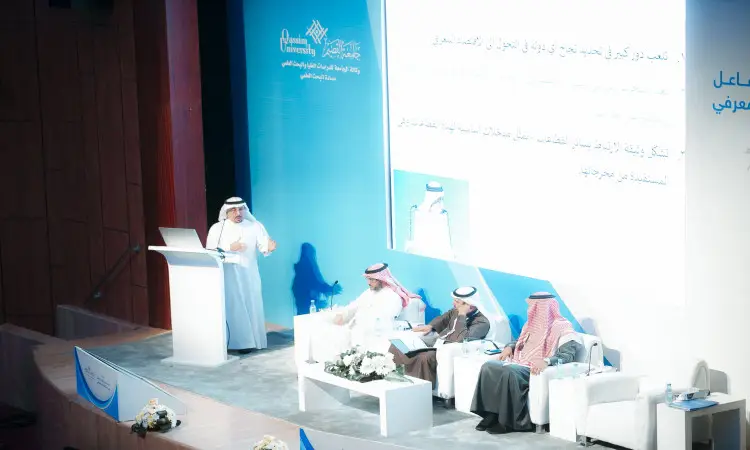
His Excellency Prof. Dr. Abdulrahman bin Hamad Al-Dawood, President of the University of Saudi Arabia, affirmed that universities in the Kingdom of Saudi Arabia are mandated to provide everything that develops the aspect of the knowledge economy, which is the main pillar for increasing production and development, especially in light of the great support that universities receive from the wise leadership by the Custodian of the Two Holy Mosques and His Highness the Crown Prince - may Allah protect them -.
During his patronage of the "Towards Effective Scientific Research in Building the Knowledge Economy" conference, which kicked off on Wednesday at Al-Malidah University City and continues until tomorrow, Thursday, with the participation of 13 specialists from various universities and research centers from inside and outside the Kingdom, Al-Dawood added that universities are the focus of discussing such topics, pointing out the importance of students specializing in various graduate programs understanding the importance of their role in developing, promoting and the future of scientific research in our country.
Al-Dawood also stressed that holding this conference at Qassim University comes out of the keenness of the University Vice Presidency for Studies and Scientific Research and the specialists in the university's colleges and research centers to activate this axis stipulated by the Saudi Vision, and to activate this term of the knowledge economy not only by talking, meetings and conferences, but we must also take these research and experiences from universities to the production stage, and then the development stage and then the encouragement stage.
Al-Dawood added that the university will not stop at holding this conference, but will be followed by conferences and events, until we celebrate, God willing, the increase and diversity of production that we all seek at the level of universities, especially since the country needs to discuss, activate and develop this matter. He thanked everyone who attended, participated and worked to make this conference a success, and the interest in this topic, stressing that the university will continue these efforts, God willing, until we reach advanced stages of scientific research to compete with those who preceded us in this field, stressing the importance of students, especially graduate students, attending such seminars and conferences, which will reflect positively on their performance and reflect on the homeland.
For his part, Dr. Ahmed Al-Turki, UQU Vice President for Postgraduate Studies and Scientific Research and Chairman of the Conference Organizing Committee, stressed that it is no secret that directed scientific research is the foundation on which the knowledge economy is built, and it is the one that transforms knowledge into products of economic value that may exceed the value of natural resources, and therefore it was necessary for universities and research centers in the Kingdom of Saudi Arabia to seek to direct scientific research priorities into applied research that ends with products that can be developed and then marketed to contribute to building a knowledge-based economy, which is one of the basic aspirations emphasized more than once by the vision of the Kingdom of Saudi Arabia.
Al-Turki explained that one of the most prominent examples based on the knowledge economy in the world is the work of Apple, which made from cheap raw materials such as glass, plastic and copper smartphones that are sold for thousands of dollars, as the income of this company exceeded the world's companies in the fields of oil, gas, cars and real estate, indicating that from this perspective and in order to achieve this vision, the university wished to organize this conference to benefit from these experiences and direct practical research in universities towards a knowledge economy, and to identify the obstacles and challenges to practical research towards transformation into marketable products.
He added that the conference also aims to identify the obstacles and challenges in this field and to activate the opportunities that contribute to building the knowledge economy, and to benefit from successful experiences in the Arab and international world in this field. The conference included various themes, the most important of which are the requirements of the knowledge economy, obstacles, challenges, areas and opportunities, in addition to successful practices and bright experiences, and the conference was approved by 13 researchers who have experience, expertise and scientific research in the field of the conference from some Saudi universities.
Dr. Mohammed bin Abdullah Al Abbas, a member of the Shura Council, delivered the participants' speech in which he stressed that the science of economics is still full of secrets, renewed ideas and many challenges, quoting a quote from an international economic writer: "The economy as we know it today would not exist if economic predictions were correct, but the economy as we know it today is the result of the mistakes of economists more than their correct predictions." He pointed out that the enormous economic events that passed during the past centuries could not be accurately predicted and in many cases could not be theorized, and yet many of the economic facts as we see them today are the result of them.
Al Abbas said that the world is going through the fourth industrial revolution, which is the stage that witnesses the penetration of technology into all human life, in which robotics, artificial intelligence, nanotechnology, and 3D printing appear to lead us towards major changes in production and management systems, and yet this huge breakthrough has hardly been theorized and its effects on societies, noting that our Vision 2030 shows the main interest in making a strategic qualitative leap in line with this technological era, pointing out that the annual speech of the Custodian of the Two Holy Mosques King Salman bin Abdulaziz - may God protect him - which was delivered by the Custodian of the Two Holy Mosques.
"Al Abbas" stressed the importance of effective investment in human capital, and the realization that developing and investing in human capital requires many measures to enhance the status of science and scientific research, as investing in knowledge in general is a bigger issue than investing in human capital, indicating that this was emphasized by the Saudi Minister of Finance in his meeting with the International Transport Fund when he stressed the importance of capacity building that leads to the construction of advanced technologies by governments and individuals in general, and addressed the importance of technology in promoting financial inclusion globally, while stressing the importance of utilizing this tool to promote economic growth and develop markets
UQU President: The National Industries Development Program contributes to transforming the Kingdom into a major industrial powerhouse
His Excellency Prof. Dr. Abdulrahman bin Hamad Al-Dawood, President of the University, affirmed that the launch of the National Industries and Logistics Development Program, which is one of the most important and largest programs of the Kingdom's Vision 2030, will contribute to transforming the Kingdom into a major industrial power that contains many industrial castles and will make it an important station on global trade routes to provide logistics services, making the most of the untapped natural resources and distinguished geographical location granted by God Almighty to our dear homeland.
He pointed out that the Custodian of the Two Holy Mosques King Salman bin Abdulaziz and His Royal Highness the Crown Prince - may Allah protect them - are leading this economic transformation to achieve Vision 2030, reducing dependence on oil as the main source of income in the Kingdom, focusing on a number of other vital sectors that are important tributaries to economic and social development, namely the industrial, mining, energy and logistics sectors, raising their contributions to GDP by more than one trillion riyals, creating more than one and a half million jobs, attracting more investments and raising the volume of non-oil exports to exceed one trillion riyals.
He added that education and scientific research will have a major role in the development, promotion and development of the industries to be established in the next stage, as the industry depends mainly on trained and qualified cadres scientifically and practically to operate these factories, and universities will have a major role in providing qualified cadres in the fields of science, engineering, mining and others, in addition to scientific research and studies that can contribute to the development of many industries and benefit from the innovations and inventions produced by research laboratories in the Kingdom's universities.
Al-Dawood explained that this blessed step confirms that the Kingdom is moving towards the future with firm steps and unrelenting determination, and that the tricks and machinations of the enemies of this great nation will not deter it from achieving its goals in a more prosperous, safe, stable and united future under the banner of unification, to ensure a better life for future generations in all fields, praying to God to guide the leadership of this dear country and its people to what is good and development, and to guide their steps and make them the pride of this homeland and its people.
Dr. Al-Abdalmanim crowns Qassim University's top achievers and opens innovation exhibition
More than 255 students celebrated by the Deanship of Student Affairs
Dr. Al-Abdalmanim crowns Qassim University's top achievers and opens innovation exhibition
The Vice President of Qassim University, Prof. Dr. Abdulmunim bin Ibrahim Al-Abdulmunim, crowned the march of the outstanding male and female students in all colleges of the university in all stages (bachelor, master, doctorate) in a beautiful ceremony organized by the Deanship of Student Affairs in the hall of celebrations (A) in the university administration building in the presence of the Dean of Student Affairs, Dr. Khalid Al-Sharida and deans of colleges and deanships and university students, where he presented certificates of excellence and memorial shields to more than 255 students.
In his speech during the ceremony, Al-Abdulmunim praised the efforts of the Deanship of Student Affairs in preparing and organizing this celebration, saying: On behalf of myself and the UQU President, I extend my thanks to them for these clear efforts to organize this distinguished meeting, and thanks are also extended to my colleagues deans, deans, vice deans, vice deans, heads of departments and faculty members for their efforts. On this occasion, I congratulate the outstanding students, wishing them continued success and success, and ask the rest of the students to redouble their efforts to continue the march of excellence to achieve the highest ranks in their scientific career, stressing that the university is keen to support the march of excellence in its faculties.
The Vice Dean of Student Affairs, Dr. Ahmed Al-Shabaan, also praised the university administration's support for outstanding students, stressing the university's keenness to support and encourage them: It is the students' right for us to honor and celebrate them in such a scientific and cultural event that brings together outstanding students, inventors and researchers from the university,
The ceremony included a number of speeches and poems by the outstanding students, and a movie entitled "Success Story" was shown, which reviewed the activities of the different colleges and the successes achieved, in addition to meeting some of the outstanding students through recorded speeches about their educational journey at the university,
The UQU Vice President also opened the innovation exhibition at the Akkal Center for Talent and Creativity under the Deanship of Student Affairs, which aims to discover and nurture talented people, as the exhibition includes a number of different innovations from male and female university students.
Qassim University Organizes the Sixth International Conference of the American Computer Society (MEDIS 2014)
The 6th ACM International Conference on Management of Emergent Digital Ecosystems (MEDES'14) will be organized by the College of Economics and Administration at Qassim University during the period 20-22 Dhu'lqa'dah 1435H corresponding to September 15-17, 2014 at the Mövenpick Hotel in Buraydah.
This was stated by the Dean of the College, Dr. Obaid Al-Mutairi, who pointed out that the organization and hosting of the conference comes in response to the college's mission and responsibility towards the latest development issues represented in generating and building knowledge in order to build an advanced knowledge society, pointing out that the conference is considered one of the conferences of the American Association for Computing Machinery (ACM) specialized in technology and information systems, and has previously been held in a number of countries during the past years such as Luxembourg, the United States of America, and France. Hosting this conference in the Kingdom of Saudi Arabia is a unique opportunity to learn about scientific and practical experiences specialized in building advanced management information systems, and a continuation of the efforts of state institutions to develop Eco-System tools as the cornerstone and basis for building a knowledge society based on innovation.
It is noteworthy that the conference aims to discuss the most prominent modern methods and techniques in the field of advanced and sustainable management information systems. A number of specialized keynote speakers and a number of prestigious international universities such as University of California Irvine, University of Boston, Temple University, DTS ITC and INRIA will participate in the opening session of the conference. The President of King Abdulaziz City for Science and Technology on the experience of local innovation systems under the EcoSystems umbrella and the President of Saudi Telecom Company on the role of local telecom companies in the knowledge economy will also participate in the opening session of the conference.
Conference site: http://sigappfr.acm.org/MEDES/14.
Dr. . Dr. Al-Suwaiyel compares the Kingdom's position with the countries of the world in innovation with a strategic lecture: Qassim University succeeded in attracting giants in a conference that the Kingdom is proud of
Qassim University discusses innovation in business schools
The College of Economics and Administration at Qassim University will hold a workshop entitled "Innovation In Business Education" tomorrow morning, Monday, Muharram 17, 1436 A.H., at the college's conference hall, in addition to the mechanisms of developing and improving teaching methods, designing study plans and achieving educational goals in business schools. The workshop aims to present the best international practices in the field of administrative education and education in business schools, in addition to the mechanisms of developing and improving teaching methods, designing study plans and achieving educational goals in business schools. The workshop also presents a presentation of some leading experiences in this field with the participation of a group of experts from leading and accredited business schools in the world, in addition to the participation of the College of Economics and Administration at the university.
The Dean of the College of Economics and Administration, Dr. Obaid bin Saad Al-Mutairi, pointed out that the holding of this workshop stems from the keenness of the College of Economics and Administration to assume its responsibilities towards the higher education sector in the Kingdom, based on the college's mission to serve the community and the business sector at a time when education in business schools in the world is undergoing a qualitative shift due to the acceleration in various business fields, which requires these schools to keep pace with economic changes and competition factors in which professionals who graduate from business schools play the most prominent role.
Dr. Al-Mutairi stressed the need to crystallize the concepts of innovation and impact in business schools and to link study plans, course methodologies and academic programs to these concepts in a way that can build qualified graduates who are able to keep pace with market requirements and make the required impact in line with the concepts of the knowledge-based economy as a strategic goal adopted by the UAE.
For his part, the Vice Dean of the College for Educational Affairs, Dr. Mohammed bin Ibrahim Al-Obayeb, explained the urgent need to hold such purposeful workshops that contribute to clarifying many developmental concepts that are lacking in many business colleges in the region. Especially in light of the acceleration of economic growth, the business sector and its increasing requirements, which business school graduates are unable to keep up with in light of maintaining traditional study plans, curricula and evaluation mechanisms.
Dr. Al-Obayeb also pointed out the importance of the central role that business schools occupy in the Kingdom and the need to consolidate the concepts and mechanisms of executive continuous improvement that work to achieve the objectives of educational programs and advance education in business schools.
Dr. Qasim Zureiqat, Director of the AACSB International Academic Accreditation Office at the college, said that the college's journey in recent years in the field of international accreditation and the developmental and improvement practices in the educational process have provided the college with distinctive experiences in the field of education. This workshop comes as an initiative by the College of Economics and Administration to present the best practices based on standards and strategies adopted by leading business schools in the world, in addition to indicating the possibilities and mechanisms of application and ways to link international standards with the reality of business schools in the Saudi Arabian environment, with the need to work on linking the land.
Dr. Zureiqat went on to say: This workshop is considered one of the distinguished workshops at the level of the entire region through its presentation of the mechanisms of building academic programs in business schools and linking these programs to the requirements of the business sector, in addition to its focus on the concepts of innovation in academic programs and the implementation mechanisms for these concepts.
It is noteworthy that the College of Economics and Administration at Qassim University is one of the colleges that has made a distinguished journey in its quest to obtain international academic accreditation from the Accreditation Commission for Business Schools (AACSB). It obtained the initial qualification in 2012, and worked to submit a plan to comply with the standards, which was approved in July 2013, and obtained the approval of the Accreditation Commission for the first performance report in September 2014, and is currently continuing in the stage of preparing the self-assessment report and preparing for the examiners' visit.
References
[1] [Online]. Available: .https://www.qu.edu.sa/content/news/145
[2] [Online]. Available: .https://www.qu.edu.sa/content/news/792
[3] [Online]. Available: .https://www.qu.edu.sa/content/news/1045
[4] [Online]. Available: .https://www.qu.edu.sa/content/news/1135
[5] [Online]. Available: .https://www.qu.edu.sa/content/news/90
[6] [Online]. Available: .https://www.qu.edu.sa/content/news/193
[7] [Online]. Available: .https://www.qu.edu.sa/content/news/199
[8] [Online]. Available: .https://www.qu.edu.sa/content/news/220