 Official government website of the Government of the Kingdom of Saudi Arabia




11
11. Sustainable Cities and Communities

- About SDG 11
- Public access to buildings
- Public access to libraries
- Public access to museums
- Public access to green spaces
- Arts and heritage contribution
- Record and preserve cultural heritage
- Sustainable practices targets
- Promote sustainable commuting
- Allow remote working
- Affordable housing for employees
- Affordable housing for students
- Pedestrian priority on campus
- Local authority collaboration regarding planning and development
- Planning development - new build standards
- Building on brownfield sites
Related Content
SDG 11: SUSTAINABLE CITIES AND COMMUNITIES
Qassim University’s Contribution to SDG 11: Advancing Sustainable Cities and Communities
Sustainable Development Goal 11 (SDG 11) focuses on making cities and human settlements inclusive, safe, resilient and sustainable. As the pace of urbanization accelerates, sustainable cities and communities are increasingly important to ensure a high quality of life while minimizing environmental impact. Qassim University, located in Saudi Arabia, recognizes the importance of SDG 11 and is actively engaged in initiatives that promote sustainable urban development and community well-being.
Urban Planning and Design:
Qassim University contributes to Goal 11 through its focus on urban planning and design. The university offers programs that teach students about sustainable urban development, efficient land use, and infrastructure design that minimizes environmental impact.
Research on Urban Sustainability
The university's commitment to Goal 11 is reflected in its research efforts focused on urban sustainability. Qassim University's research projects explore solutions to urban challenges such as waste management, transportation, green spaces, and energy efficiency. By producing knowledge, the university contributes to the development of sustainable cities and communities.
Community Engagement and Participation
Qassim University actively engages with local communities through outreach programs. The university collaborates with residents, government agencies, and non-governmental organizations to address community needs, promote awareness of sustainable practices, and encourage active participation in urban development projects.
Enhancing Green Spaces
Qassim University calls for the creation and preservation of green spaces within cities. The university emphasizes the importance of parks, green spaces and recreational areas that contribute to the well-being of the community and improve the quality of air and the overall beauty of cities.
Educating Future Urban Planners
The university's commitment to Goal 11 extends to educating future city planners and urban designers. Qassim University equips its students with knowledge about sustainable urban practices, urban infrastructure management, and the integration of smart technologies to create cities that are adaptable and responsive to changing needs.
Collaboration for Smart Cities
Qassim University collaborates with government agencies and industrial partners to promote the concept of smart cities. Through research, workshops and projects, the university contributes to the development of urban areas that utilize technology to enhance services, improve efficiency and raise the quality of life for residents.
Sustainable Campus Initiatives
The university leads by example through sustainable campus initiatives. Qassim University applies energy efficiency technologies, waste reduction measures and green building practices on campus, creating a model that can be applied in communities.
Capacity Building for Local Authorities
Qassim University offers capacity-building programs for local authorities and city planners, focusing on sustainable urban development strategies, effective infrastructure management, and community engagement techniques that contribute to achieving Goal 11.
Cultural Heritage Preservation:
Preserving cultural heritage is an essential part of sustainable urban development. Qassim University emphasizes the importance of preserving historical and cultural sites within communities, to ensure that the identity and heritage of the region is preserved.
Qassim University's commitment to Goal 11 is demonstrated through its multiple efforts to promote sustainable cities and communities. By educating future city planners, conducting research, engaging with local communities, promoting green spaces, collaborating for smart cities, and implementing sustainable campus initiatives, the university is actively contributing to the development of inclusive, resilient, and environmentally conscious cities. Through its commitment, Qassim University plays an important role in advancing Goal 11 and creating a more sustainable and livable urban environment.
General Administration of Libraries and Knowledge Resources
Vision
A distinguished administration at the national level in supporting education, scientific research, and serving the Qassim community.
Mission
The department seeks to provide diverse and advanced information sources that meet the needs of beneficiaries in line with the requirements of the era and the development of educational and research performance at the university, and in line with its distinguished role in serving the community.
Values
In light of the commitment to the institutional values of Qassim University, the General Administration of Libraries and Knowledge Resources believes in the following values:
knowledge: It contributes to building a knowledge society.
Quality: We adhere to quality standards in performance and service delivery.
Creativity: We believe in providing an environment that supports continuous innovation and development.
Communication: We communicate efficiently with all our partners.
Integration: We promote integration in all our activities.
Objectives
- Achieving excellence in serving the educational process and scientific research.
Enhancing the role of the deanship in community service.
Updating paper-based information sources.
Developing databases, information technology, and digital resources.
Improving the attractiveness of the library to increase patron frequency.
Optimize hardware and improve site services and infrastructure.
Improving service delivery.
Increase efficiency, satisfaction and retention rates of human resources, improve management performance and maximize financial resources
University introduces visitors to the contents of its library at the Qassim Book Fair
The university is participating in the second Qassim Book Fair held at the International Center for Exhibitions and Conferences with a pavilion that introduces visitors to the contents of the university library of paper and electronic sources of information.
The number of books in the university library is estimated at 553,586 titles, while the number of periodicals and volumes reaches 14,110, in addition to 2,834 university theses and 25 rare manuscripts. On the electronic side, the library hosts more than 146 databases, 310,963 electronic periodicals, 51,422 electronic books, and 1,824,480 electronic university theses.
The university's participation is represented in displaying and selling its publications of books and peer-reviewed scientific journals, in addition to displaying the works of faculty members, as well as introducing the university and its shared electronic services through the Deanship of Library Affairs, which include information databases, electronic programs, documentation programs, plagiarism detection programs, journal classification programs, and other electronic programs that serve the university's affiliates.
For his part, the Dean of Library Affairs at the university, Dr. Sattam Al-Otaibi, said that the university is keen to participate in the community participation in the oasis of science and knowledge represented in the book fair, where the efforts of the university and its affiliates are reviewed through the special pavilion participating in the fair, by introducing visitors to the number of branch libraries at the university, the number of research papers published in university journals, the number of supported research, in addition to the number of university theses and manuscripts and the number of graduate programs (master and doctorate) in all faculties of the university through graphics shown on the sides of the university's pavilion.
Al-Otaibi added that the university was keen to make its pavilion at this year's exhibition one of the best and most attractive pavilions for visitors, interested people and intellectuals by displaying the group of faculty members and peer-reviewed scientific journals in all their parts.
Key Facilities at the University
The university has many facilities, including but not limited to the following:
Colleges, including laboratories, workshops, lecture halls, and office rooms for university employees, whether in the university city in Al-Malidah or in other branches.
Senior management buildings and buildings of deanships and departments.
The library building and branch libraries that provide services to all university affiliates.
The University Hospital Building, an integrated medical facility that is part of the Medical City in Al-Malida University City, will provide services to university affiliates and community members, in addition to the existing general and specialized medical clinics that provide health care to all university affiliates, including students, faculty and staff.
A residential city for students with integrated service facilities such as restaurants, prayer rooms, dining rooms, and rest rooms.
University housing for faculty members.
Sports City, which includes a range of cultural, social, and sports facilities implemented using modern designs, and provides a full range of playgrounds and services for students, faculty, and staff.
This grouping includes the following:
Bowling alley and recreational games (billiards, baby foot soccer, and ....).
Multiple gyms (soccer, basketball, volleyball, badminton, and ....).
A service building (for administration, restrooms, locker rooms, and ....).
A swimming pool building with a public amphitheater and is equipped for tournaments.
A social building equipped with meeting rooms, social living rooms, and a cafeteria.
A set of outdoor courts for soccer, basketball, and tennis.
These facilities have a total area of 98,800 m2 and cost SAR 89 million. They were built according to the latest construction models and equipped at a high level to serve the affiliates of Al-Qassim University through the Deanship of Student Affairs.
College of Agriculture and Veterinary Medicine Farms
Student and faculty cafeterias
Grand Ballrooms
Rules and Regulations for Utility Use
Rationalizing the use of facilities at the university is organized through a mechanism that goes through several stages, which can be listed as follows:
The first stage:
The stage of screening applications and making sure that what is being requested is not already available at the university.
Second stage:
Continuous work on rationalizing the use of facilities. The Facilities Management Department at the university has an important role in organizing and rationalizing the use of university facilities, in accordance with the above-mentioned facilities management tasks.
With the aim of rationalization and effective use, the university and colleges entrust the management of their farms, laboratories, medical clinics, sports and cultural facilities to specialized departments, including administrative and technical leaders, in order to rationalize and ensure the effective management and efficient use of all facilities. The university is also keen to make optimal use of university facilities such as laboratories, quality halls and others, and to organize the use of these facilities and equipment by all university affiliates and external parties through agreements that achieve financial return.
The university also guides the spending process with economical plans to provide equipment through alternatives to direct purchases such as renting and implementing services such as landscaping, cleaning and transportation by contracting with specialized companies.
Third stage:
Training the users of the devices to make the most of them. The university concludes all contracts for the supply of devices on the condition that the supplier provides training courses on how to use and operate the devices for those who will use them at the university.
In addition to the previous requirements for vendors to provide training on their devices, the academic system allows colleges to organize for experienced professors to impart their expertise and train teaching assistants and new faculty to use the devices in laboratories and elsewhere, through lectures and joint classroom activities.
The university sets regulations for the use of facilities, including:
Some facilities are restricted to the use of some university employees.
Some facilities are used on a time-restricted basis.
Some facilities are used according to financial controls.
Some facilities are available to all university affiliates.
Student Housing Department
University housing for students within the university city is one of the basic components of the university city, and it is important to provide the appropriate and comfortable atmosphere for students to complete their university studies easily, motivate them to achieve scientific excellence, and invest their free time and utilize it for their benefit through the services provided by the university within the university city, which are easily accessible to the student.
Sections:
- Student Affairs and Activities Unit.
- Supervision and Follow-up Unit.
- Maintenance and Services Unit.
Comprehensive statistics:
- Number of buildings used: (5) buildings.
- The building contains (12) wings, with a capacity of (94) rooms per building, for a total of (470) rooms in the five buildings.
- Number of Saudi students: (160) students.
- Number of internal and external scholarship students: (170) students.
UQU President announces 100% increase in Qur'an and Sunnah Competition rewards during his patronage of the Peoples' Heritage Festival
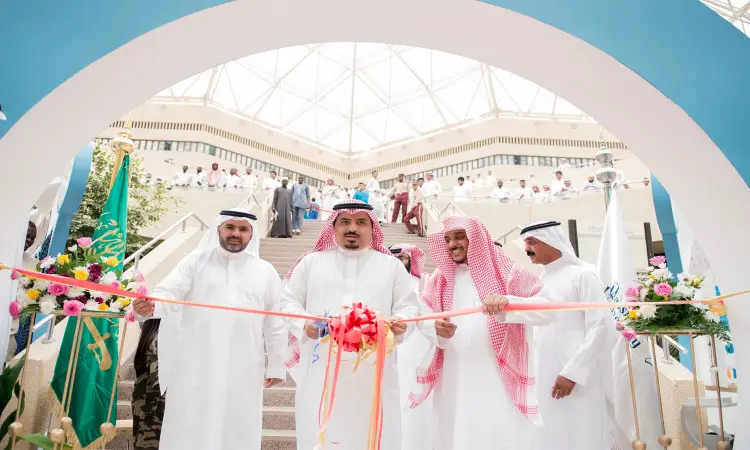
His Excellency Prof. Abdulrahman bin Hamad Al-Dawood, President of Qassim University, inaugurated the Heritage of Peoples Festival and the conclusion of student activities for the year 1439 AH in the main lobby on Monday morning, 23 Rajab 1439 AH, organized by the Deanship of Student Affairs, represented by the Student Housing Department, with the participation of 25 countries from different countries of the world, where each country was represented by 5 students from internal and external scholarships to show their products and popular foods and a window of the landmarks and civilization of their countries.
The exhibition witnessed the participation of Saudi Arabia, Syria, Afghanistan, Kosova, Bosnia, Pakistan, Yemen, China, Tunisia, Albania, Philippines, Thailand, Indonesia, Benin, India, Guinea, India, Malawi, Turkey and Chad, with 125 students participating in the exhibition, and the scholarship students presented a sign expressing their thanks to the government of the Custodian of the Two Holy Mosques for giving them the opportunity to study in the Kingdom of Saudi Arabia, while the participating students presented popular performances representing their countries.
Al-Dawood expressed his thanks for all the work and efforts of students, faculty members and participants in the Peoples' Heritage Festival or student activities, which brings together the various departments and colleges of the university with continuous work and thoughtful planning, and the Deanship of Student Affairs is always present in the scientific and cultural curricula and extracurricular activities and has achieved awards and championships for the university, most notably the first place in the Saudi Universities Futsal Federation Championship and other distinguished things.
Al-Dawood announced two good tidings for the university students. The first is an increase in student bonuses for the Quran and Sunnah by 100% due to the importance of these two competitions and to motivate students to participate in the good competitions. He explained that the university always seeks to encourage its employees to memorize the Book of Allah and the Sunnah of His Messenger, the constitution of this blessed country, which the leadership of this country is keen on, and to sponsor such two competitions led by the Custodian of the Two Haramain King Salman bin Abdulaziz and His Royal Highness Crown Prince Muhammad bin Salman - may Allah protect them - and the university is part of this blessed country. We hope that the Deanship of Student Affairs will expand in this field and receive the largest possible number of university affiliates, and the other good news is the establishment of a charitable fund for scholarship students, the proceeds of which will be for them, help them and take care of their needs and activities and will have an upcoming announcement with all its details to serve them. Al-Dawood explained that the university embraces students from more than 75 countries around the world, hoping that they will benefit from the activities provided to return to their country for the benefit of their country.
Mohammed Al-Omar, director of student housing and supervisor of the People's Heritage Festival, emphasized: The idea of the festival is based on the representation of grant students to display the heritage of their peoples in a festival that brings together the different cultures of the students of Qassim University. The university witnesses the embrace of students of more than 75 countries and the history of the country, the most prominent heritage, landmarks and popular foods are displayed to benefit the students and the mechanism of participation lies in the submission of a request from the students and the exhibition is studied and then approved.
UQU President inaugurates the "Heritage of Peoples" festival with the participation of more than 20 countries
His Excellency Prof. Abdulrahman bin Hamad Al-Dawood, President of the University, inaugurated on Tuesday morning the "Heritage of Peoples 40" festival, which is organized by the University, represented by the Deanship of Student Affairs at the headquarters of the University City in Al-Malida, and includes pavilions for more than 20 different countries, represented by scholarship students studying in various faculties of the University, where each country is represented by 10 students who display the most prominent heritage features of their countries and their products and popular foods.
The UQU President toured the different wings of the exhibition and expressed his admiration for the exhibits that contribute to introducing university students to the cultures of peoples and provide them with useful information about the diversity of heritage, customs and legacies among peoples.
The festival aims to showcase the different cultures of scholarship students and gather them under the dome of the main lobby of the university city in Al-Malida, where the university hosts students from more than 75 countries, and this festival gives them the opportunity to present the history of their countries and highlight the heritage, landmarks and popular foods to benefit the students. The festival, which is decorated with pavilions and flags for each country, aims to present the folklore of each country, its most prominent world, and popular performances, in addition to an entertainment theater, competitions and valuable prizes for the attendees.
The "Saudi" corner participating in the festival presents a number of popular and heritage traditions of the Kingdom of Saudi Arabia, including: Hijazi sessions, dates, ghee, Arabic coffee, falcons and the famous Saudi Majlis, where the pavilion was divided into two main sections, the first is the Saudi Majlis section, and the other is the heritage section, and the Majlis was divided according to the customs and traditions of several regions of the Kingdom to show the cultural diversity in the Kingdom, where each region is characterized by specific customs and legacies.
The festival has pavilions for many countries of the world, including: India, Indonesia, Ghana, Benin, Afghanistan, Malawi, Syria, Congo, Pakistan, Albania, Russia, Bangladesh, Philippines, Palestine, Ethiopia, Chad, Yemen, Thailand, Kyrgyzstan, Gambia, Singapore, Ivory Coast, Tunisia and Sri Lanka.
College of Science and Arts in Bakiriyah organizes an exhibition entitled "The Kingdom between ancient and modern"
On Monday, 21/3/1441 A.H., the University, represented by the College of Science and Arts for Girls in Al-Bakiriyah, organized an exhibition entitled "The Kingdom Between Ancient and Modern", which reviewed the diverse cultures of the Kingdom, as the exhibits combined the fragrant past, the glorious history of the country, and the culture of the prosperous present, to emphasize the Saudi Arabian identity and root the national heritage in all its aspects.
It also includes exhibits that represent the ancient civilizations and cultures of the Kingdom and its heritage, represented by the products of the folk market and handicrafts from tools
Decorations and tools that were used by the Saudi citizen in his environment more than 50 years ago, in addition to other aspects of folk heritage, which were represented in the display of local costumes in the countryside, popular cuisine and dates with Arabic coffee, in addition to heritage shows, handicrafts and small crafts related to fronds and weaving with pictures and brochures that deal with the most prominent features of the heritage and the country's authentic history.
The exhibition was also characterized by displays representing modern life in the present, such as samples of modern devices such as smart phones and digital cameras, as well as cork sculptures and paintings representing the Kingdom's Vision 2030, in addition to brochures, paintings and products representing modern technology, development and modernity.
Faisal bin Mishaal patronizes the conference "The Kingdom's efforts in consolidating the values of moderation and civilized coexistence" at the university
His Royal Highness Prince Dr. Faisal bin Mishaal bin Saud bin Abdulaziz, Governor of Qassim Region, stressed that the most prominent establishment of the values of coexistence in our dear country is the gathering of Muslims in the House of God, and in the mosque of His Messenger, the best prayer and peace, from all nationalities and sects, which is a close and not distant example that the world sees them all praying in one place and behind one imam, pointing out that this is the summit of coexistence away from racism, factionalism and sectarianism, this great coexistence that gives a clear picture of this Islam, the message of Islam and the unity of Muslims, which gives a white image of this Islam, the message of Islam and the unity of Muslims.
This came during his patronage of the conference "The Kingdom's efforts in consolidating the values of moderation and civilized coexistence: Concepts and Practices", on Tuesday morning, 24/6/1441 A.H., organized by the University, represented by the College of Sharia and Islamic Studies, in the presence of His Excellency Prof. Dr. Abdulrahman bin Hamad Al-Dawood, President of the University, Prof. Dr. Abdullah bin Abdul Mohsen Al-Turki, Advisor at the Royal Court, Dr. Osama Al-Sayyid Al-Azhari, Religious Advisor to the President of the Arab Republic of Egypt, Dr. Abdullah bin Mohammed Al-Fouzan, Secretary General of the King Abdulaziz Center for National Dialogue, the patron of the conference His Eminence Sheikh Mansour bin Ali Al-Qaraawi, university vice deans and colleges, and several speakers from inside and outside the Kingdom.
During his speech, HH the Emir of Al-Qassim pointed out that the Messenger of Allah, may Allah bless him and grant him peace, dealt with people of other religions and all those who are not Muslims in a good way, and his tolerance towards them had the greatest impact and is a good example for others to follow, stressing that the manifestations of coexistence in Saudi Arabia are evident in the stability and balance over the past years with friends in the countries of the world. The Kingdom's openness to all countries of the world seeking goodness and the interests of their peoples without regard to race or religion, pointing out that the Kingdom has great diversity in terms of tribes, social backgrounds, sectarian and cultural backgrounds, doctrinal and non-doctrinal doctrines, currents and customs, all of which are equal in terms of citizenship, rights and duties.
His Highness pointed out that the Kingdom's moderation made it confront all extremists, extremists, terrorists, and behavioral and intellectual degenerates, as it set regulations and rules that guarantee moderation and spread it among people, in education curricula, in people's public life, and its continuous scientific efforts, in addition to the establishment of the King Abdullah International Center, the Center for Dialogue of Civilizations at Imam University, the National Dialogue Center, and the Prince Khaled Al-Faisal Institute for Moderation, noting that the Kingdom maintains the approach of supporting Islamic centers in other countries and the continued great support for these centers is the summit of moderation and spreading Islamic Da'wa (Islamic call).
He added that Hajj and Umrah are among the most prominent forms of the values of moderation because of the familiarity, love, security and safety among Muslims, in addition to the Kingdom's efforts to consolidate the values of moderation and civilized coexistence by holding a number of conferences, meetings and workshops in this field, and its exertion of many efforts that support such, including the establishment of the King Salman Center for Relief and Humanitarian Aid, whose services include all countries of the world in need and affected, praying to God to maintain love among Muslims, and to grant the participants in this conference success in what is good and sound, and all who contributed in making this conference a success.
The two-day conference aims to monitor Saudi efforts to consolidate the values of moderation and civilizational coexistence at all levels, and to demonstrate the impact of Saudi legal discourse in spreading the concepts of civilizational coexistence. It also aims to establish the legal basis for the values of human communication and address its issues, highlight the role of governmental and non-governmental legal and cultural institutions in bridging the relationship with the other, introduce Saudi diplomatic efforts and relief institutions in deepening the meaning of mutual communication, and inspire pioneering Saudi experiences over the past years and decades.
For his part, His Excellency the UQU President, the General Supervisor of the conference, spoke about the determination of our country, the Kingdom of Saudi Arabia, to move steadily, with the grace of Allah, towards achieving its plans and goals with distinguished successes, in a global reality riven by troubles, polarizations and transformations, accompanied by its Constitution based on the Book and the Sunnah, and according to a comprehensive strategic vision based on the principle of integration in all levels, noting that Vision 2030 is a road map for sustainable development towards an ambitious nation, a prosperous economy and a vibrant society based on the Saudi human being who is its pillar and essence.
Al-Dawood referred to a speech by the Custodian of the Two Holy Mosques King Salman bin Abdulaziz, may God protect him, at the opening of this comprehensive vision, in which he said: "My first goal is for our country to be a successful and leading model in the world at all levels, and I will work with you to achieve this," followed by a speech by the architect of the vision, His Royal Highness Prince Mohammed bin Salman, Crown Prince and Minister of Defense, may God protect him, in which he said: "Our vision for the country we want: A strong and prosperous country that expands for all, whose constitution is Islam, whose approach is moderation, and which accepts others."
He explained that this conference, organized by your university, Al-Qassim University, represented by the College of Sharia and Islamic Studies, is based on this unique vision, and on the Kingdom's great efforts in spreading the correct concepts of Islam, and to shed scientific light on these efforts in the field of human communication based on moderation and moderation, which is carried out and consolidated by state agencies and institutions, according to a firm Islamic principle, as the Kingdom bases its relations with others - across different nations and diverse environments, cultures and fields - on a legal principle expressed by the Holy Quran in the words: {and we made you people of different nations and tribes}.
Al-Dawood emphasized that the Kingdom of Saudi Arabia's efforts in this vital field in terms of concepts, positions and applications are extended, broad and comprehensive, so this conference came to discuss a number of axes, including the legal basis for the values of human communication and addressing its issues, the Saudi legal discourse and its impact in spreading the concepts of communication, the role of governmental and non-governmental legal and cultural institutions in bridging the relationship with the other, diplomatic efforts in deepening the meanings of mutual communication, the role of relief institutions, and pioneering personal experiences, in addition to personal experiences.
The UQU President extended his thanks and gratitude to the Custodian of the Two Holy Mosques and His Highness the Crown Prince for the unlimited support the university receives, to His Highness the Emir of Qassim for his honor and encouragement for the various activities of the university, and to the colleagues in charge of preparing and organizing this conference, especially the organizational committee headed by Dr. Khalid bin Bani Al-Harbi, Vice President for Planning, Development and Quality, and the colleagues in the scientific committee headed by the Dean of the College of Sharia and Islamic Studies, Dr. Khalid bin Abdulaziz Abul Khail, and all colleagues in various departments.
After that, the head of the conference organizing committee, Prof. Dr. Khalid Bani Al-Harbi, UQU Vice President for Planning, Development and Quality, spoke about the countries that write their history with the good values they offer to this world, where the Kingdom of Saudi Arabia, praise be to God, has laid solid foundations since its establishment by the late King Abdulaziz bin Abdulrahman, where the Kingdom adhered to Islam as a method and practice, but also policy and education, and persisted with its leaders until the reign of the custodian of our renaissance King Salman bin Abdulaziz and his Crown Prince, may God bless them both, establishing understanding and cultural understanding in its comprehensive concept in all the joints of life
Al-Harbi added that the scientific committee, led by Dr. Khalid bin Abdulaziz Abu Al-Khail, Dean of the College of Shari`ah and Islamic Studies at the university, has received many abstracts and research ideas since the announcement of the organization of the conference. This work resulted in the participation of more than 9 countries with about 30 researchers participating in a number of qualitative research works to cover the themes and objectives of the conference. We were blessed with God's success in this forum with a partner for success represented by the strategic partner, Sheikh Mansour bin Ali Al-Qaraawi, and we are grateful to him for the most abundant and greatest praise and the most recognition for the fruitful constructive cooperation he returned to us, we look forward to the continuation of this partnership
The head of the organizing committee thanked the participating parties, namely: The Intellectual Warfare Center at the Ministry of Defense, the King Abdulaziz Center for National Dialogue, the General Directorate for Combating Extremism at the Presidency of State Security, and the King Salman Humanitarian Aid and Relief Center.
His Excellency Dr. Osama Al-Sayed Al-Azhari, religious advisor to the President of the Arab Republic of Egypt, delivered a speech on behalf of the conference participants in which he spoke about the Kingdom's great efforts in the field of moderation and coexistence, including the Muslim World League, which was established sixty years ago, and continued for decades as an incubator for Muslim scholars from the East and West to discuss major issues that concern Muslims, and the King Abdullah bin Abdulaziz International Center for Interfaith and Intercultural Dialogue, founded in 2010 by the Kingdom of Saudi Arabia, Austria and Spain, with the Vatican as an observer founding member, in addition to
Al-Azhari added that among the Kingdom's diligent efforts in this field is the Mecca Document, which was signed in the month of Ramadan in 1440 AH, on the sidelines of the international conference on the values of moderation and moderation organized by the Muslim World League in the Kingdom, which stipulates combating terrorism, injustice and oppression, rejecting the violation of human rights and dignity, and establishing the values of moderation and coexistence between religions, cultures, ethnicities and sects in the Islamic world He also referred to the Kingdom's generous sponsorship of the major Islamic scientific schools that have spent centuries consolidating the values of moderation, such as Al-Azhar and others, concluding his speech on behalf of the conference guests with wishes of success and success for all, and wishing the Kingdom of Saudi Arabia, the land of Kenan, Egypt, and our nations security, prosperity and prosperity.
In the end, a video was shown about the conference, its objectives and vision, and then HH the Emir of Qassim honored the participants.
References
[1] [Online]. Available: .https://www.qu.edu.sa/managements/lad/
[2] [Online]. Available: .https://qu.edu.sa/content/news/1110
[3] [Online]. Available: .Facilities Usage Guide
[4] [Online]. Available: .https://www.qu.edu.sa/students-housing/
[5] [Online]. Available: .https://www.qu.edu.sa/content/news/823
[6] [Online]. Available: .https://www.qu.edu.sa/content/news/1136
[7] [Online]. Available: .https://www.qu.edu.sa/content/news/1572
[8] [Online]. Available: .https://www.qu.edu.sa/content/news/1737
- About SDG 11
- Public access to buildings
- Public access to libraries
- Public access to museums
- Public access to green spaces
- Arts and heritage contribution
- Record and preserve cultural heritage
- Sustainable practices targets
- Promote sustainable commuting
- Allow remote working
- Affordable housing for employees
- Affordable housing for students
- Pedestrian priority on campus
- Local authority collaboration regarding planning and development
- Planning development - new build standards
- Building on brownfield sites