 Official government website of the Government of the Kingdom of Saudi Arabia




King Abdulaziz Convention Center
Introduction to the Center:
is King Abdulaziz Conference Center at Qassim University The largest conference center in the Qassim region, built on a total area of 55 acres,000 m² with a total building area of 23,500 m² with a capacity of up to 3,500 personwhich qualifies it to host major conferences, symposiums and events at the university and regional levels.
The center consists of three main parts (A, B and E) and includes an integrated set of halls and supporting facilities, including:
- Large main theater with a capacity exceeding 2,000 seatsdedicated to major conferences and events.
- Medium theater with a capacity of more than 700 seatsSuitable for seminars and lectures.
- Large meeting room with a capacity of more than 72 seats.
- Permanent exhibition Featuring more than 20 corners To view accompanying posts and activities.
- Multipurpose training rooms.
- Meeting rooms.
- Support Services Offices.
- Dining halls to serve the center's patrons.
- Parking lots Serving visitors and event staff.
This integration of facilities and equipment contributes to enhancing the center's role as an integrated platform for organizing events and conferences and supporting the university's academic and community mission, under the supervision of the General Administration of Facilities and Housing.
Upper Center Range
The scope of work of the King Abdulaziz Conference Center includes hosting and organizing conferences, forums, seminars, and official events in support of the university's academic and institutional activities. The General Administration of Facilities and Housing supervises the operation of the center by following up the readiness of the halls and facilities, coordinating with the beneficiaries, supervising the technical equipment and operating the systems according to the approved standards.
Technical Equipment and Institutionalization
The center includes integrated technical and operational equipment that ensures efficient organization of events and quality performance, and contributes to enhancing the university's ability to host major events, support scientific activities, highlight the university's institutional image, and enhance the integration of its facilities and services.
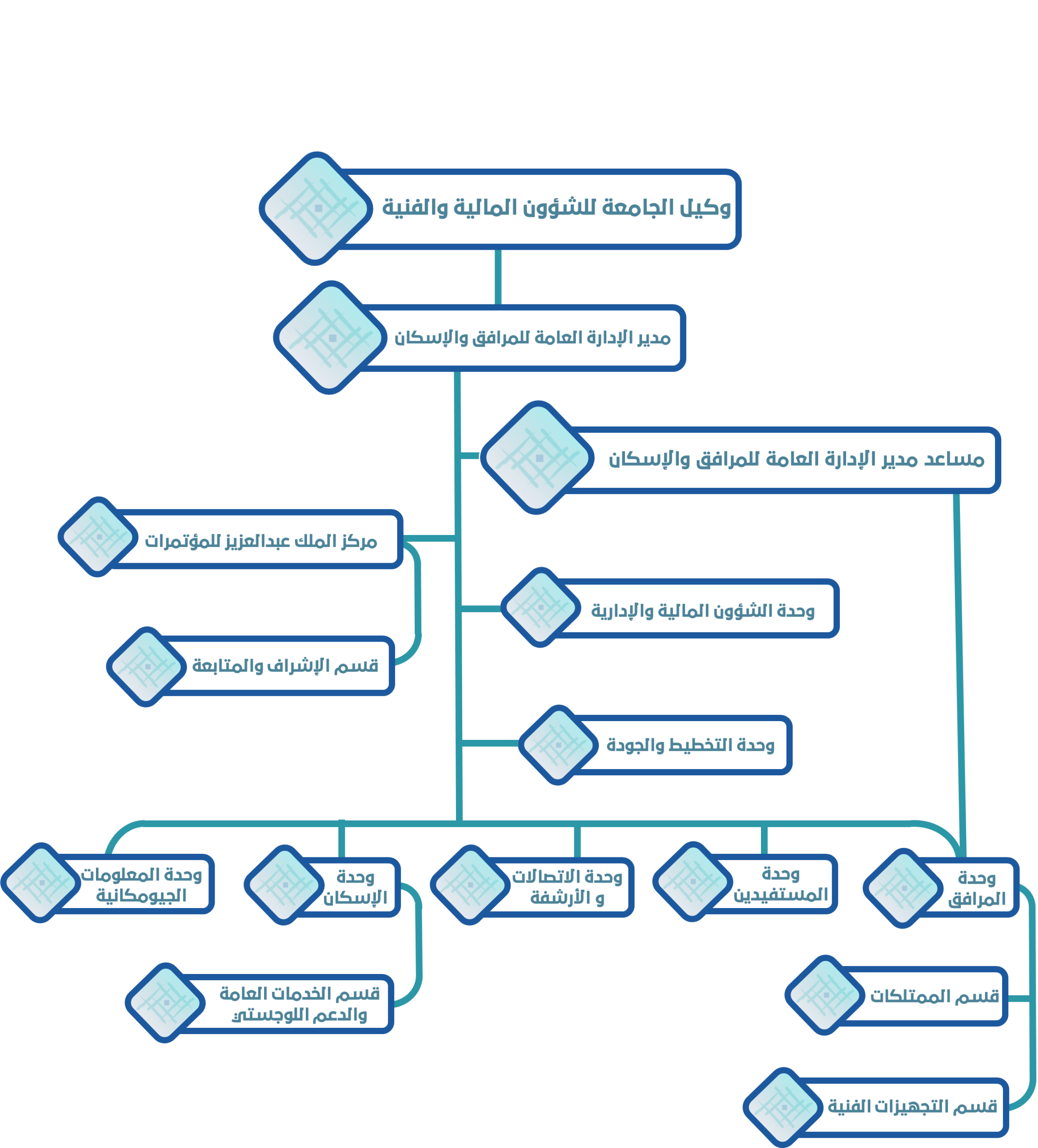
Administrative Unit
Introduction to the work of the unit:
The Administrative Affairs Unit is the organizational pillar supporting the work of the General Administration of Facilities and Housing. It organizes administrative affairs, human resources, correspondence management, and job performance follow-up, which contributes to providing an organized and stimulating work environment that supports the achievement of the administration's objectives efficiently and effectively, and promotes integration between its various departments.
Work and achievements during the year:
- Human Resource Management: The unit oversaw the management of 21 It monitored daily attendance and achieved an attendance rate of 97%. She also processed various leave requests (annual, sick, and emergency) with high efficiency, while ensuring continuity of work in all departments.
- Administrative transactions: The unit handled a lot of incoming and outgoing administrative transactions, while maintaining an average response time of no more than 24 An hour, which contributed to enhancing the speed of fulfillment and raising the level of administrative discipline
- Professional development: Enroll employees in specialized training courses in areas such as project management, computer skills, and leadership skills. Take advantage of these courses 90% of the department's employees, which contributed to raising the efficiency of employees and improving their performance.
- Volunteer opportunities and community engagement: During the year, the unit offered a number of volunteer opportunities to support the department's work and initiatives. (16) volunteering opportunities, with total volunteer hours amounting to (15,600) hours, with the participation of (156) Volunteers. These initiatives contributed to enhancing the culture of volunteer work, supporting the work of the administration, and achieving integration with the university community.
Utility unit
Introduction to the work of the unit:
The Facilities Unit is the backbone of the department, which is responsible for managing and operating all buildings and facilities belonging to the entity, including inventorying and documenting them, handing them over to the beneficiaries, and managing their reservations for various events and activities.
Work and achievements during the year:
- Inventory and management of facilities: During the year, the unit achieved tangible achievements in the management and operation of facilities. 11,650 facilities were inventoried and registered in the geospatial database.
- Delivery of utilities: 29 facilities were handed over to different entities within the university, and 9 facilities were handed over outside the university.
- Manage event bookings: The department received and approved 1,568 applications for utility reservations.
Property SectionIntroduction to the work of the department: The Property Department is responsible for the management and governance of the university's assets, through inventorying, documenting, and updating property data periodically, ensuring their preservation, proper utilization, enhancing data accuracy, and supporting efficient spending and decision-making. Work and achievements during the year:
|
Technical Equipment DepartmentIntroduction to the work of the department: The Technical Equipment Department is responsible for supervising the preparation of buildings dedicated to events, such as theaters, halls, and spaces for conferences and seminars, and providing the necessary operational and technical supplies. The department also contracts with specialized companies to operate audio-visual and other systems to ensure the provision of high-quality technical services during various events. Work and achievements during the year:
|
Housing unit
Introduction to the work of the unit:
The Housing Unit is responsible for managing and operating the university housing units and providing housing services for the university's academic staff members, which contributes to achieving housing stability, improving the quality of work life, and raising the level of satisfaction among the beneficiaries. The unit works to organize the use of housing units, develop procedures, and enhance operational efficiency in accordance with the approved regulations and policies.
Work and achievements during the year:
- Automating housing procedures: The unit finished preparing and equipping the electronic system for the housing unit, which covers all stages of work from submitting the application to receiving the housing unit, to achieve a full automation rate of 100% for housing procedures for Saudi faculty members, which contributed to raising work efficiency, accelerating procedures, and improving the quality of service.
- Housing for Saudi faculty members: The unit has housed approximately 155 faculty members in the housing complexes at the main headquarters, exceeding the occupancy rate in housing Saudi faculty members by 60%. A place has also been allocated to hold social events and occasions, thus enhancing the social aspect of the university housing.
- Developing supporting services and facilities: Three (3) mosques intended for the housing of faculty members have been received from the Projects Department, and prayers have started to be held in them. In addition, cooperation was established with the Holy Quran Memorization Society in Buraydah to hold Quran memorization classes for both sexes within the housing complexes, thus contributing to enhancing the religious and social environment for the residents.
- Eliminate rented buildings: The unit completed the handover of rented buildings and the transfer of electricity and water meters to their owners, which contributed to ending dependence on rented buildings and achieving zero% of rented buildings, supporting spending efficiency and optimal utilization of assets.
- Accommodation of Medical City employees: The unit handed over 48 housing units to the employees of the medical city, including technicians and nurses, to support the stability of health cadres and support the work of the medical city.
Geospatial Information Unit
Introduction to the work of the unit:
The Geospatial Information Unit is the analytical arm supporting the General Administration of Facilities and Housing. It manages and updates the spatial data of university facilities, prepares digital maps, and analyzes geographical information, which contributes to supporting planning, improving asset and project management, and enhancing the efficiency of decision-making at both operational and strategic levels.
Work and achievements during the year:
- Geospatial data collection and data base building: During the year, the unit focused on collecting geospatial data for university facilities, conducting field surveys, and building and updating the spatial database in preparation for the development of a digital map system. The work included documenting the locations of facilities and assets, entering basic data and linking them to geographical locations, thus contributing to increasing the reliability of information and supporting the future use of maps.
- Development of digital systems and geospatial database: The unit has developed an electronic system and a field application to support data collection and field survey work, allowing the concerned departments to enter data directly, enabling the facilities unit to fill in facilities data and prepare periodic reports, and the property department to enter and update asset data. The Geospatial Information Unit is responsible for overseeing the geospatial database, managing it, updating it, and monitoring the quality of the data, ensuring the standardization of information sources, increasing its reliability, and supporting integration between units and departments.
- Geospatial support and integration with departments: The unit carried out a number of supportive works in the field of spatial analysis, which contributed to providing preliminary readings about the location and use of facilities, and supporting some administrative and planning decisions. The unit also provided geographical technical support to different units and departments by coordinating, collecting data, and providing them with available spatial information, which helped unify data sources, raise data quality, and enhance integration between the department's units.