 Official government website of the Government of the Kingdom of Saudi Arabia




Standing Committee on Scientific Integrity
The committee is concerned with promoting the culture of scientific integrity at Qassim University, supervising the application of policies and regulations related to research and publication ethics, and studying cases of suspected plagiarism, forgery, or falsification, in order to ensure confidence in the outputs of scientific research.
Reporting a scientific integrity violation (a link to report and an email is sent to the committee when a report is received)
Integrity/Publication Consultation Request (a link to receive consultation requests and an email will be sent to the committee upon receipt of any request)
Overview
Based on the importance of building an organizational system that ensures adherence to ethical standards and enhances confidence in scientific research outputs, the Permanent Committee for Scientific Integrity works to support a transparent and objective research environment and deal with suspected cases of unethical practices in accordance with the approved regulations.
Objectives of the Commission
- Promoting a culture of scientific integrity at the university.
- Supervising the application of policies and regulations related to scientific integrity and research ethics.
- Studying suspected cases of plagiarism, forgery or counterfeiting and taking the necessary measures.
- Regularly review and update scientific integrity policies.
- Ensure that relevant research complies with approved ethical standards.
- Coordinating with entities related to scientific integrity and ethics.
Objectives of the Commission
- Sustainable giving .
- Innovation and development.
- Cooperation and partnership.
- Belonging and responsibility.
Committee services
Scientific Integrity Violation Report
Submit a notarized report with supporting evidence and get a follow-up number.
Integrity Counseling/Publication
Supporting researchers and students before publication or during the preparation of scientific theses.
Policies and models
Access to approved policies, manuals, and models.
Awareness and training
Courses, workshops, and awareness materials to promote sound research practices.
How do we work?

Receive the communication/request and issue a follow-up number.
Initial triage to determine the path and actions required.
Studying the case/request and preparing recommendations in accordance with the regulations.
Notify the parties of the outcome and follow up on the relevant procedures.
Meetings and reports
The committee holds periodic meetings according to the approved organization, and submits periodic reports that include performance indicators, the number and nature of cases, procedures, and development recommendations.
Frequently Asked Questions
What is research misconduct (scientific integrity violations)?
It is any practice that violates the integrity of research and publication such as plagiarism, forgery, falsification, falsification, or any material breach of the rules of scientific integrity.
How do I report a scientific integrity violation?
Are the reports confidential?
What happens after the report is filed?
Is it possible to request a consultation before publishing?
Yes, via the (Integrity Consultation/Publication Request) service to minimize the risk of rejection or suspicion of unacceptable similarity.
About the Commission
Overview
The Standing Committee on Scientific Integrity is the committee responsible for promoting scientific integrity and research and publication ethics, overseeing the implementation of relevant policies, and examining cases of suspected unethical practices in scientific research.
Terms of reference of the Commission
- Supporting and developing scientific integrity policies and research and publication ethics.
- Receiving and studying reports and complaints related to ethical violations.
- Oversee the integration of the ethics system in coordination with the subcommittees.
- Prepare development reports and indicators to increase the quality of research outputs.
Principles of work:
- Autonomy
- Neutrality
- Confidentiality
- Avoid conflicts of interest
- Procedural justice
Brief questions:
Are communications confidential?
Is it possible to seek counseling?
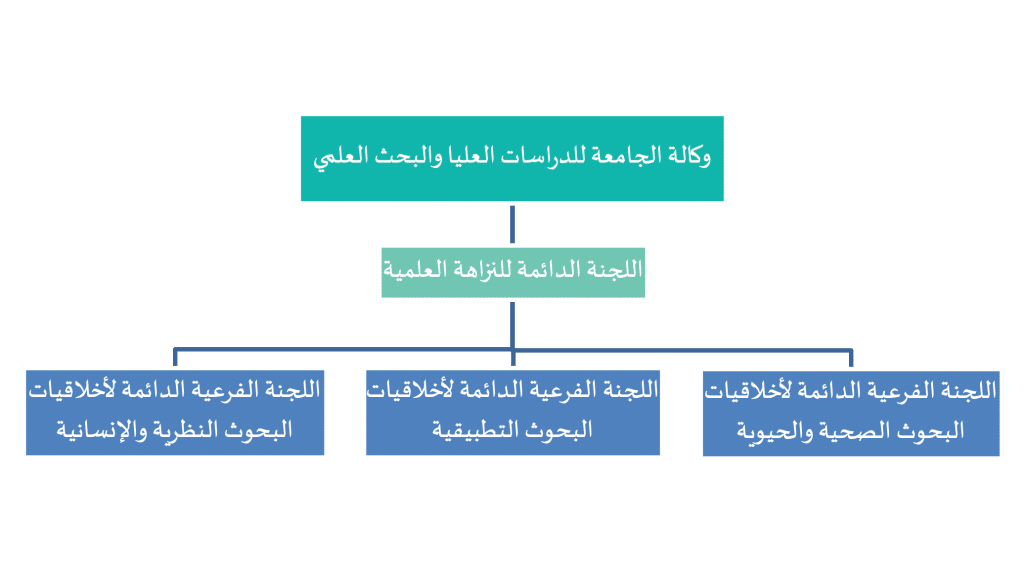
Organizational Structure
This section outlines the organizational structure of the Standing Committee on Scientific Integrity and its subcommittees for research ethics.
Policies and documents
This section aims to standardize the references of scientific integrity and research and publication ethics at the university, and facilitate access to models and guides.
Systemic references
The Executive Regulations of the Ethics Regulations for Research on Living Creatures.
Scientific Research and Innovation in Universities Regulation and its executive rules.
Internal policies (updatable list)
Scientific Integrity and Publication Ethics Policy.
Communications and Complaints Handling Policy
Privacy and Data Protection Policy
Conflict of interest policy
Electronic services
Digital services that enable researchers, students, and university affiliates to submit reports and requests, attach documents, and track the status according to the approved organization.
Services
*Assistance message: Before submitting, please prepare a brief and accurate description of the communication/request and attach any supporting documentation (if applicable) to ensure speedy processing.
Brief questions:
How do I know the application has been received?
Can you attach files?
Frequently asked questions
In this section you will find brief answers to the most common queries about scientific integrity, communications, consultations, and policies.
What is research misconduct (scientific integrity violations)?
It is any practice that violates the integrity of research and publication such as plagiarism, forgery, falsification, falsification, or any material breach of the rules of scientific integrity.
How do I report a scientific integrity violation?
Are the reports confidential?
What happens after the report is filed?
Is it possible to request a consultation before publishing?
Yes, via the (Integrity Consultation/Publication Request) service to minimize the risk of rejection or suspicion of unacceptable similarity.
Are communications confidential?
Yes, in accordance with the approved rules and authorities.
Is it possible to seek counseling?
Yes, via online services.
How do I know the application has been received?
A follow-up number appears after sending.
Can you attach files?
For general inquiries or technical support, you can contact the following channels:
*Note: For official reports, please use the (Report a Scientific Integrity Violation) service to ensure that the request and follow-up number are documented.